At Home with Tech

Unlock the power of all your technology and learn how to master your photography, computers and smartphone.

Build a Time Machine with Filament LED Bulbs
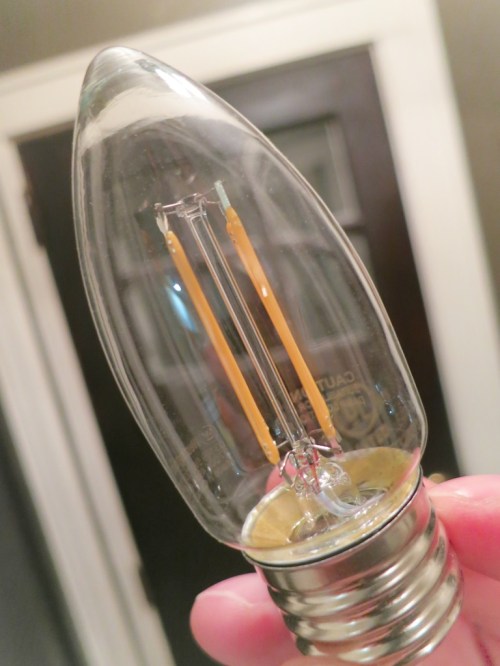
Filament LED bulbs have brought us full circle to the day Thomas Edison invented his light bulb. These vintage-looking, LED bulbs can bring you back to the future. But it can also cost you…

Filament LED bulbs have taken us full circle to the day Thomas Edison invented his light bulb. These vintage-looking, LED bulbs can bring you back to the future. But it can also cost you…

Recently, I started noticing a proliferation of really cool vintage light bulbs prominently displayed in certain restaurants. I thought it was really impressive being bathed in light by these Edison-style throwbacks. The secret I didn’t realize was these weren’t incandescent replicas. Not at all…

They were actually LED bulbs designed to mimic an illuminated filament thread.

How exactly was that possible? It seemed like only yesterday that the basic replacement LED bulb was born. And what an ugly duckling that was. But soon after, technology upgrades improved its form factor.

But this was something entirely different! An LED bulb that glowed exactly like an old-time bulb.

And guess what? You can buy these “filament LED” bulbs for your home. They’ve been spreading throughout Europe over the past few years, and now they’re becoming more readily available here…

Filament LED Bulbs are Cool
Okay, so let’s review how light bulbs used to work… Since the days of Thomas Edison, incandescent bulbs harnessed electricity to heat a metal filament to make it “white hot,” or incandescent.”

Now, filament LED bulbs incorporate thin LED strands shaped to look like vintage traditional tungsten filaments. That’s done by mounting many tiny LED chips onto a transparent substrate. And all of these low power LED chips don’t require a heat sink, which previously contributed to that alien-like construction of early LED bulbs.

Finally, the many, mini LEDs, which are often colored blue and red are then coated in a silicone resin and phosphor to create white light.

Kind of genius. Right?

Unfortunately, these filament LEDs have a shorter life than traditional LED bulbs, but we’re still talking about years.

There is however, another problem…

Not All Filament LEDs are Created Equal
When you Google “Filament LED,” seemingly dozens of websites pop up wanting to take you back to the future. And for very reasonable price, too.

It seems almost too good to be true…
As it turns out, the old adage – “You get what you pay for” still applies.

Cheaper bulbs are… well… Cheap.

They use a lower-grade silicone coating, which has a shorter life span. But there’s a more important risk that goes beyond premature bulb failure…

Bad Filament LED Bulbs Can Damage Your Eyes
Improper LED coating can create leakage of blue light from the blue LEDs. And not to alarm you… but apparently this kind of blue light exposure can cause macular degeneration over time.

Yes, I was a little non-plussed to discover the negative effects of blue LED light exposure, especially when there are plenty of electronic devices regularly glowing at you with various levels of blue LED light.

The other problem with over exposure to blue light is it can mess with your serotonin levels, which affects your sleep.

Wow.
So theoretically, a cheap LED filament bulb can really wreck your life.

But I’d imagine you’d really have to outfit your whole house with leaky filament LEDs to put your eyes and sleep cycle at real risk. And then there’s the cumulative amount of exposure it would take to be dangerous…
(Which, of course, nobody knows for sure how long that is)

My next step after absorbing all of this scary, blue knowledge was to take three deep breaths…
(And stop worrying so much)

I was only interested in purchasing three filament LEDs for one ceiling light fixture next to our kitchen. It’s a light we pop on occasionally. Certainly not a central light source that we often use. So I figured as long as I exercised sufficient due diligence to find a decently constructed bulb, I would not be putting my family’s health at risk…

In Search of the Right Filament LED Bulb
As I began my search, I first realized that I needed to remember the naming conventions of non-traditional shaped bulbs. This chart on bulbs.com is a great resource and told me that my broken bulb was an F15. So I wanted a form factor close to that in my new filament LED…

I also recalled that my ceiling light fixture was on a dimmer switch. So my new bulb had to be dimmable.
(Not all filament LEDs are)

I also looked at a few more factors in narrowing my search…

Energy Star certified is a great clue you’re getting a good bulb. Unfortunately, there aren’t a lot of filament LED makers that have earned that rating yet.

I started looking at name brands, hoping that would lead to a reasonable option. Westinghouse has a presence via Amazon. So I focused my search in that direction.

I zeroed in on this Westinghouse dimmable 5 watt filament LED ‘decorative’ bulb. (470 lumens with a color temperature of 2700 K)

It’s actually a B11 shape, which is a bit smaller and not Christmas tree light-shaped like the F15, but I couldn’t find an F15 option anywhere…
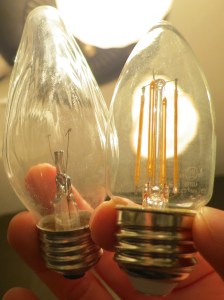
Incandescent F15 Vs B11 Filament LED


The Westinghouse bulb costs $11.88, which isn’t cheap, but seemingly the going rate for many filament LED bulbs today.
(Happily, basic LED bulbs have come down in pricing.)

But remember… the value proposition is compelling:

  • It only draws 5 watts (as opposed to 40 watts)
  • It’s designed to last for 15,000 hours
  • So hopefully, I won’t have change the bulb again until I own an iPhone 12!

Click.

My Fascination with Light Bulbs
I dream of the day I won’t have to ever replace a light bulb. Wouldn’t that be nice?

We’re still not going to exactly get there with current LED bulb tech, but as I’ve gradually weaned my home away from incandescent bulbs, I’ve noticed a clear shift away from what seemingly used to be a weekly practice of replacing a light bulb somewhere around the house.

And who knows… one day I may actually lose my interest in writing about light bulbs.
(Don’t count on it…)

The Best Beginner’s Drone for Your Child

What’s the best first flying toy to learn with… a RC helicopter or a quadcopter? Should you spend more to buy a better machine or go with a cheap throwaway model? How old does your child need to be to control one of these entry-level drones? Let’s find out…

What’s the best first flying toy to learn with… an RC helicopter or a quadcopter?
Should you spend more to buy a better machine or go with a cheap throwaway model? How old does your child need to be to control one of these entry-level drones? Let’s find out…

One of my earliest memories of a favorite toy was my 1969 Apollo 11 ‘LEM” lunar lander. It was actually a simple balloon my father inflated that was nestled on top of a circular plastic frame with pod legs and a NASA logo. When I tossed my balloon spaceship into the air, it floated down faster with the extra base weight.
(Helium not included)

However, the toy’s other half was a ground-based fan powered by four size D batteries. The fan looked like a satellite dish and swiveled around so I could blow the balloon about. The goal was to try to direct my spaceship towards a cardboard ‘landing pad’ using the fan as a directional guide.

It was completely impossible to do, but I was absolutely delighted with the idea that I was “flying” my toy.

Fast forward a few decades and the ongoing technology revolution…

Now, little flying helicopters and drones are so common you can almost find one at the bottom of a cereal box.

So I figured it was time to get my five-year-old son his own flying contraption for the holidays. A radio-controlled helicopter? Maybe a quadcopter?

Our needs were simple: I wanted a model that was easy enough for my son to fly and could also take an inevitable licking.

My little boy and his drone… How cool would that be?!

Do You Know a Good Pilot?
I know you must be experiencing a little déjà vu, because last week I went through the same exercise to buy him a radio-controlled toy car. But there’s a big difference between choosing a sturdy car to handle a few accidental impacts into our living room wall and handing my boy the keys to his new flying ‘Millenium Falcon.’

In fact, my little Han Solo in-training has no idea how to control a flying toy in 3D space, even if it’s only a few feet off the ground. But I figured if I introduced him to the basics of RC helicopter flying, maybe he could get the hang of it.

There’s only one problem…
I didn’t know the basics.
(Other than how to move a balloon around with a fan)

Fortunately, the good news is a little Googling can quickly change up that equation…
And unfortunately, it can also send you simultaneously down a rabbit hole…

The Search Begins…
My early research sent me to a couple websites that seemed to own the RC helicopter conversation:

These ‘experts’ promote indoor radio-controlled helicopters over RC quadcopters as an entry-level toy because ‘RC’ helicopters are easier to handle. So I focused my attention on that category.

For those who need a quick primer… there are two general types of RC helicopters-

Cheap Toy RC Helicopters

  • They typically cost $20 or less.
  • Have ‘2 channels’ of control.
  • Designed with a main rotor up front and a tail rotor.
    That gives you front up/down power and rear ‘yaw ‘for turning.
    (The heli’s forward weight simply drifts the body forward.)
  • Provides relatively short flight times on one battery charge. (5-6 minutes)
  • No replacement parts. When your chopper breaks, you throw it in the trash.

Hobby Grade Quality Helicopters

  • These generally run $100… up to several hundred bucks.
  • Have ‘3 channels’ of control and up.
    (Although some would say that 3 channels isn’t the ‘real deal.’)
  • The 3rd channel gives you forward and back control.
  • A 4th channel would provide side-to-side control.
    (Roll)
  • Longer flight times on a battery charge.
  • An extra charged battery can be swapped in.
  • When a critical piece breaks off after a big ‘crash,’ there are usually replacement parts available.

Look at Coaxial RTF RC Helicopters

The consensus out there is a hobby-grade, 3-channel ‘co-axial’ heli is the way to go for beginners-

  • Coaxial means two stacked, counter-rotating main rotors in front. This design is more stable and negates the need for a rear blade to handle torque.
  • More conventional-looking single rotor RC helis with one rotor in front and a tail rotor (to prevent torque) are generally harder to fly.
  • Tiny helis in the ‘micro’ category have a smaller mass and so are less likely to break on crash impact.
    (But that doesn’t always speak to build quality.)
  • And micro helis usually need to stay indoors, as they don’t have enough power to handle outside wind.

Okay… So I wanted a micro 3 channel co-axial RTF heli.
(RTF means ready to fly.)

My problem was there are still a mind-crushing number of choices out there in this category. But I found two that seemed to dominate the hive consciousness…

EFlite Blade Scout CX RTF

  • $49.99 on Amazon and elsewhere.
  • ‘Toy grade’ pricing (almost) with hobby grade product.
  • Uses more advanced 2.4GHz radio control.
  • Weighs 3/8 oz.
  • You can pop in a spare battery.
  • ‘Blade’ is a well-regarded brand in hobby circles.
  • Recommended minimum age: 8 years.

Blade Scout


The Blade has been around for a few years and incorporates more advanced stabilization technologies to make it easier to fly. Lots of a reviewers love it. But adoration is not universal.

(Is it ever?)

Syma S107G

  • It runs around $20.
  • The remote is infrared.
    (Not as advanced as a radio-based unit. Sunlight can interfere.)
  • It weighs 1.25 oz… heavier than the Blade.
    (More weight creates bigger crashes?)
  • You can’t swap out the battery with a fresh one.
    (So you’ve got to wait to charge it back up.)

Yet, it’s more advanced than other choices for the money.

  • Technically, it has 3.5 channels of control. The extra .5 channel powers an onboard light.
    (No biggie.)
  • You can get replacement parts, which is unusual at this price point.
  • It has a rear blade for more proportional tail control.
  • The blades are breakaways that fold on contact.
  • It’s supposed to cost twenty bucks, but Amazon’s pricing ranges from $19.78 to $29.95 for the newer green version.
    (Apparently there are a lot of fakes on the market… so you’ve got to wonder if the cheaper ones are clones.)
  • Recommended minimum age: 14 years.

Syma S107G Green


So the Syma isn’t quite as advanced as the Blade, but it does have a few design advantages. And hey… what do you expect anyway for only twenty bucks?!

Many say it’s a great starter heli…
(Even though the S107G has been around for a number of years, there’s also an earlier version… the Syma S107 that’s still out there. It’s okay, but as you’d expect, not as advanced as the S107G.)

The one major concern the S107G choice left me with was the counterfeit question. I didn’t know how to prevent getting stuck with an inferior lookalike via Amazon…

So my decision stalled.

My Son Is Not Quite a Teenager Yet
Another issue I couldn’t shake is the advanced age ratings for these gadgets…

  • The Syma is 8 years.
  • The Blade is 14 years!
    (whoah!)

My son is 5.

I began to question the intelligence behind my entire heli search. But before I allowed myself to fall down another bottomless rabbit hole, I thought I might benefit from a little more perspective…

Entering the Hobby Store World
So I went down to my local hobby shop in an attempt to break through all of my confusion…

As I walked in, I spotted the salesman (I’ll call him Fred) tinkering at the counter. He looked like he’d been flying RC helicopters for half a century. He seemed a friendly type… so I figured I’d pick his brain.

Fred immediately confirmed the superior build quality of Blade products.

Sold!
(Right?)

Not quite…

He turned my attention away from the Blade Scout and towards the 4-channel Blade mCX2 RTF.
This one cost twice as much as the Scout.
(Though it’s built tougher.)

I wavered…

Then, I brought up my quadcopter question to confirm that they were indeed harder to learn to fly on…

He firmly disagreed.
(Ah ha! Maybe this was the game-changer moment I was looking for…)

And in fact, it was.
The turn in conversation gave him a new idea…
He suggested I look a new, entry-level quadcopter drone called
the Blade Inductrix.

Meet the Blade Inductrix

He claimed the Inductrix is a cinch to fly and almost unbreakable.
And indeed, this little flying tank looked pretty tough…

Blade Inductrix


  • 4 channel 2.4 GHz controller.
  • Flying weight – .67 oz.
  • Uses ‘SAFE’ technology to create a more stable flight.
  • You can swap out the battery, which charges up in just a few minutes.
  • You can purchase replacement parts should you need them.
  • It’s $70 with the controller.
  • Or $50 without the controller.
    (If you already have one that can ‘bind’ to the Inductrix)

Looks, good, right?!

But then I began to waffle again with Fred.

“Are you sure 4 channels of control isn’t too much for my five year old? All the websites I read said 3 channels are easier to learn with.”

A customer (we’ll call him Joe) who was listening into our conversation disagreed. He stepped forward…

“Do you want to teach your boy to fly?”

“Well… yes.”
(I suddenly felt like a caveman trying to teach my boy the basics of hunting.)

“Then start him off the right way with 4 channels. You don’t want him to have to relearn everything when you upgrade from 3 channels.”

Joe had a point. Plus this guy proclaimed to have 30 years of RC helicopter flying experience.
(His perspective was probably worth more than some of the heli bloggers I found who are barely just past puberty…)

Okay… I was sold.
I pulled out my wallet, and Fred handed me my very own customer number along with my new Blade Inductrix.

As I walked out, I spotted Joe playing with the demo Inductrix on the counter.
My gut told me I had made the right choice….

No Click?!
Yes, I broke a fundamental rule I usually follow and made my purchase in the hobby shop… a brick and mortar store!
(What universal life force had taken over my web-based shopping savvy in that moment?)

Well, it seemed like the logical thing to do, as Fred sells all of the replacement parts that I’ll ever need.
(Though this tiny drone is supposed to be almost bullet proof)

And this cluttered store designed to delight the kid in all of us felt like a safe haven from all of my online research confusion and the real risk of buying a counterfeit product.

I know it may seem a little unusual for me to shy away from a challenge. But there’s nothing wrong with shopping smart. Bottom line pricing isn’t always the only consideration.

And as it turns out, the Inductrix wasn’t available online for less.
(Yes, of course I checked as soon as I got home…)

Changing Up the Shopping Groove
I rather enjoyed practicing a little old-fashioned 18th century commerce.
(Fred threw in an extra battery for free…)

Plus I was able to focus on the newest quadcopter choice out there.
(Pouring through website reviews that are years old sometimes has its limitations.)

Finally, I’m really happy I’ve brought home a flying machine designed for indoor use only. I don’t want it crashing into my neighbor’s house kitchen window.
(That said, Fred said it would successfully fly outdoors when there’s no wind.)

There’s only one question left that remains…
Can my young pilot in training fly the Inductrix?

Fred: “Yes.”
Joe: “Oh yeah!
Barrett: “Clear away all of the breakables.”

Here we go….!

The Best RC Vehicle for Your Six Year Old

From the wreckage of various failed radio-controlled toy cars gifted to my son, I have stepped into my rightful role to find a worthy replacement. To shamelessly steal a line from the most eagerly anticipated film of the year’s movie trailer- “I will finish… what you started!”

From the wreckage of various failed radio-controlled toy cars gifted to my son, I have stepped into my rightful role to find a worthy replacement. To shamelessly steal a line from the most eagerly anticipated film of the year’s movie trailer…       “I will finish… what you started!”

My son has been driving little radio-controlled vehicles around the house for the past couple of years. Actually, my five year old crashed them into walls more often than not. The result was early termination for these ‘RC’ toys and some noticeable wear and tear for our baseboards.

As I considered the general wreckage, I must admit I felt some ongoing frustration. Not only because a number of baseboard paint jobs had been added to my to-do list.
But because the vehicles couldn’t hack it.

Where did everything go so wrong?
(I exaggerate slightly.)

But then I realized it wasn’t really my fault… in fact I hadn’t bought these toys.
They were gifts.
So maybe I could do better….

With the holidays coming up, I decided it was time for Daddy to strap in for a little online shopping…

The Perfect RC Car Design
So what exactly was I looking for?

  • The vehicle ideally needed rubber tires placed in front of its plastic chassis.
    (This would minimize impact damage.)
  • The remote control unit had to offer variable speed control.
    (As opposed to full throttle or reverse… and nothing in between)

I simply wanted a durable toy that could be easily controlled and not inflict significant impact damage. Is that so much to ask?

Flipping for the Stunt Car
But as I poked about, all of the cars I found were designed with plenty of race-car plastic out front that would likely snap off on impact.
(You can’t blame the toy designers…. That’s the way real cars are built.)

But then I came upon a different category of car – the ‘stunt vehicle.’ This design immediately seemed more advanced than what I wanted, except for the fact the car indeed had its rubber wheels extended to guard the plastic body.

It was exactly what I was looking for…

Carrera Mini Turnator
Say hello to the Carrera RC Mini Turnator. These cool wheels are considered an all-terrain stunt car. The yellow body (also comes in red) can do a flip and then continue to zoom about without skipping a beat…

  • It’s 11.5 cm long
  • Protected by ‘chunky’ pneumatic tires
  • Operates on a 2.4 GHz frequency
  • Runs for 20 minutes
  • Takes 40 minutes to recharge
  • And powers up with a USB cable… so you don’t have to perform surgery to regularly pull out the batteries from inside the car

It’s Just a Car
As part of the Mini Turnator description, I found the following proclamation:

Boys become men –

Men become boys
(Whoah – that’s some serious testosterone-based marketing.)

With a top speed of up to 20 km/h, it would seem to be a bit overpowered and overambitious for what my son needed in a simple RC car.
(I imagine if you smash its pneumatic tires into a living room wall at that top speed, there’s still going to be damage somewhere.)

That said, I think my son’s eye/hand coordination has come a long way since he pummeled his last RC vehicle.
(But then again, I shouldn’t forget that coordination has nothing to do with the pleasure that comes from the child art of crashing toy cars.)

The Fine Print
To complete my research, I downloaded the instruction manual. I took one look and immediately felt more comfortable when I uncovered the following caveats:

“Never operate the product on grass surfaces. There is the risk of grass hindering the movement of the axles, which can lead to the motor overheating.”

“Do not use the Carrera RC vehicle for transporting goods, persons or animals.”

And my favorite-
“Do not expose the Carrera RC vehicle to direct sunlight.”
(It can overheat.)

Slim Pickings
Okay, so this is really more of a child’s toy and not intended for older kids two to ten times his age.
(It’s rated 6+.)

The Carrera RC car is made by a Salzburg family-owned business.
And I’ve usually found German manufacturing to be a good thing.
(My boy adores his green Bruder Land Rover I got him last year.)

Perfect.

At $25.12 on Amazon, it costs a little more than any of a number of inexpensive toy RC vehicles you can find on Amazon. But you’d have to spend a lot more before entering the ‘hobby-grade’ category.
(Which my son isn’t ready for)

Don’t you think it’s strange that there isn’t much out there that fits this particular middle nitch?
(Maybe all of the other tech-savvy dads are buying RC quadcopters for their children this year.)

As it turned out, I couldn’t find any other RC cars that fit my specs.
So the decision was easy.

Click.

Strap In…This could be a Bumpy Ride
Yes, I’m bringing a spinning toy stunt car home. Is it the best radio-controlled vehicle for your six year old? Again, the Carrera is really the only one I could find in its class.
(Anyone else have another suggestion?)

I think the Mini Turnator could be more than I bargained for, and I’ll certainly have to own all the cascading results that come from its use. On the other hand, maybe I nailed it. Well see…

Regardless, my son is sure to love it even though he’s still a couple seasons away from his sixth birthday.
(What’s a few months among friends?)

Just don’t tell him it has a bigger, even more powerful cousin…
The ORIGINAL “Turnator”
If all goes well, I’ll be writing about that one a few years down the road.

Vroom.