At Home with Tech

Unlock the power of all your technology and learn how to master your photography, computers and smartphone.

Category: family

How to Prevent Yankee Swap from Ruining Your Holiday Spirit

Many years ago, I learned the art of Yankee Swap. And that’s when I figured out it’s also a sport. This group holiday gifting game goes by other names, including Secret Santa and White Elephant. 

If you haven’t yet participated, Yankee Swap is a game of chance, as everyone first picks a number out of a hat to determine the order of gift selection from an anonymous pile of presents. However, there’s plenty of strategy involved, especially if family members ‘unofficially’ align as a team.

Yankee Steal
There are variations on the rules, but in short, each person picks a wrapped gift and then decides whether to keep or swap it with a previously opened present. If everyone gets into the spirit of the game, it becomes ‘Yankee Steal.’ There’s usually a gift or two that everyone wants, that those get swapped multiple times throughout the game.

So, if played properly, this game is effectively about stealing the best gift for yourself and leaving everyone else with the lumps of coal. (You’ve got to feel comfortable being a little ruthless.)

Three Ways to Feel Like a Winner
I must admit that after participating in this holiday tradition many times, I often found myself disappointed with the results. (Statistically, that’s going to happen to many players.)

So, I’ve learned a few tricks that help me feel like a winner, no matter what happens. Here are my top three tips:

#1
Worst Gift Ever
Yes, it’s always nice to give and receive a great gift. But a terrible gift… that can actually be the best Yankee Swap present ever. But it has to be over-the-top bad. If so, it will get a huge laugh in the group. 

The best ‘worst’ gift I ever saw was a 15-pound frozen turkey gift wrapped in a box. Priceless.

I’ve given my share of intentionally terrible gifts over the years. A few of my favorites include:

  • Ugly Lumberjack Winter Hat 
    (for a Brooklyn/Manhattan crowd)
  • Giant Angry Bird plush toy 
    (This one was an unexpected hit.)
  • NapSack Sleep Hood 
    (This was just a box with a photo of a man sleeping on a bench wearing a blue sack over his head. The box was empty. The gag was just the silly idea of it.)

#2
A Boring Gift Should Not Affect your Holiday Zen

But a boring Yankee Swap gift is that exactly that… and nobody wants one of those. Unfortunately, I’ve seen a lot of nicely wrapped boxes fall into this category. 

And these are the ones that can really suck the holiday spirit out of your soul. There’s nothing you can really do about it, other than accept it’s like walking into a casino… the house usually wins. 

So, the next step is to recognize that this game should be more about the fun and laughs…not snagging the best gift. That’s how you can retain your holiday Zen when holding that useless item. 

Yes, it will surely go in the garbage when you get home (or banished to your regifting pile, if you do that). But you’re still smiling thinking about that frozen turkey Uncle Harry got.

#3
Bring a Gift You Wouldn’t Mind Getting Back
I can’t tell you the number of times someone swapped back my own gift with me, especially the ones that were ‘terrible.’ That’s the result of other players learning my gifting style over the years and predicting I was the original culprit.

So, I’ve adapted my strategy a bit and made sure that I would be happy enough taking home whatever Yankee Swap gift I show up with.

That can also make shopping much easier. Simply buy a gift that you’d want for yourself. (That increases the odds you’ll bring home a present you can use.)

The Real Gift is Spending Time with Your Group
New England often has harsh winters. Yankee Swaps are no different. So, mindset matters more than anything when playing this game.

Remember, this is not about the present. It’s about being together with a group of people and having fun. It’s about celebrating this little world you’re a part of… family, friends, and yes… maybe even co-workers.

It’s about time well spent, being together… and not alone. And that’s usually a gift worth celebrating.

Happy Holidays, and here’s to always feeling like a winner at every Yankee Swap!

How to Digitize Your Parents’ Old 8mm Movies

It’s been three years since my father passed away, and I’m still working on digitizing many of his old photos. I also have his negatives and ancient slides. It’s been a slow and painful process, both physically and emotionally.

I can’t possibly digitize every photo. So, I need to decide which ones are important in telling the official family history. 

Are You Peering into an Alternate Universe?
Curating a family’s story across generations can be a draining process. Some photos fit in nicely to support your own memories. Others seem like splinters to slightly alternate dimensions.

There can be a variety of little surprises that force you to realign your understanding of your own past. The good news is that can also contain priceless gems. These gifts can make what is an otherwise time-consuming process worth it.

So, I’ve started. Stopped. And started again, sometimes months later. 

I’ve been using an Epson scanner/printer for my parents’ old prints and a Wolverine slide/negative converter to drive my digitizing/archiving project.

I’ve made progress, and I know there’s a finish line out there, which I’ll eventually reach.

What are You Supposed to Do with 8mm Film?
But I’ve also inherited dozens of my father’s 8mm film reels. They’re tiny time capsules from decades ago that reveal the past in action… three minutes at a time.

But how am I supposed to convert this ancient media without a working film projector?

I had three choices:

  • Package up my 8mm movies and mail them to a company to do the work.
  • Find a store in town where I can physically hand over my dad’s motion pictures.
  • Buy a conversion device to do it myself.

Do You Actually Know What’s On Those Film Reels?
Mailing out your film reels to digitize is usually less expensive than using a local brick and mortar operation. (That said, working with a local establishment may feel more secure, because there’s no risk of losing your film in the mail.)

But mailing it in can still be relatively expensive. And that price point can sting even more if you don’t really know what’s on all those film reels. (My father didn’t label his reels well.) So, you may be spending hundreds of dollars for old footage that you wouldn’t otherwise want to keep. 

Yes, it’s a different story if you do know what’s on your film. With that level of knowledge, paying someone else do the conversion is an incredible time saver and can be worth it.

But for me, the only way to know for sure is to first engage a do-it-yourself strategy. And then if you uncover a few reels that contain priceless memories, then you can send just those few out for professional conversion.

So that’s what I set out to do…

Film Digitizers to Consider
There are two conversion devices on the market that I researched:

  • Wolverine Data Film2Digital Moviemaker-Pro
  • Kodak REELS Film Digitizer

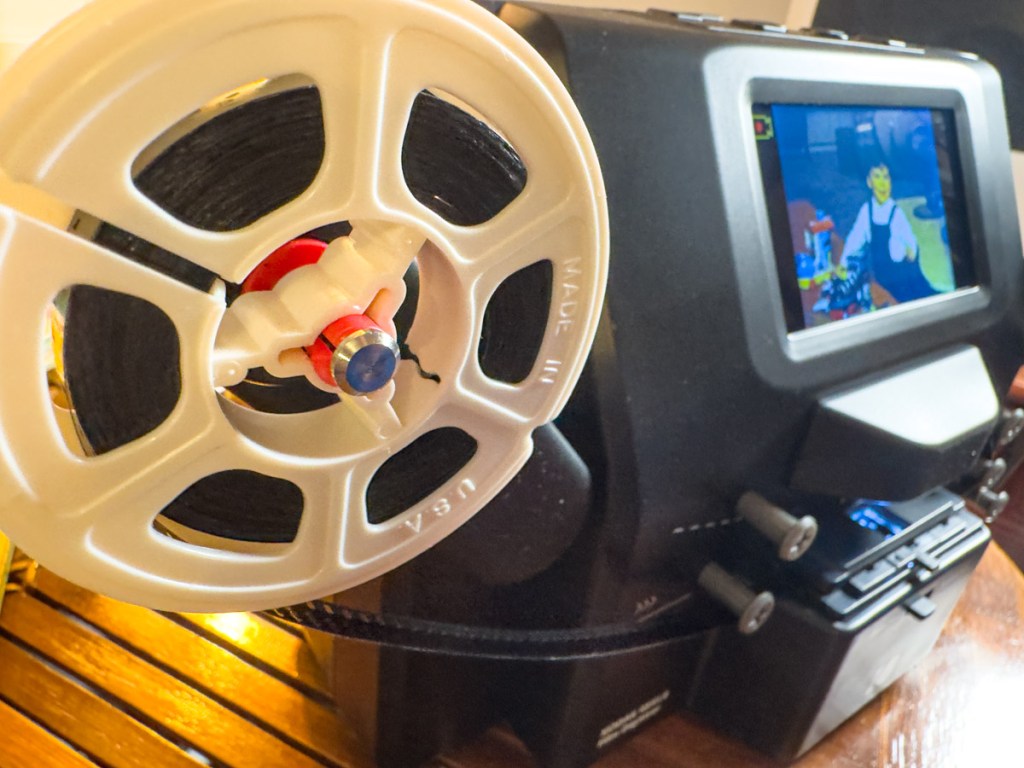
These movie film scanners literally photograph each frame of your film (8mm or Super 8) one at a time and then stitch them all together into a movie file on an SD card. 

This takes a while.

  • Each 3-minute reel takes about 30 minutes to scan. So, you should plan your workflow accordingly.
  • There’s no sound conversion
    (8mm film didn’t contain sound anyway).

Ultimately, I ended up purchasing the Kodak REELS Film Digitizer because it creates a slightly higher resolution file (1728×1296).

Who Are Those People?
As I write this, I’ve converted my 10th film reel. So, I’m about five hours in, and I’ve got a long way to go…

The process has so far felt like sifting for gold. I’ve found plenty of family vacation footage from tropical locations with me running around as a young child. Yes, I know I was cute, but a few of those shots is all anyone could possibly want to watch now. 

Then, there are clips of what looks like friends of my parents, but they are total strangers to me. They may have a place in another family’s family archive, though not mine.

Remember you really can’t tell what you’re going to get from the first few frames on a reel. You need to go through all of it.

Separating the Digital Wheat from the Chaff
In hindsight, I’m not surprised I’ve had to sift through a lot of cutting-room floor clips to find the money shots. This is all unedited footage. (If someone should somehow find my iPhone in 100 years and extract my own family video clips from it, I’m sure many of them will seem superfluous as well.)

That said, I am finding some cool clips of my family in action that are worth saving. So, I’m glad I’ve embarked on this project.

I also came upon some interesting environmental shots from the 1960s.

My father was clearly flying somewhere and shot this clip over Manhattan. Nice!

Doing It Yourself is a Reasonable Choice
As for the quality of my father’s converted films using my Kodak REELS Film Digitizer, it’s what you’d expect. It’s good… good enough.
(I know a professional shop would do a better job using equipment worth many thousands of dollars.)

And so far, my Kodak consumer unit has been operating well, though the image framing sometimes slips out of its center a bit after you start a conversion.
(So, you need to start it again.)

Don’t Wait Any Longer
Yes, I’m pleased with the way my film conversion project has been going. It’s a very hands-on process working with film, and I have to admit the tactile experience is strangely satisfying. 

And yes, I’m glad I didn’t pay a company to globally convert all my father’s 8mm movies. 

No matter how you approach this, it’s a lot of work (and some money). But if you’re the family’s archivist and you uncover old family film footage, there’s really no choice on what to do next.

Digitize it.

Do You Know Where the Red Reset Button Is Located?

My home’s furnace quietly stopped working last week. I didn’t notice the specific moment, but it was shortly after dinner. I thought I felt a bit cold, and I stopped what I was doing. My ‘Spidey Sense’ told me something was wrong. 

I turned to glance at a little digital thermostat I keep near my home office desk. The temperature was four degrees cooler than it should have been. 

My new Google Nest Learning Thermostat runs a tight ship. So, I knew something was off. (If I were starring a science fiction movie on a spaceship, the next scene would show a pinhole leak in the hull as oxygen vented out.)

My Furnace Wouldn’t Fire Up
I listened for the normal background hum of our heating system. Nothing (no comforting purr of my warp engines). I hurried down to our basement to check the circuit breakers. All good there.

I rushed backed up to check out my gleaming Nest Learning Thermostat. It knew that it was too cold but reported that my furnace was actually running, and my house would reach its desired temperature in 45 minutes.

Houston, we have a problem. 

My furnace just wasn’t firing up, and it was 38°F out. My family didn’t know the situation yet. But the clock was ticking.

There was only thing I could do. So, I made the call…

The Big Red Button
I called for an emergency repair. Yes, I pay for an annual plan to protect against this specific moment.

Ninety minutes later, the technician showed up.

The first thing he asked me was whether I had pressed the red button.

“The red button?”

“Yes, the big red reset button. Do you know where that is?”

I did not.

The technician opened up the side of my furnace and pointed. I had to look closely. It wasn’t exactly a bright red button, but there it was, red enough to see… if you were looking for it.

Red Alert
I’m not sure how I didn’t know about the red reset button after all these years. There have been plenty of opportunities during the annual maintenance checks of my heating system. But clearly, I wasn’t paying attention. (Or perhaps no one ever told me.)

The technician reached forward and pressed it. The system started to chug to life.
(Really? How embarrassing if this was the simple fix.)

And then my furnace coughed and conked out.

I felt a sigh of relief. At least it wasn’t the red button. (I dodged that reputational bullet.) 

The problem clearly ran deeper.

Warp Power Restored
The good news is twenty minutes later, my Scotty had my warp engines running again. Something about nozzle misalignment and carbon build up. (I processed his explanation as my “dilithium crystals” were out of alignment in their chamber. My Star Trek brain would understand that.)

He was on his way, and my family had heat again.

I walked back into my home office, sat down at my desk and thought about my experience…

Hello, HAL
I felt a bit giddy. I was so happy this little emergency wasn’t somehow my fault. My furnace actually required a repair technician’s attention. Yes, I knew I had been oblivious to the red button fix, but I was worried I had missed another obvious sign, like a circuit breaker. (I hadn’t.)

Plus, as my story demonstrates, pressing the reset button doesn’t always work.

Ultimately, I think this all points to a larger issue. Don’t we all want some mastery over the various technologies that impact our daily lives?

Time to Upskill
Of course we do. But it’s becoming easier every day to allow that equation of control to drift further away from us.

And this certainly extends beyond running the electronics and systems in your own home.

It’s about how you interface with technology in just about every part of your life.

On most days, it’s simply a remarkable partnership. And to maximize that potential, we’ve all got to upskill and learn to use the new, revolutionary AI-fueled interfaces.

But sometimes systems break down, and you’d better know where that red reset button is located.

It’s equally important to remember that the red reset button isn’t always the fix.

Remember Your Backup Plan
So where does that leave us exactly?

Well, life is complicated. Always has been. 

Things don’t always work the way you expect. User error is no excuse. So don’t abdicate your responsibility to understand the basics.

Have a plan. Then, have a back-up plan. The buck always stops with you.

And yes… it never hurts to know where that red button is located.