At Home with Tech

Unlock the power of all your technology and learn how to master your photography, computers and smartphone.

Category: Homemade Videos

How to Turn your Zoom Recording into a TV Talk Show

If you’re looking to improve the look of your recorded Zooms, you don’t have to invest in expensive equipment or hunt down mothballed gear. Here are a few simple ways to simulate the structure of professional television production.

Recording a Zoom conversation is easy. It’s a one-click process. But if you’re looking to create a more controlled visual product that follows the traditional structure of a professional video interview or TV talk show, you’ll need to put on your MacGyver hat and use the Zoom interface a little differently.

It’s all about finding the best way to control which webcam feed is being recorded at any given moment.

Active Speaker View Mode is Faster than Pinning Each Shot
I originally thought it would be better to manually choose shots by ‘pinning’ the appropriate video frame, instead of letting Zoom’s default Active Speaker View follow the voices.

I was wrong.

Frequently pinning different shots ends up being a clunky process that’s slow and can also generate unexplained two-frame video glitches in the recording.

Instead, allowing Active Speaker View to automatically switch back and forth between your shots is faster and yields better results. (another example of the superiority of software over humans)

Use Gallery View as your Wide Shot
Then, all that’s manually left to do is occasionally click back and forth from Active Speaker View to Gallery View to show all of the video frames at once. That simulates what viewers are used to seeing in the wide shot of a TV talk show.

Just be sure to activate ‘Hide Self View’ if you’re not a part of the conversation and simply acting as a behind-the scenes director. You’ll find this option to make your image disappear in the drop-down menu after hovering over your own video box. Then click on the three-little-periods icon in the upper right corner.

Keep it Simple
No, Zoom isn’t really designed to give you the same technical control when recording a multicamera conversation as a traditional video switcher in a TV control room.

And no, you can’t record the individual shots separately to edit together later.

That said, if you simply let Zoom automatically follow the conversation and then occasionally sprinkle in the Gallery View, you’ll get a remarkably decent result.

And that’s all from the comfort of your home, and free for anyone to do.

Don’t worry about the video thumbnails you’ll see on the top of your screen during Active Speaker View. They aren’t recorded. Neither are the names on the bottom of the video frames.

Imperfect but Good Enough
Of course, the overall visual result pales in comparison to shooting a multicamera interview in a professional TV studio, mostly due to the limited quality of webcams, imperfect lighting conditions and cluttered home backgrounds.

But today and for the foreseeable future, webcam video is our new normal. Most everyone has embraced it during this COVID reality show we’ve all been cast in. Of course, I crave the beautiful imagery that professional cinema cameras can generate. We’ll get back to that… one day.

For now, if you want to record a webcam conversation that follows the structure of a studio-based TV talk show, Zoom will easily do that using limited assistance from the human brain and a few important clicks.

It works.

And it’s just another example of why Zoom became a household name overnight.
Why Now’s the Time to Go Mobile with Zoom

Do you feel like you’ve exhausted all options to improve your Zoom video set up at home? Here’s a new angle to help solve your problem.

If you’re experiencing a general sense of malaise while using video conference apps like Zoom to maintain your tether to the outside world, it may be due to your mediocre home-office arrangement.

You could be responding to the suboptimal visual conditions of your Zoom shot. Or perhaps your background reveals the current state of messiness in your home (not judging).

I’ve shared best practices that will minimize these challenges for you. Still there are probably only so many places where you can safely and comfortably relocate your computer or laptop.

To access that perfect location for your Zoom shot that’s probably out of reach for your computer, you need a mobile solution.

And that right there… is your answer.

Use the Zoom app on your smartphone!

Don’t Make Zoom a Balancing Act
By untethering myself from my iMac and instead using Zoom on my iPhone, I immediately opened up several new shot possibilities for my video communications.

But you can’t simply hold your smartphone for thirty minutes in the perfect location for your next Zoom call. Instead, you need a way to safely mount it.

In one of my less inspired moments, I tried carefully placing my iPhone on the top ledge of a living room window. The lighting was glorious, and the framing was perfect. But using that plan for any extended period would be begging for disaster.
(Our cat would certainly find an interest in ruining that scenario!)

So, the only reasonable way to get the shot is to securely mount my iPhone onto a tripod.

Many of us may already have access to a tripod at home, but you also need a way to attach your smartphone to your tripod.

That’s the situation I found myself in.

How to Mount your Smartphone to a Tripod
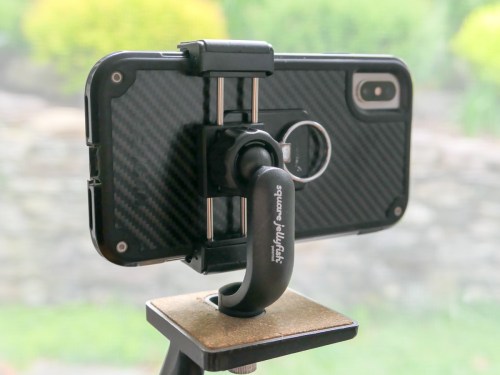
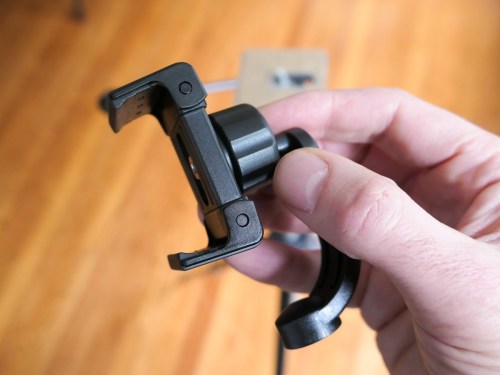
I needed to buy a smartphone tripod mount for my iPhone. There are a variety of options on the market and fortunately not that expensive.

I went with a Square Jellyfish Jelly Grip Tripod Mount for smartphones.

It’s $12.95 on Amazon Prime.

Click.

Break Free from your Desk
Now, I’m free to Zoom around my house! And a huge added benefit is the option to stand in my tripod-enabled shot. Believe me, that’s so great when you feel like you’ve been glued to your chair for the past nine weeks.

So, go ahead and take your next Zoom call on the road… or at least to the next room.

A change of scenery may be just the adjustment you need!

The Best Way to Fix the Lighting for your Next Zoom Call

If video conferencing has become part of your daily life at home, you’re likely going to need additional gear to light your shot. Here’s what I did…

It seems like everyone has discovered Zoom (or a similar video-conferencing app) to stay socially connected in our new age of physical disconnection.

I think the big leap forward here is its sudden use at home and how every generation has almost instantly needed to figure it out to integrate it into their lives while they’re sheltering in place.

  • My son has been staying connected to his teacher and fourth grade class on Zoom while his school is closed.
    My wife and I have been keeping in touch with family and friends on group Zoom calls with the participants ranging from Millennials to the Greatest Generation.
  • Yes, it’s taken a few weeks, but by now, everyone’s pretty much figured it out.
    (Just make sure your audio and video icons aren’t muted!)

But just because you’ve got the technology working doesn’t mean you’ve optimized it.

Follow the Basic Rules of Video Production
Of course, the key part to video conferencing is… video. And so you should really pay attention to how you show up.

Usually, that takes a certain amount of ‘preproduction’ work to set up a shot and background that creates a clear and ‘pleasing’ image of you. And if you think that shouldn’t matter, well it does.
(Come on… everyone wants to look good when a photo gets snapped. So why would video be any different?)

You should always follow these important prep tips to create a flattering video image:

  • Your webcam should be level to your face and not peering up at you.
  • Your background should be relatively uncluttered.
  • You need to have light in front of you to properly illuminate your face.
    (Never sit with windows behind you, because the daylight will silhouette you.)

Avoid the Common Lighting Mistakes
Now, I know that many folks have already figured much of this out on their own over the past few weeks.

But the lighting factor requires more effort than you’d think. If you really want to look great on your next video conference call, you need pay more attention to the kind of light that’s hitting your face and how harsh it is.

Simply pointing a desk lamp with a 800-lumen bulb at your face will likely overwhelm your webcam and make you look like you’re on the surface of the sun.

The key is finding a softer light source to gently bathe your image.

One trick is to use daylight from your window as long as the sun is not directly shining on you. (Again, that would be too harsh.)

But I know that moving your home office around to get you closer to a window may not be practical. So, you’re left with the option of adding in artificial light.

Using a ceiling light may be helpful as long as it’s not directly over your head. If it is, the lighting will create some really deep and unflattering shadows on your face.

Trying to split the difference between an overhead light and a window is also a bad idea, because the two types of light have different color temperatures. Combining both in your video shot will likely confuse your webcam, creating unnatural coloring on your face.

So don’t do that.

Buy a Webcasting Light
I actually had that exact problem with the way my home office was set up, trying to use my ceiling light on one side of my face, a window on the other side, and the glow from my iMac hitting me directly from the front.
(I looked like I was on the dark bridge of an evil Romulan ship on “Star Trek: Picard.”)

So, I finally decided that it was time to buy a soft ‘webcasting’ light that would become my main light source for video conferencing.

Of course, I went through my usual rabbit-hole experience of online research where I couldn’t find exactly what I wanted across dozens of options. Much of what I found used traditional light stands that were simply too cumbersome and couldn’t easily integrate into my limited home-office desk area.

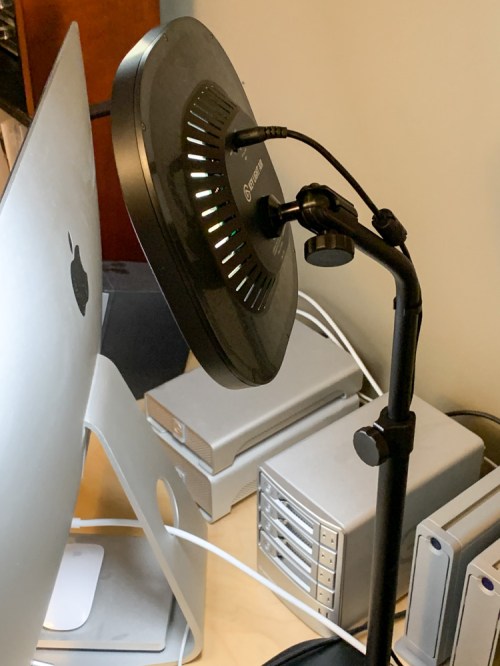
Elgato Key Light Air
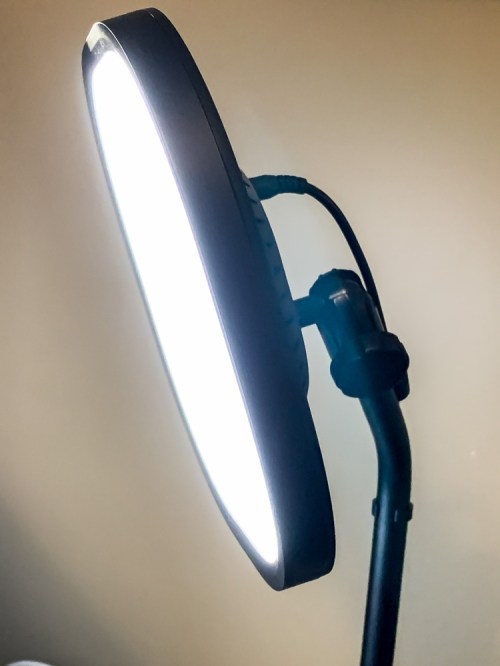
Then, I came upon the Elgato Key Light Air. It was exactly what I was looking for. It stands on your desk like a small lamp with a telescopic pole and offers multi-layer diffusion for it’s 80 little LEDs.

  • 1,400-lumen output (more than you’ll likely need)
  • 2,900-7,000 K color range

You control the Key Light Air entirely through its smartphone Elgato Control Center app, and you can easily tweak its light output and color temperature to help you look your best!

The Key Light Air costs $129.99 on Amazon Prime.

It was perfect.
Click.

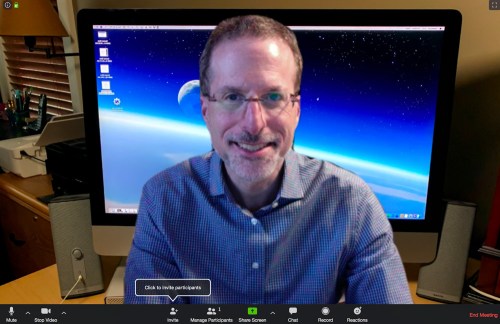
Here’s what I look like on Zoom with just my overhead light and window:

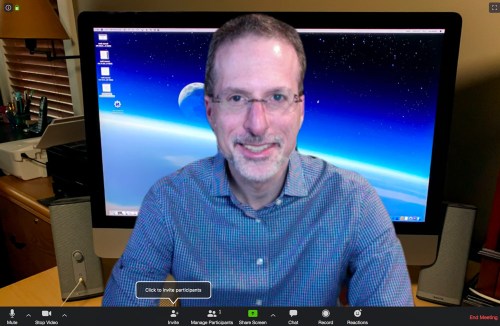
And here’s the big visual upgrade using my new Key Light Air:

Just like Scotty on “Star Trek” used to say… “The right tool for right the job!”

Another Elgato Option
If for some reason the Key Light Air isn’t powerful enough for your needs, it’s got a bigger sibling. The original Elgato “Key Light” ($199.99 on Amazon Prime) is larger and brighter, but it’s entirely overkill for my set up and little iMac webcam.

Plus, the Key Light’s desk-grip mount makes it less functional if I want to move it around to another surface.

Lume Cube
The Elgato Key Light Air not an inexpensive solution, but it certainly gets the job done. That said, there are cheaper choices out there that will still improve the lighting of your shot…

My friend recently bought the little Lume Cube 2.0.
($89.95 on Amazon)

The Lume Cube’s strength is its portability. You can easily throw it into your laptop bag.
(Not that you’re probably going anywhere right now.)

My friend tested it with me on Zoom using his laptop, and I thought it worked relatively well, although it definitely needed its little diffusion attachment.

LumeCube also offers a softer-throw Video Conference Lighting Kit.
($69.95 on Amazon)

Illuminate Properly
Face it… no room in your home was designed to serve as a video-streaming studio. Sure, following some basic rules of video production will help improve how you look on your next Zoom call.

But to really step it up, you’ve got to add in the right kind of light as your ‘key’ light source. And that means buying a specific light made for the job.

For me, it’s my new Elgato Key Light Air.