At Home with Tech

Unlock the power of all your technology and learn how to master your photography, computers and smartphone.

Category: movies

How Real Is This AI Video If I Created It Using My Own Photos?

Technology has chipped away at the definition of reality. Digital photography and photo editing software provide almost endless adjustment opportunities for creative expression. But now, with AI-powered tools, you can literally reconstruct an entire photo. You can remove distractions and even people. So, what’s real anymore?

For the past few years, I’ve been fighting a certain sense of guilt as I’ve learned to ‘improve’ my photography using AI-fueled enhancements. Sure, my resulting photos are better, but I sometimes worry that they’re no longer the pictures I captured. But I’ve been careful, and I’ve worked hard to keep it real.

Today, I happily use all the AI-powered photo editing tools in Adobe Lightroom, because I make sure my modified pictures are still faithful to the core images. This is essence of my rule book, and I follow it without angst. 

Next comes video.

AI Can Turn Your Photo into a Video
Text-to-video prompting and photo-to-video magic is today’s big creative disruptor. And I know I must face this revolution head on, as it changes everything about the work I’ve been doing for decades.

I’m particularly interested in the generative AI power to to turn a real photo into a video that looks shockingly similar. AI can replicate and then extend the creative elements in your photos into full motion video. Remarkable. (The results are not always perfect, but they’re improving.)

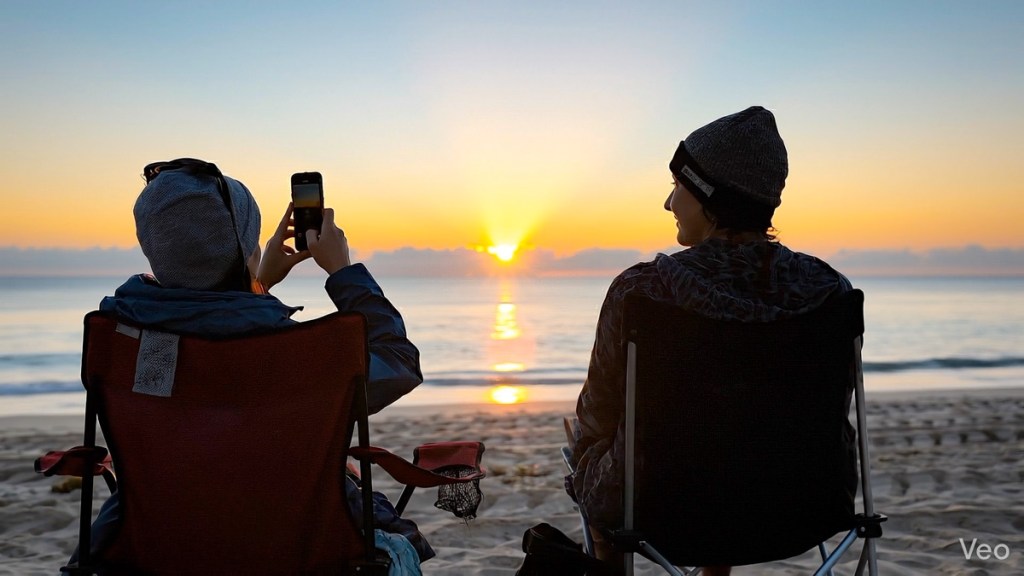
So, I embarked on a little creative exercise. I chose a few silhouette photos I snapped during a sunrise over Delray Beach on our recent Florida vacation and ran them through Google Veo. This process generated 8-second video clips that almost exactly followed the visual elements from my photos. The only exception was Veo created alternate, though similar, people on the beach. (And that’s fine.)

Then I edited the AI video clips together to create this sequence representing my own sunrise experience on that beach.

AI Video Generated from My Photos

As Real as Art Can Be
So, what exactly is this? What have I created here? Well, it’s simultaneously real and not real.

My photos provided enough creative direction for Veo to effectively clone each photo and then extend each moment.

So sure, then it’s easy to call this sequence ‘fake’ as Veo has invented 8 seconds from each frame I gave it.

But these individual scenes faithfully reflect the reality I saw.  They do express the essence of my experience.

So perhaps this entire AI-enabled creative process should fall under the category of art. Yes, maybe that’s what I’m doing here.

No Professional Video Crew Required
I also found it wildly fun that I’m able to generate video clips that would otherwise require me to hire a professional video crew for the day.

In my AI video, the opening shot of the two people walking on the beach… yes, I might be able to capture that with my DJI Osmo 3 gimbal. 

But that closing tracking shot of the paddleboard man surfing? That’s a clear step beyond Barrett’s personal filmmaking chops (for now).

The Limits When Recording Real B-Roll
Of course, I don’t need AI to create video for me. Here’s some actual b-roll I recorded on Delray Beach that same morning with my Osmo.

Real Barrett B-Roll

But while I also like this ‘real’ b-roll, these are necessarily wider shots, limited by the realities I encountered in those moments on the beach. (Shooting b-roll can be an intrusive process. And I didn’t want to mess with people’s sunrise Zen.)

Snapping a photo is quick and usually less invasive. As a result, I think my original silhouette shots had additional visual impact.

Real Barrett Photos

But now, I can also use my new AI tools to express my creative interpretation of these same images into longer scenes. I can build on these moments, magically extending my stills into the video realm. That’s so cool!

But what does this all mean moving forward? Well, I’m not exactly sure. 

A Digital Painting in Motion
I don’t truly understand my little Frankenstein video. Yes, I made it, but what is it? 

  • It’s alive… and yet not 
  • Fabricated, but very close to reality
  • Hard to exactly define, other than an artist’s interpretation

Perhaps I’ll simply call it my digital painting in motion. 

Of course, there are any number of unanswered questions regarding the broader topic of AI-generated video for our society. But I’ll leave that for another day.

For now, I’m pleased that I was able to simply share with you the flow and true ‘spirit’ of my beautiful sunrise experience with a little artistic help from AI. 

And I hope you liked the paintbrush I chose to use.

How to Digitize Your Parents’ Old 8mm Movies

It’s been three years since my father passed away, and I’m still working on digitizing many of his old photos. I also have his negatives and ancient slides. It’s been a slow and painful process, both physically and emotionally.

I can’t possibly digitize every photo. So, I need to decide which ones are important in telling the official family history. 

Are You Peering into an Alternate Universe?
Curating a family’s story across generations can be a draining process. Some photos fit in nicely to support your own memories. Others seem like splinters to slightly alternate dimensions.

There can be a variety of little surprises that force you to realign your understanding of your own past. The good news is that can also contain priceless gems. These gifts can make what is an otherwise time-consuming process worth it.

So, I’ve started. Stopped. And started again, sometimes months later. 

I’ve been using an Epson scanner/printer for my parents’ old prints and a Wolverine slide/negative converter to drive my digitizing/archiving project.

I’ve made progress, and I know there’s a finish line out there, which I’ll eventually reach.

What are You Supposed to Do with 8mm Film?
But I’ve also inherited dozens of my father’s 8mm film reels. They’re tiny time capsules from decades ago that reveal the past in action… three minutes at a time.

But how am I supposed to convert this ancient media without a working film projector?

I had three choices:

  • Package up my 8mm movies and mail them to a company to do the work.
  • Find a store in town where I can physically hand over my dad’s motion pictures.
  • Buy a conversion device to do it myself.

Do You Actually Know What’s On Those Film Reels?
Mailing out your film reels to digitize is usually less expensive than using a local brick and mortar operation. (That said, working with a local establishment may feel more secure, because there’s no risk of losing your film in the mail.)

But mailing it in can still be relatively expensive. And that price point can sting even more if you don’t really know what’s on all those film reels. (My father didn’t label his reels well.) So, you may be spending hundreds of dollars for old footage that you wouldn’t otherwise want to keep. 

Yes, it’s a different story if you do know what’s on your film. With that level of knowledge, paying someone else do the conversion is an incredible time saver and can be worth it.

But for me, the only way to know for sure is to first engage a do-it-yourself strategy. And then if you uncover a few reels that contain priceless memories, then you can send just those few out for professional conversion.

So that’s what I set out to do…

Film Digitizers to Consider
There are two conversion devices on the market that I researched:

  • Wolverine Data Film2Digital Moviemaker-Pro
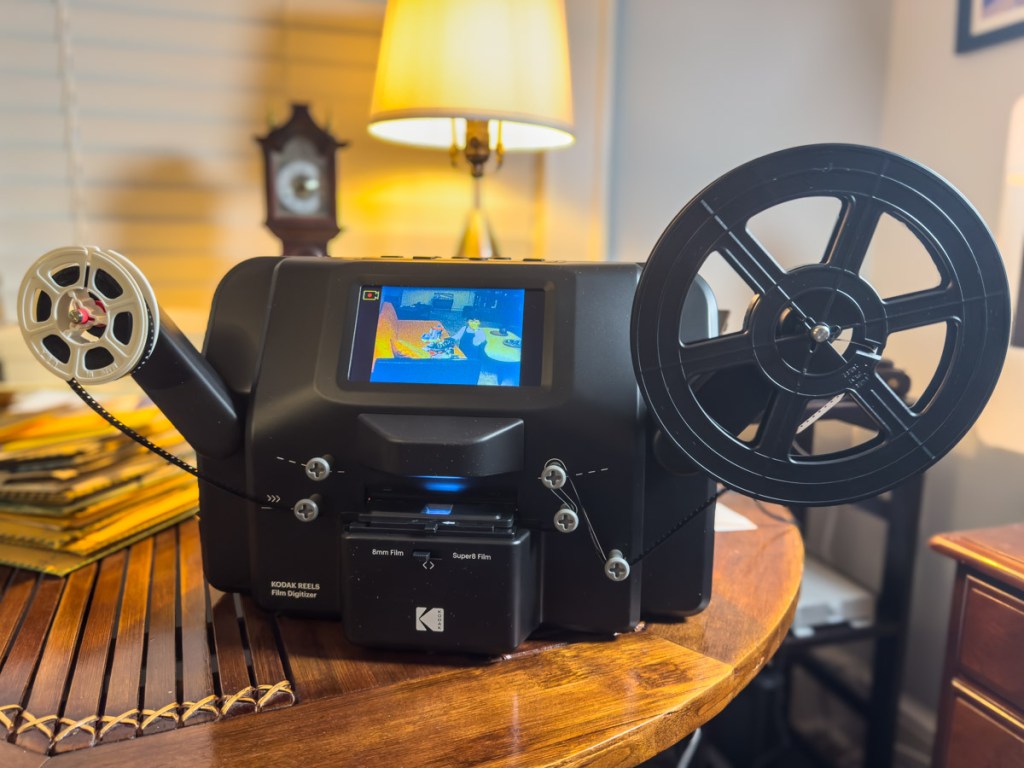
  • Kodak REELS Film Digitizer

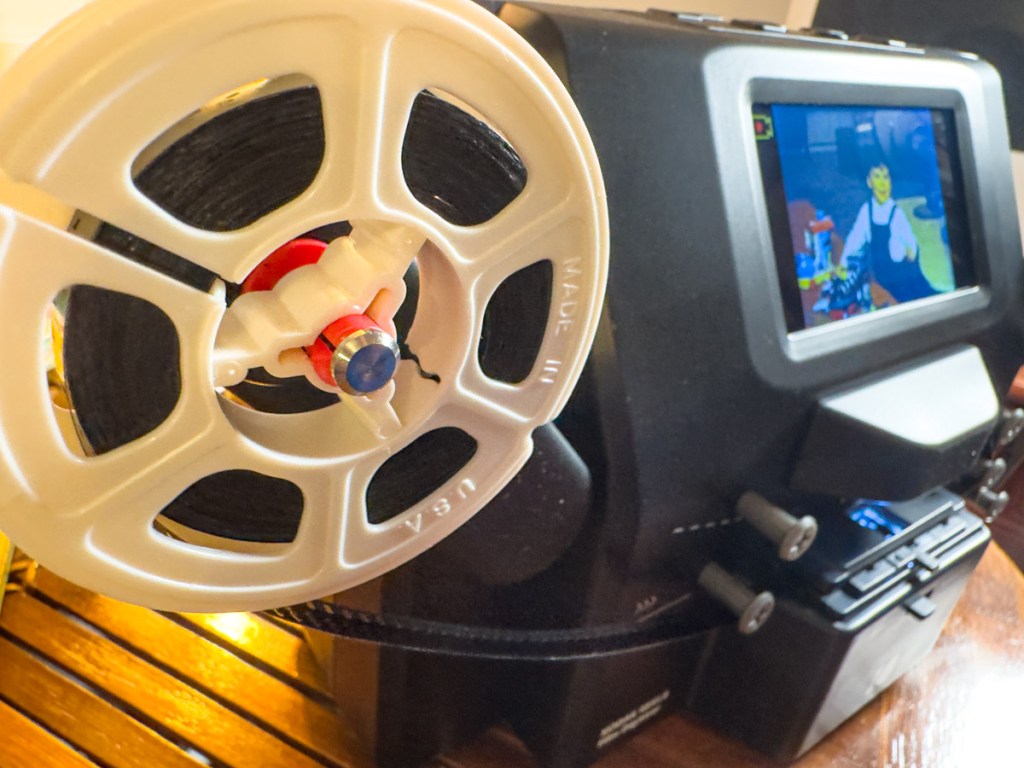
These movie film scanners literally photograph each frame of your film (8mm or Super 8) one at a time and then stitch them all together into a movie file on an SD card. 

This takes a while.

  • Each 3-minute reel takes about 30 minutes to scan. So, you should plan your workflow accordingly.
  • There’s no sound conversion
    (8mm film didn’t contain sound anyway).

Ultimately, I ended up purchasing the Kodak REELS Film Digitizer because it creates a slightly higher resolution file (1728×1296).

Who Are Those People?
As I write this, I’ve converted my 10th film reel. So, I’m about five hours in, and I’ve got a long way to go…

The process has so far felt like sifting for gold. I’ve found plenty of family vacation footage from tropical locations with me running around as a young child. Yes, I know I was cute, but a few of those shots is all anyone could possibly want to watch now. 

Then, there are clips of what looks like friends of my parents, but they are total strangers to me. They may have a place in another family’s family archive, though not mine.

Remember you really can’t tell what you’re going to get from the first few frames on a reel. You need to go through all of it.

Separating the Digital Wheat from the Chaff
In hindsight, I’m not surprised I’ve had to sift through a lot of cutting-room floor clips to find the money shots. This is all unedited footage. (If someone should somehow find my iPhone in 100 years and extract my own family video clips from it, I’m sure many of them will seem superfluous as well.)

That said, I am finding some cool clips of my family in action that are worth saving. So, I’m glad I’ve embarked on this project.

I also came upon some interesting environmental shots from the 1960s.

My father was clearly flying somewhere and shot this clip over Manhattan. Nice!

Doing It Yourself is a Reasonable Choice
As for the quality of my father’s converted films using my Kodak REELS Film Digitizer, it’s what you’d expect. It’s good… good enough.
(I know a professional shop would do a better job using equipment worth many thousands of dollars.)

And so far, my Kodak consumer unit has been operating well, though the image framing sometimes slips out of its center a bit after you start a conversion.
(So, you need to start it again.)

Don’t Wait Any Longer
Yes, I’m pleased with the way my film conversion project has been going. It’s a very hands-on process working with film, and I have to admit the tactile experience is strangely satisfying. 

And yes, I’m glad I didn’t pay a company to globally convert all my father’s 8mm movies. 

No matter how you approach this, it’s a lot of work (and some money). But if you’re the family’s archivist and you uncover old family film footage, there’s really no choice on what to do next.

Digitize it.

What’s Really Happening in the Sci-Fi Series Pluribus?

I’m hooked watching ‘Pluribus’ on Apple TV. That said, this series doesn’t easily fit easily into a particular genre. ‘Pluribus’ or ‘PLUR1BUS’ (which is how the title credits spell it) is technically science fiction but isn’t what you’d expect from a traditional sci-fi series today. 

Created by Vince Gilligan, this show plays more like an episode from ‘The Twilight Zone,’ but quite not as ominous. That said, in one sense, it couldn’t be more frightening. It’s about the days (spoiler alert) after the human race is infected by an alien virus.

The first episode is effectively a chilling variant of the famous ‘Invasion of the Body Snatchers.’ The result is a complete ‘Star Trek’ Borg-like psychic takeover where everyone is suddenly connected to a hive mind. The twist here is this alien-mind collective makes everyone happy and is supposedly benevolent. 

Is Resistance Futile?
Only 13 people in the world aren’t absorbed into this global cult (for some unknown reason) including Carol from Albuquerque, New Mexico, played by Rhea Seehorn. 

Carol, a romance writer, is generally a cranky person, and her negative energy later turns out to be something of a superpower for her.

She’s immune to the virus and determined to find a cure. Each episode follows her efforts to figure out how to reverse the takeover.

While this set up might be perfect for a tight sci-fi thriller, ‘Pluribus’ takes its sweet time revealing its clues. It’s actually way more mystery than sci-fi.

I’m five episodes in, and the writers are clearly more interested in exploring Carol’s understandably overwhelmed reactions to this insanity rather than furthering along the main pieces of the plot.

And that’s just fine with me.

Fan Predictions
I’ve seen some online reactions where fans are intensely studying every detail of each scene to reveal the plot ahead and even how the series is destined to end. (Who has the time for this radical deconstruction?) 

Frankly I’m not buying all these spoiler predictions. I just want to watch this story unfold. No need to rush it. 

In one scene from episode 5, Carol is trying to get some sleep, and the camera focuses on her nightstand with a book clearly in focus. It’s Agatha Cristie’s ‘And Then There Were None.’ Okay… so, that’s certainly a clue for rough times ahead.

Happy Zombies Vs Unhappy Person
I’m really enjoying ‘Pluribus.’ It’s quirky and offbeat. It’s dark but not without its lighter comedic moments. For now, the plot is clearly simmering. You can tell there are likely twists to come.

We’ve got billions of happy, connected zombies living in harmony. Is that so bad? Will Carol save the world? Does the world even need saving?

The writing throws big questions at us: Is restoring individualism worth the price of returning to our horribly fractured society? Isn’t total harmony the utopia we all thought we wanted? But at what cost? 

I think this is what ‘Pluribus’ is about. (Yes, it’s hard to describe succinctly.)

It’s the End of the World as We Know It
If I had to put it in one sentence… This series is a mystery about how one average person tries to repair the human race by saving the essence of humanity.

But I know this is too simplistic an answer. It’s just the framework. Who knows what’s really happening here.

The success of any mystery depends on the answers we eventually receive. I’m sure I don’t have to remind you how the mysteries from other famous TV series (‘The X Files,’ ‘Lost’) have not always been as satisfyingly resolved as we wanted.

The answers simply need to be as good as the questions. 

Season 2 is already confirmed, and the producers want to make a total of four seasons. Here’s hoping ‘Pluribus’ delivers on the expected payoff. 

For now, I’m sitting back and simply enjoying how one woman fights back against the end of the world.