At Home with Tech

Unlock the power of all your technology and learn how to master your photography, computers and smartphone.

Category: Tech Fixes

How AI can Fix your Low-Resolution Photos

If you’ve got an old digital photo that looks grainy when you crop in, it’s time to add in more pixels with a little AI assistance. This cropped photo of our cat from 2008 benefits from 4x more pixels on the left generated by Adobe Lightroom.

We all know the famous scene in the 1982 sci-fi movie “Blade Runner” where Harrison Ford’s futuristic detective inserts a photo into a computer and tells it to zoom in and enhance the clarity of the background until he finds a person hidden in a reflection from a tiny mirror.

No, we can’t tell today’s computers to scan a photo, “track 45 left” and then “enhance 15 to 23” to find what’s there. But we’re getting closer.

That’s thanks to today’s software that can increase resolution in lower-res photos while maintaining the quality (and without adding digital artifacts). This trick can also clean up jaggy edges that become more apparent when you zoom into a low-res pic.

Often, when you crop in too tight on a photo, grainy problems show up, because you’ve deleted too many of the pixels. You’ve suddenly created a low-res photo that clearly needs pixel infusion.

Enhance Tool is Not Science Fiction
Adobe Lightroom can help. It has an AI-powered upsampling ‘Enhance’ feature called ‘Super Resolution.’ This nifty tool creates a duplicate photo with four times the pixels. And that can make a significant difference.

Here’s how to ‘enhance’ a digital photo in Lightroom:

  • Click on the Photo dropdown on the top menu
  • Click on Enhance
  • Click on Super Resolution
  • Then click Enhance
    (You can preview the effect before you proceed.)
  • Voilà! An ‘enhanced’ file is generated in a DNG format.

There are other companies that offer similar solutions, but as Adobe Lightroom Classic is my main photo-editing and organization tool, I’m very happy to keep my workflow in one place.

A Useful Tool for the Right Circumstances
I’ve used this enhance trick mostly when I work with digital photos that I took twenty years ago. That’s, of course, during the early age of digital photography when original file sizes were relatively tiny.

It’s a helpful solution, but this tool is not magic. It can’t create what’s not there or fix a blurry photo. But it does add in a bit more visual crispness, even if you’re not having a pixelization problem.

It’s also quite helpful if you want to print out the photo. A physical print is usually more unforgiving than a computer screen.

Adding Pixels into My Old Photos
Here’s a photo I took of an actor playing a Klingon at the Star Trek Experience in Las Vegas back in 2001.

The original photo file was only 1024 x 768 pixels. I’ve cropped it in tight to just 198 x 264 pixels. The enhanced version on the left gets our friendly Klingon up to 396 x 598, which does make a difference.

Here’s a street shot I took in Hong Kong in 2005.
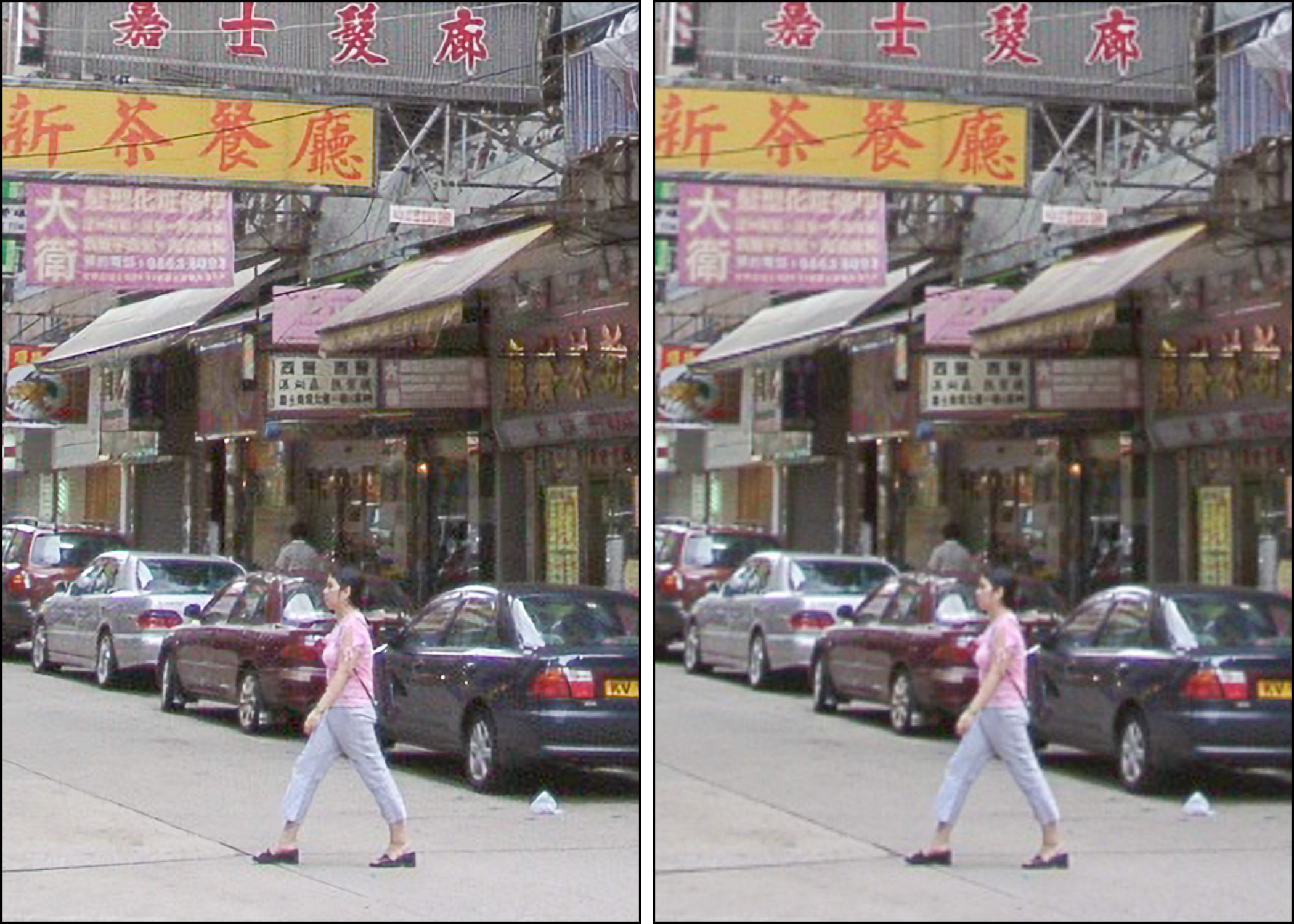
The enhanced shot on the left helps to bring out the background. You can also make out some of the car’s license plate letters.

Smile for AI
If you’ve found yourself having to squint to pick out the above differences, that’s okay. They’re minor, but they’re there. I think it’s fair to say that Adobe Lightroom’s “Super Resolution” mostly gives you minor sharpening.

It’s not a magic wand, but it does give you 4x more pixels to work with out of thin air.

With AI’s text-to-image capabilities already in common use today, I’m sure this is not the last time we’ll be discussing how AI can rebuild old photos in just a few clicks.

Best Way to Quickly Reset your Zoom Shot after You’ve been Kicked out of your Home Office

Here’s a trick that can help you instantly relocate your laptop to another Zoom-friendly location at home when you’ve been unexpectedly banished from your usual room.

By now, we’ve all identified our preferred Zoom meeting locations at home where you can stream yourself to your world. Beyond finding a quiet space that’s not in the middle of your family’s normal traffic patterns, there are other factors that can make a particular corner Zoom/Teams/Google Meet-friendly.

For me, being close to natural light near a window is important. That’s an easy way to properly illuminate your face. That said, it’s not too hard to power up a small battery-powered LED light or a ring light.

Setting up in front of a relatively organized and clutter-free background is always a best practice to demonstrate some visual order and professional look in your shot. You probably don’t want to show off an unmade bed with unfolded towels and underwear fresh from the dryer heaped on top. (Of course, simply use a virtual background for an easy fix.)

The Most Important Detail in a Good Zoom Shot
Fundamentally, the one detail to nail when generating a flattering Zoom shot is to simply position your laptop where its webcam is at the same level as your eyes.

Your webcam should point horizontally to your eyes. It shouldn’t be focused up your nose towards the ceiling. (This unflattering angle is what you’d normally get if you’re sitting at your desk with your laptop). So, you need to somehow elevate your laptop.

One way to MacGyver that is to stack a few hard-cover books and then carefully place your laptop on top.

Always Have a Backup Plan
Angles. Books. Windows. Backgrounds. Who knew we’d be simulating TV live shots from home a few years back? But we’ve adapted.

The only problem is life invariably happens, and you may suddenly find yourself temporarily displaced from your normal Zoom set up. Then you’ve got to wing it and quickly find a flat surface somewhere else in your home to move your laptop for your next Teams meeting in three minutes.

And that can be harder to find than you may think, considering your family’s needs competing for the same spaces. (The inherent challenges of multiple concurrent remote meetings.)

Wouldn’t it be great if you could just magically plop your laptop wherever you wanted, even if there’s nowhere to put it?
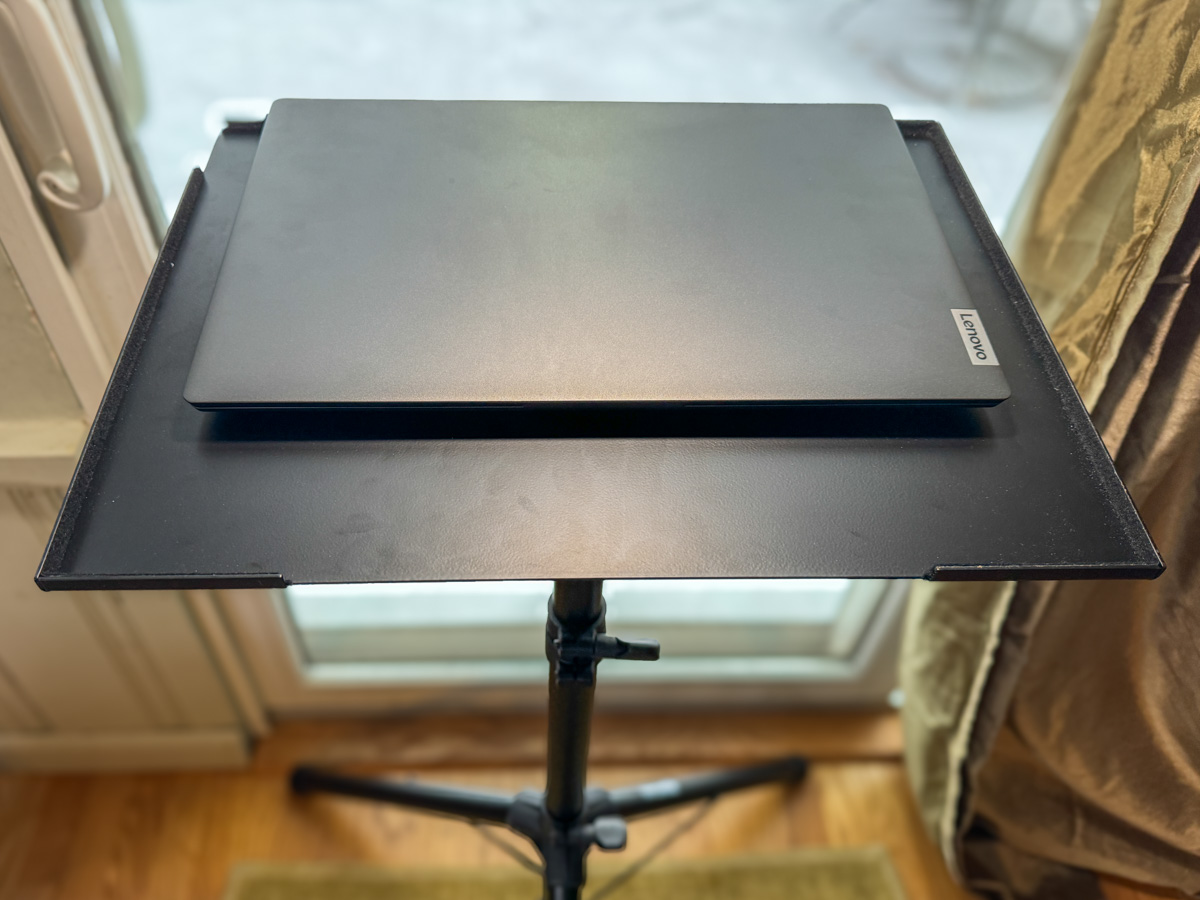
A portable floor laptop stand can do exactly that for you.

Portable Laptop Stand
It’s effectively an articulating standing tray that you can grab with one hand as you escape into another room with your laptop. Think of it as a tripod for your webcam and simultaneously a portable standing desk for your laptop.

Laptop stands are usually designed for presentations on stage or video/media production work, but why can’t you have the same access to this solution for home use?

Another superpower for this kind of stand is it will bring your laptop back to eye level wherever you go, because you can easily adjust its height. No more need to stack books.

And you can fold it up when you’re done.

Time to Choose
Buying one is simple. There are numerous choices online in the $40-$50 range. Some are more expensive, but I don’t think it needs it to be built like a tank to withstand abuse. I know I’ll treat it well at home. I just want it to be steady and not fall over. (That would be bad.)

Amazon has a variety of choices. Here are three options:

I bought the Amazon Basics model, not because the Amazon Basics brand screams ‘best quality,’ but because it’s the tallest. So, when I choose to use it while standing, that would be best for my height.
And it works just fine. In fact, it’s plenty beefy at over 10lbs. You can use it for your laptop, portable projector or any other piece of tech that needs a pop-up surface.

The Importance of Maintaining Visual Communication
Of course, you could always choose another path that sidesteps this entire challenge. Just don’t turn on your webcam. I know many folks follow this practice.

But I’ve said it before… If you want to stay connected to your world from the comfort of your home, you’ve got to show up for your close up.

Always keep your webcam on.

And a portable laptop stand can help make that all the easier no matter which room you’ve been banished to!