At Home with Tech

Unlock the power of all your technology and learn how to master your photography, computers and smartphone.

Category: Tech How To

A Poem for Dads on Mother’s Day

Photo collages are ideal for creating the perfect holiday card. Here’s how to do it all at home with a poem for easy reference.

What have you been doing with those thousands of family photos you’ve collected over the past years? Posting a few on Instagram or Facebook? That’s great. But what about all of the others?

Well, you can create annual photo books that will capture hundreds of your favorite photos. Those photo books should last through the century (actual mileage may vary). But that’s always a huge project to pull off.

Tackling a smaller version where you’re collecting only 15-20 images is clearly more manageable. How about applying that towards a “photo collage?!”
(Light bulb moment)

Photo collages are perfect for holidays or any occasion to give a physical card.

You just load your photos into a template. (Lots of photo websites like Shutterfly offer this.) You can pay them to print your card, or you can take a screenshot and instantly print out the photo collage card yourself. (That’s what I do.)

In honor of all mothers (and one in particular), here’s my little poem for fathers that doubles as an emergency instruction manual.

Instructions for Fathers on Mother’s Day

That day has arrived
When dads should applaud

With a pile of gifts
Though we are so flawed

But time is fleeting
Delays mute your plans

Amazon is late
Your wish is now sans

You are on your own
Just laptop and pics

A photo collage
That could be the fix

The story is there
For you to now share

You’ve got the photos
For you to declare

Websites will help you
To do this cool trick

Just load it all in
A template is slick

Then print out your card
It’s easy as pie

You’re back in the game
It’s okay to cry

Stuff doesn’t matter
It’s the life you share

Your collage reflects
Each day that you care

Say Happy Mom’s Day
For all that you are

This photo collage
Shows you are my star

A Tale of Three Headsets to Get through Fifth Grade

If you’re concerned about getting the right headset for virtual learning that will help protect your child’s hearing, you’re not alone. Here are the results of my shopping journey to date.

It’s not like my son has never worn a headset before. But over the past year of Zooms and virtual learning, our fifth grader has seemingly had one fused to his head. (Haven’t we all?)

And I’ve been concerned about the level of audio streaming into his ears. Is it too loud? What about the risk of long-term hearing loss?

So I’ve wanted him to wear a headset with volume-limiting capabilities. And I’ve got to tell you, strangely, there’s not a lot of choices out there.

POWMEE is for Younger Kids
I originally landed on a pair of POWMEE P10 Kids Headphones with a built-in microphone on the cord.

The POWMEE worked well, and they were only ten bucks. But the headphones were a little tight on his head. Four months later, they gave out. That may not seem like a long time, but I imagine the designers didn’t assume so many hours of daily use and cable twisting by little hands.

When I realized the POWMEE were small, I immediately initiated a new search to find a bigger headset designed for tween/teen heads.

Even fewer options with volume limiting capabilities exist for that age group. I suppose the idea is a real buzzkill from a marketing perspective.

PuroGamer Barely Got out of the Box
I finally landed on the PuroGamer Volume Limited Gaming Headset, which is targeted for teens. I bought it for $29.99 on Amazon, although it’s now gone up in price.

I got it and threw the box in the back of the closet. I knew the PuroGamer could be called to action at any time.

And the day came when boy my walked into my home office to see me. He had a stricken look on his face. Had Old Yeller gone to the doggy pasture in the clouds? (Actually we have a cat.) Nope. His POWMEE had died.

When I instantly pulled out the replacement, his shock and instant glee were priceless. (I felt like a hero.) And off he scampered with his PuroGamer.

But I didn’t have much time to take my parental victory lap.

The PuroGamer lasted about 2 weeks before the sound in one ear started to fizzle. (The USB connector gave out shortly after that.)

The cable was seemingly the culprit. It couldn’t handle all of the bending and ‘action’ a child will likely offer. Perhaps a gaming teenager wouldn’t give the PuroGamer cable the same workout?

Maybe the fault was mine getting the PuroGamer for a ten year old. Or perhaps I’m just making excuses, and the PuroGamer should be more durable.

Either way, it was back to the drawing board.

Time for an Adult Headset
I eventually decided my mistake had been limiting my search to headsets designed just for kids and teens. It was time to look for adult headsets.

Yes, shopping in the adult aisle is inevitably going to cost more. But I’ve already crossed that line for his sneakers and summer sandals. (He’s growing up fast!)

And unfortunately, technology for kids is often marred with inferior gear that won’t hold up. Yes, it may be cheaper, but you get what you pay for.

I’m certainly seeing that now.

Go with What You Know
As I puzzled over how to attack this new shopping challenge, I took a look at what I had fused to my own skull throughout much of my work day.

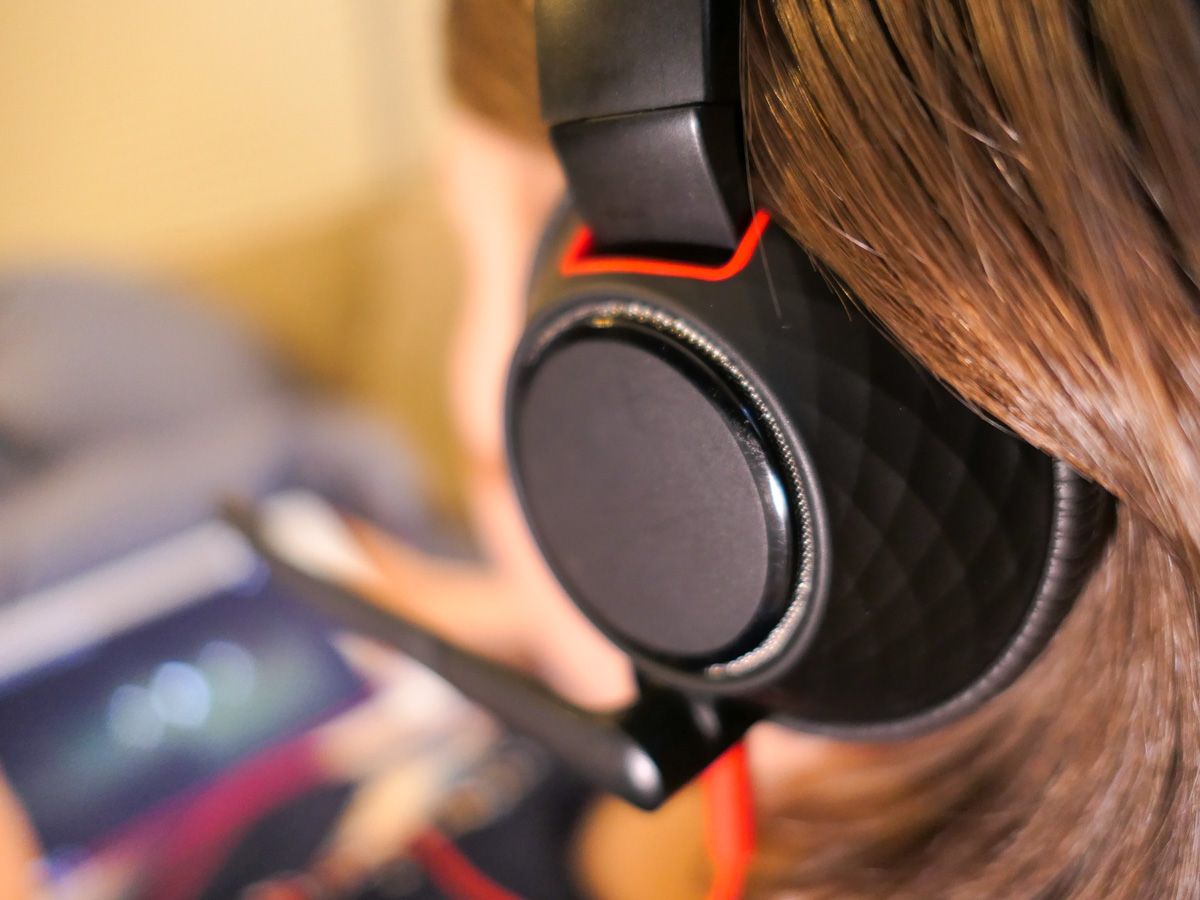
I was wearing a Plantronics (Poly) Blackwire C5210T single-ear headset.

My Blackwire headset had been great. It was comfortable, and sported two interface options. (3.5mm and USB connectors)

Like father, like son?

Another Blackwire
So I Googled the Blackwire headset and looked at the specs. And guess what?

Yes, it’s got built-in hearing protection. I didn’t even know!
(The SoundGuard DIGTAL technology protects against sound levels over 118 dBA, and Time-Weighted Average prevents average daily noise exposure from exceeding 85 dBA.)

There’s also a dual-ear design that would be perfect for my son.

Before I made my decision, I called my boy over to try on my headset. Within seconds, I saw that big smile.

Research complete.
Click.

If at First You don’t Succeed
Yes… this headset purchase was expensive. But sometimes you’ve got pay for what you really need. (And by the way, I purposely avoided going down a Bluetooth headset rabbit hole.)

It’s been almost a month, and my boy’s Blackwire headset has been holding up. (Fingers crossed.)

No, I’m not especially excited that it’s taken three headsets to get him through fifth grade, but if that’s the biggest technical glitch through this year of virtual learning, I’ll take it!

More importantly, I’m trying to do what I can to protect his hearing.

How to Fix your Ceiling Shot Problem during Zoom Meetings

Using a tabletop tripod to elevate your webcam shot is a great way to help your Zoom viewers experience you eye to eye.

It’s been over a year since the Zoom revolution took over so many parts of our lives. The good news is many of us have mastered the basics of video production while video conferencing from home. But there’s one mistake I see plenty of people still struggling with. To be fair, it’s not entirely their fault. Some blame has to be shared with laptop manufacturers who insist on putting webcams down at the bottom of the laptop screen.

The Evil Ceiling Shot
The resulting problem is your webcam pointing up at your face with the ceiling as the background. The shot is incredibly unflattering. Who wants their viewers staring at their chin or peering up their nostrils?

The fix is not an easy one. You’ve got to find a way to bring your webcam up to a more level position with your eyes. That will create the balanced visual you need.

Stacking a few hardcover books under your laptop can help. If you’ve got a standing desk, it’s time to raise it up all the way. Anything you can do to elevate your webcam will reduce the evil ceiling shot.

You also might want to consider investing in a little more gear to improve the Zoom experience for both you and your viewers.

Time to Buy a Tabletop Tripod
To move your shot high enough to make your webcam parallel with your eyes, you may need to invest in a standalone webcam. And then, most critically, you absolutely have to perch that webcam on a tabletop tripod.

A good tripod that can fit on your desk will be your unsung hero to help create a great video shot for your next Zoom.

The trick is making sure the mini tripod is tall enough to meet your eyes.

There are plenty of inexpensive tabletop tripods out there for webcams and portable LED lights. The problem is many of them are too short, only coming up a few inches. You really need a mini tripod that telescopes up 15 inches or more.

And you should also make sure you don’t choose a model that will take over your desk. It needs to be compact.

In looking to improve my own desk setup with a new tabletop tripod, I found these options to consider:

  • Lume Cube Desktop Light Stand
    30” max height
    $34.95 on Amazon
    The tallest option if you need it, but it’s also more expensive.
  • OrangeMonkie Tripod50
    19.7” max height
    $44.99 on Amazon Prime
    I love this little tripod. Even though it’s the most expensive of the group, it’s a great value. Unfortunately it’s overkill, made for heavier gear. The design will also take up more space on your desk.
  • Neewer Photography Mini Table Top Stands (2)
    20” max height
    $19.99 on Amazon Prime
    The price is right, but you can’t tilt the mount.
  • Ulanzi MT-16 Tripod
    15” max height
    $22.95 on Amazon Prime
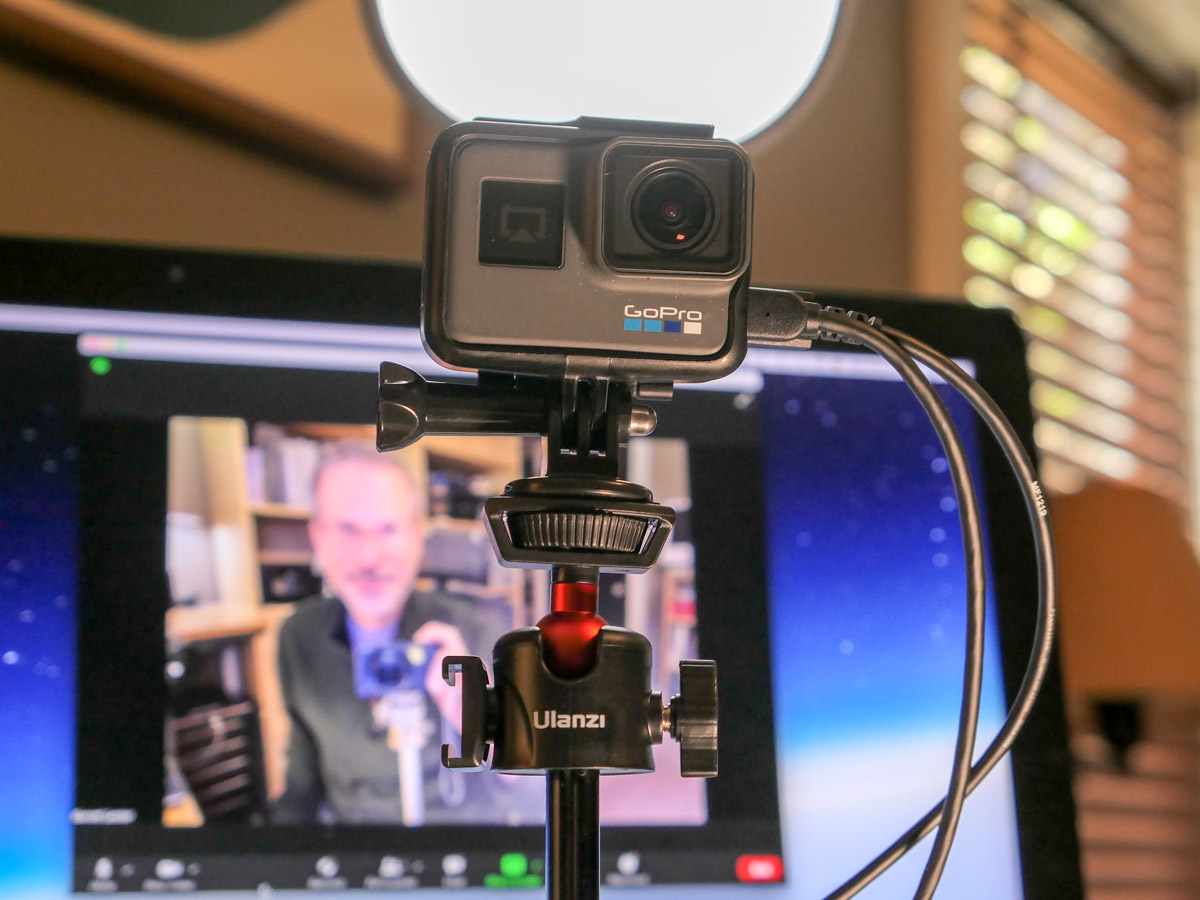
    Just tall enough. Comes with a standard 1/4” screw mount and a GoPro mount.

Ulanzi MT-16
So, I ended up going with the Ulanzi MT-16 tripod. It’s great to support my portable Genaray Powerbank 96 Pocket LED light. It’s also a perfect choice to hold up my GoPro when using it as a webcam.

Yes, GoPros can be repurposed as webcams. To do that trick, you just need an HDMI-out to USB 3.0-in adapter. That interface will connect your GoPro’s video feed to your computer. (I use the Elgato Cam Link 4K.) Once attached, your GoPro is ready to live stream.

Elevate your Zoom Game
Remember, to create your best video shot for your next Zoom, you have to bring your webcam up high enough to meet your eyes. And stacking books under your laptop can only take you so far.

A separate webcam on a desktop tripod can really elevate your Zoom game. (The same goes for portable LED lights. You want your soft light source hitting your face at eye level.)

Using a little tripod will make a big difference!