At Home with Tech

Unlock the power of all your technology and learn how to master your photography, computers and smartphone.

Category: Tech in the News

How to Use Your New Chip Credit Card

You’ve probably noticed lately that replacement credit cards have been showing up in the mail containing new EMV chip technology. I certainly have…

You’ve probably noticed lately that replacement credit cards have been showing up in the mail containing new EMV chip technology. I certainly have…

A few weeks back, I was eating dinner with my father at his favorite neighborhood diner. I picked up the bill and walked over to the cashier to settle up. I pulled out my new ‘EMV’ chip MasterCard and performed the new dip maneuver instead of ‘swiping’ at the updated payment terminal.
(More on this later…)

The lady at the register asked me if I wanted to add a tip to the bill. I immediately felt confused by the shift in payment sequence. For decades, I’ve added the tip after the payment slip comes out of the terminal’s printer.

She must have sensed my imbalance and politely volunteered that tips now have to be added before the transaction goes through when using these new chip cards.

Oh.

So I professed my numerical opinion on the waiter’s service, and that was the end of that.

Still… this was all very different than the standard anonymity provided by secretly writing a tip onto the payment slip.

Fighting Credit Card Fraud
Sure, these microchip credit cards are said to be more secure than the old technology in magnetic stripe cards, although my new chip card still has a magnetic stripe on its back.

And there’s been a sudden rush by U.S. retailers to install new chip card terminals, because of the recent ‘counterfeit liability shift’ decisions by American Express, Discover, MasterCard and Visa. This shift makes retailers responsible for fraudulent credit cards transactions if they don’t use chip-enabled card readers to process EMV-equipped cards.
(Liability used to be handled by the card issuers.)

It’s clear we’re currently in transition in the U.S. where both card technologies are still in use.
(Chip technology has been the standard protocol in Europe and Asia for years…)

But honestly, I’m not sure what to expect the next time I walk into a restaurant…

Dip. Don’t Swipe
Of course, this is the obvious functional change you need to learn. You have to vertically dip your card into a slot and leave it there until the terminal beeps at you to retrieve your card…
(Swiping is so passé.)

A Counter Seat
If you’re sitting in a diner or at a bar counter, you need to add your tip to the tab as part of the initial chip card transaction.

I suppose that’s not such a big adjustment, because you’re dealing with someone else other than your waiter or waitress. You’re free to express your feelings however you like…

Awkward!
But if you’re dining at a restaurant where someone used to whisk your check away with your credit card, I think you’re going to need to learn a new dance… and quick!

You’d better feel comfortable publicly giving a smaller tip for mediocre service.
Because now you’ll have to do it while looking at that restaurant employee straight in the face.
(Via a hand-held payment terminal at your table or even worse… you’ll have to dictate the amount.)

This scene hasn’t actually happened to me yet.
(No portable card reader has silently appeared at my side while I’m finishing up my after-dinner tea with my dad.)

I wonder if that’s because the restaurants I frequent are choosing to use my chip card’s magnetic stripe to maintain the customer’s ‘classic’ experience as long as possible…?

New Rules
I did a little online research about this evolution in digital commerce at restaurants…

  • Will You or Won’t You?
    Depending on the type of chip card you have, sometimes you’ll have to tip in advance… other times you won’t.
  • Chip-and-Pin Cards
    There are differences between ‘chip-and-signature’ and ‘chip-and-pin’ cards.
    (The latter always requires the new dance at your table.)
  • Tip Tolerance
    Apparently, even when using a chip-and-signature card, you can technically still add in 15-20% after the original transaction goes through.
    (So unless you’re an unusually gracious tipper, does that mean nothing really has to change in your payment process after all?)

Check, Please…
Once everyone’s credit cards have been replaced with chip versions here in the States, I imagine we’ll finally see some consistency in the experience.

Until then, I wish you unending positivity while dining out.

Oh, one last tip…
Don’t forget to take your card when you’re done with your dip…

That would create quite a blip in your trip.
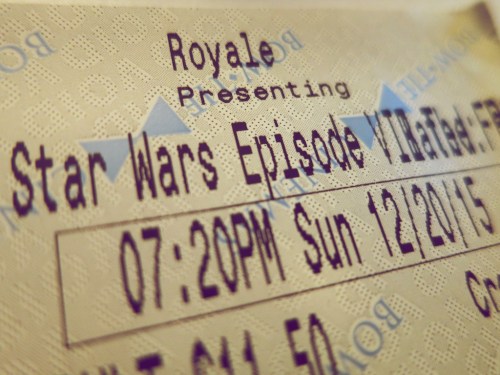
I’m Watching Star Wars Right Now

This is my ticket to the hottest show on this planet. If you want to avoid any spoilers, don’t worry… I won’t be blogging from the movie theater.

This is my ticket to the hottest show on this planet. If you want to avoid any spoilers, don’t worry… I won’t be blogging from the movie theater.

These words were written in your past. In the very moment they are released on Sunday, December 20, 2015 at 8:00pm… I will no longer exist on the planet Earth.

In fact, I will have been transported to a galaxy… far, far away.

Yes, you guessed it… I’ll be about fifteen minutes into
“Star Wars: The Force Awakens.”
And I’ve got to say, if all goes well, that will be quite the accomplishment… for me.

I suppose I should admit it’s something of a sad state to acknowledge I couldn’t get it together to buy my tickets for opening day months ago, like any self-respecting sci-fi geek did.
(And then I figured it would be impossible to find tickets for days or weeks after opening weekend.)

But a work colleague, who was more organized than me and successfully got himself to an opening-night screening suggested I find the opportunity to see the new J.J. Abrams’ flick soon… before people started to talk openly about the plot.

His comment sounded a little ominous…

“The Force Works in Mysterious Ways”
As I was driving home from work on Friday thinking about how distant the Force still felt from my eyeballs, my wife called and told me she just received an email from Fandango proclaiming there were still tickets available in our area code to buy that very night.

Huh?

Now in the old days, we would have just gone for it, but as you know we’ve got a young Jedi in training at home… He’s only five and not quite ready to watch “Star Wars” yet.
(Especially a PG-13 rated Episode VII)

So we can’t just take a spin around the galaxy anytime we want.

But we’re not entirely unable to pivot… so we decided that if I could secure a couple tickets for tonight, we could swing the rest.

As I was driving, I figured I could either buy the tickets online when I got home…. or better yet… I could just drive a little further up the street to our local movie theater and go old school… and simply secure the tickets there.

And that’s exactly what I did.
(How 1940’s of me)

As I stood in the center of the lobby, grasping my two tickets, I looked about for some unforeseen obstacle… Like some storm trooper would walk up and demand a $200 opening-weekend surcharge. But everything seemed absolutely normal. Of course, there were lots of people on line waiting to see the sold-out Friday night show, but other than experiencing a few momentary flashbacks, I felt really good.

Flashbacks, you ask?

Oh yeah…

“Assimilate This!”
I think part of the reason I didn’t try harder to see “The Force Awakens” on opening day was because of fan hysteria and long lines for sold-out shows. I’ve been part of that scene before. And I’m not proud to admit it, but I’ve been one of “those fans” who’ve contributed to “the scene.”

I first transported back to “Star Trek: First Contact’s” opening day back in 1996. That was the time I organized a group trip and brought ten of my friends.

  • We bought our tickets…
    (No Fandango yet)
  • Stood on line for an hour with 500 Trekies
  • And finally walked in
    (There were actually three theaters that day showing the flick, and ours was outfitted with the newer “Dolby” sound system.)

Guess what?
Our tickets were for one of the other theaters. We were in the wrong one!

When one red-shirt member of our landing party took a quick trip to the bathroom, she was nabbed on the way back by a young usher, who spotted the discrepancy on her ticket.

He walked down to our group to escort all of us out of the sold-out theater. By this point, it was only a couple minutes until the film started. So it was clear we wouldn’t get into any of the other simultaneous screenings either.

What would you do…?

It was my own personal Kobayashi Maru moment…
(If you’re not a “Star Trek” geek… that refers to how someone handles a “no win” situation.)

Without giving much thought to the consequences, I simply proclaimed we wouldn’t leave.

My excuse…? I explained that we were told to stand in the line that led us to this particular theater. That was technically true, but I was hanging my hat on an unconfirmable technicality.
(We were still sitting in the wrong theater.)

The usher threatened to bring in the manager. I called his bluff.
(It wasn’t a bluff.)

It was at this point, the rest of my group started getting uncomfortable. So they started to get up to leave. My poker game was over.
Only a benevolent act by the “Q” could save me…

And then the lights dimmed. And the movie started. And we were still there…
And I guess the usher gave up.
(He never came back.)

So we watched the movie.

And yes, my friends later told me I was a little crazy to do what I did.
(I wasn’t proud of my act of defiance, but I have to admit that Dolby sound was sweet!)

Twenty years later, all I’ve got to say is that was a long time ago in a state far, far away, and I would never do something like that today.
(Do I seem a bit defensive?)

“No Growth without Assistance”
Fast forward four years…

Then there’s the time when my wife and I were dating, and we went to a packed movie house in Brooklyn about to see “Crouching Tiger, Hidden Dragon.” We showed up with five minutes to spare, and there weren’t two open seats together in the whole place.

Yep… another Kobayashi Maru.

So I ran up the stairs led by some ‘Force” and asked an entire row of people to shift one seat over.

They did.
(And happily too. I think it must be a Brooklyn thing.)

I think my wife was impressed.

But come on… that was another risky move… Right?
If it had played out poorly, my future could have evolved into a different timeline altogether.

“The Force is Strong with This One”
Fortunately, another film flashback that comes to mind is much more Zen.

It’s the hot summer day in 1977 when I saw “Star Wars: A New Hope” with my mom at the now long-gone movie house on East 86th street in New York City.

I remember being blown away by the entire movie. And though I was already a “Star Trek” geek, the groundbreaking “Star Wars” really opened my eyes.
(Along with the rest of the planet.)

“Your Thoughts Betray You”
Then, I snapped back to this reality.
It’s 2015.
Right…

So I walked through the suburban parking lot and got into my car.

I thought about the future. About tonight.

Would this experience also burn permanent memories into my neurons just like it did with “A New Hope” and “The Return of the Jedi?”
(Watching Episode VI in the massive New York Ziegfeld Theater with a thousand screaming kids begging Darth Vader to take action against the evil Emperor is hard to forget.)

Oops… time slipped again.
(Sorry)

“You Cannot Escape Your Destiny”
Will December 20th, 2015 always be a day I remember, because it’s the day I saw “Star Wars: The Force Awakens?”

I’ll let you know.
(For now, I’m just tickled I’m getting to see it on opening weekend!)

And I’m shooting for a stress-free experience this time.
(May the Force be with me.)

If you thought this was going to be a movie review, this is not the blog you’re looking for… And what self-respecting Star Wars’ fan wants to read a review ahead of time anyway?

Just go!

Build a Time Machine with Filament LED Bulbs

Filament LED bulbs have brought us full circle to the day Thomas Edison invented his light bulb. These vintage-looking, LED bulbs can bring you back to the future. But it can also cost you…

Filament LED bulbs have taken us full circle to the day Thomas Edison invented his light bulb. These vintage-looking, LED bulbs can bring you back to the future. But it can also cost you…

Recently, I started noticing a proliferation of really cool vintage light bulbs prominently displayed in certain restaurants. I thought it was really impressive being bathed in light by these Edison-style throwbacks. The secret I didn’t realize was these weren’t incandescent replicas. Not at all…

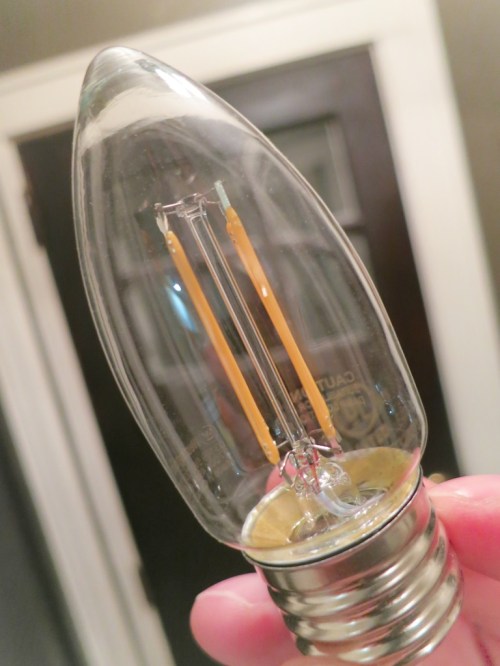
They were actually LED bulbs designed to mimic an illuminated filament thread.

How exactly was that possible? It seemed like only yesterday that the basic replacement LED bulb was born. And what an ugly duckling that was. But soon after, technology upgrades improved its form factor.

But this was something entirely different! An LED bulb that glowed exactly like an old-time bulb.

And guess what? You can buy these “filament LED” bulbs for your home. They’ve been spreading throughout Europe over the past few years, and now they’re becoming more readily available here…

Filament LED Bulbs are Cool
Okay, so let’s review how light bulbs used to work… Since the days of Thomas Edison, incandescent bulbs harnessed electricity to heat a metal filament to make it “white hot,” or incandescent.”

Now, filament LED bulbs incorporate thin LED strands shaped to look like vintage traditional tungsten filaments. That’s done by mounting many tiny LED chips onto a transparent substrate. And all of these low power LED chips don’t require a heat sink, which previously contributed to that alien-like construction of early LED bulbs.

Finally, the many, mini LEDs, which are often colored blue and red are then coated in a silicone resin and phosphor to create white light.

Kind of genius. Right?

Unfortunately, these filament LEDs have a shorter life than traditional LED bulbs, but we’re still talking about years.

There is however, another problem…

Not All Filament LEDs are Created Equal
When you Google “Filament LED,” seemingly dozens of websites pop up wanting to take you back to the future. And for very reasonable price, too.

It seems almost too good to be true…
As it turns out, the old adage – “You get what you pay for” still applies.

Cheaper bulbs are… well… Cheap.

They use a lower-grade silicone coating, which has a shorter life span. But there’s a more important risk that goes beyond premature bulb failure…

Bad Filament LED Bulbs Can Damage Your Eyes
Improper LED coating can create leakage of blue light from the blue LEDs. And not to alarm you… but apparently this kind of blue light exposure can cause macular degeneration over time.

Yes, I was a little non-plussed to discover the negative effects of blue LED light exposure, especially when there are plenty of electronic devices regularly glowing at you with various levels of blue LED light.

The other problem with over exposure to blue light is it can mess with your serotonin levels, which affects your sleep.

Wow.
So theoretically, a cheap LED filament bulb can really wreck your life.

But I’d imagine you’d really have to outfit your whole house with leaky filament LEDs to put your eyes and sleep cycle at real risk. And then there’s the cumulative amount of exposure it would take to be dangerous…
(Which, of course, nobody knows for sure how long that is)

My next step after absorbing all of this scary, blue knowledge was to take three deep breaths…
(And stop worrying so much)

I was only interested in purchasing three filament LEDs for one ceiling light fixture next to our kitchen. It’s a light we pop on occasionally. Certainly not a central light source that we often use. So I figured as long as I exercised sufficient due diligence to find a decently constructed bulb, I would not be putting my family’s health at risk…

In Search of the Right Filament LED Bulb
As I began my search, I first realized that I needed to remember the naming conventions of non-traditional shaped bulbs. This chart on bulbs.com is a great resource and told me that my broken bulb was an F15. So I wanted a form factor close to that in my new filament LED…

I also recalled that my ceiling light fixture was on a dimmer switch. So my new bulb had to be dimmable.
(Not all filament LEDs are)

I also looked at a few more factors in narrowing my search…

Energy Star certified is a great clue you’re getting a good bulb. Unfortunately, there aren’t a lot of filament LED makers that have earned that rating yet.

I started looking at name brands, hoping that would lead to a reasonable option. Westinghouse has a presence via Amazon. So I focused my search in that direction.

I zeroed in on this Westinghouse dimmable 5 watt filament LED ‘decorative’ bulb. (470 lumens with a color temperature of 2700 K)

It’s actually a B11 shape, which is a bit smaller and not Christmas tree light-shaped like the F15, but I couldn’t find an F15 option anywhere…

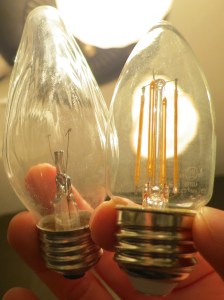
Incandescent F15 Vs B11 Filament LED


The Westinghouse bulb costs $11.88, which isn’t cheap, but seemingly the going rate for many filament LED bulbs today.
(Happily, basic LED bulbs have come down in pricing.)

But remember… the value proposition is compelling:

  • It only draws 5 watts (as opposed to 40 watts)
  • It’s designed to last for 15,000 hours
  • So hopefully, I won’t have change the bulb again until I own an iPhone 12!

Click.

My Fascination with Light Bulbs
I dream of the day I won’t have to ever replace a light bulb. Wouldn’t that be nice?

We’re still not going to exactly get there with current LED bulb tech, but as I’ve gradually weaned my home away from incandescent bulbs, I’ve noticed a clear shift away from what seemingly used to be a weekly practice of replacing a light bulb somewhere around the house.

And who knows… one day I may actually lose my interest in writing about light bulbs.
(Don’t count on it…)