At Home with Tech

Unlock the power of all your technology and learn how to master your photography, computers and smartphone.

Category: Tech Trends

Rechargeable Flashlights that Power the Rest of Your Life

Do you own flashlights that just suck the life out of your batteries? Well, that stinks. So, it’s time to upgrade to rechargeable flashlights that work harder for you in more ways than one…

B&H sent me a free holiday gift… an LED flashlight that came with
my recent Meade Instruments telescope purchase for my son.
(How nice of B&H!)

It was a little 45-lumen NITECORE TUBE keychain flashlight.
The TUBE normally sells for $9.20.


What was really interesting about this little, inexpensive flashlight was that you can recharge it via USB.
(Really?)

Had I been asleep at the wheel buying replacement batteries for my own fleet of home flashlights since I can remember?
(And believe me… my second grader has loved to play with my flashlights since he could walk. So, battery replacement has been an ongoing and expensive chore.)

Sure, I bought my dad a cool, rechargeable Klarus tactical-style flashlight to brighten his holidays a few years back…
The Klarus RS16 was rechargeable via an onboard magnetic charging port.

But I had never really considered upgrading to rechargeable battery tech for my own flashlights until my new NITECORE showed up.

The idea of ‘never’ having to replace the batteries in my flashlights ever again was quite tantalizing.
(Though I would still need to remember to recharge them)

So, I decided to take a look at today’s options…

How Many ‘Lumens’ Do You Need?
The first question I needed to address was how bright a flashlight do I really need.
(How many lumens?)

Of course, that depends on the use. For this exercise, I’ve decided to shop just for the home.
(Not for an ambitious outdoor camping trip)

Some ‘experts’ say under 100 lumens is fine. Others say you need two-three hundred lumens or more.

And there are plenty of options out there at or above 1,000 lumens!
(But that’s way brighter than I need or want)

REI has a good write up on other issues to consider when choosing a flashlight.

I decided to focus my research for a flashlight in the 250-300 lumen range with a few different illumination settings.
…And rechargeable via a USB cable as opposed to a proprietary battery charging system and charger that I would need to keep track of.
(Simplicity, please.)

Seven Rechargeable Flashlights that Get the Job Done
What I immediately found is rechargeable flashlight tech costs more.
(Not entirely unexpected)

But if you look around, you can also find additional functionality in these next generation flashlights!

Because a flashlight doesn’t have to just be a flashlight…
(More on this in a moment!)

I set my target price below $40.
And here are five good options I found…

NITECORE THUMB 85
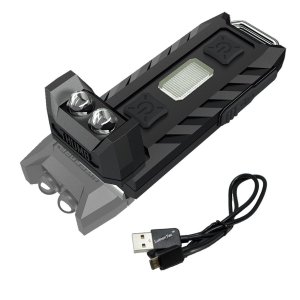


-85 lumens LED keychain flashlight
-$19.99 on Amazon
-120 degree tilting head
-White and Red LED
(This essentially has double the power of my TUBE.)

NITECORE TIP


-360 lumens LED keychain flashlight
-$29.95 on Amazon
(And this is an even stronger cousin to the TUBE.)

NITECORE TINI
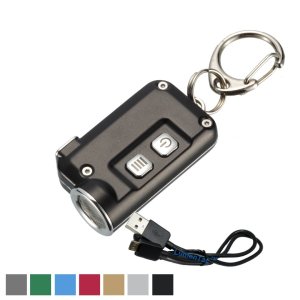


-380 lumens
-mini metallic LED keychain flashlight
-$29.99 on Amazon
(I believe this is the newer version of the TIP design.)


HybridLight Journey 250
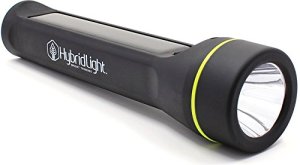
-250 lumens flashlight and charger
-4,800 mAh rechargeable battery that will also charge your mobile gear via USB
-$35.78 on Amazon
-Can rapid-charge via Micro USB port or through its built-in solar panel. (Whoa!)
-Waterproof and floats
-I also like HybridLight flashlights, because they’re environmentally friendly.
(The HybridLight appears to give you more bang for the buck compared to the Celestron.)

Nebo Slyde King (#6434)


-330 lumens LED flashlight
-250 lumens work light
-$35.95 on Amazon
(This one is cool, because you can ‘stretch’ this flashlight to reveal its center LED that glows as a work light.)


Time to Upgrade
So, many rechargeable flashlights today provide more functionality than just forward-facing illumination. Whether they offer to juice up your other gear or provide multiple light configurations, you’re getting more uses out of the rechargeable battery.

And this speaks to the progression of portable rechargeable batteries, which no longer offer illumination as an afterthought.
(Interesting how the evolution of tech has reversed the equation in this product line.)

And most importantly, rechargeable flashlights reduce the number of batteries you’ve got to go through.

That’s good for the environment.
And me!

Because it increases the chance that the next time I pick up a flashlight and press the button…
…It will actually turn on.

Brilliant.

6 Tech Gifts for the Geek in Your Life

Yes, it’s that time of year again…when you need some serious inspiration to brainstorm great gift ideas. If you’re trying to figure out what tech to get, check out the gear on my own wish list…

What do you get for the geek who has everything? Well, the good news is your special geek in fact… does not have everything. He or she is actually coveting any number of gadgets at this very moment.

What…?
You don’t know which ones?
And you haven’t brushed up on your Vulcan mind-meld technique?

Well, here’s some gear to consider from this particular geek’s holiday wish list…

More Powerful Portable Power for Your Next Camping Trip:
Goal Zero Yeti 150
Over the summer, my family and I went camping at the Grey Fox Music Festival with another family. Though I prepared sufficiently for the Lester’s power needs to fuel our personal tech in the wild, I coveted this
Goal Zero Yeti 150 Portable Power Station the other dad brought.


Sure, I packed my own lineup of tiny rechargeable Anker batteries. I even had a smaller Goal Zero power unit, but it did not compare to this compact beast’s capabilities.

The Yeti 150 quickly became the power hub for all four of the adults.
And when hooked up to a couple of Goal Zero Nomad solar panels, this 150Wh device offered almost unlimited juice.
(As long as the sun stayed out.)

The only downside is its weight… 12 lbs.
Not something you’d want to throw into a knapsack you’re carrying on your back.
But we were car camping. So, that wasn’t an issue.

It’s nice to have a little extra power when you’re sleeping under the stars.
Believe me…

A Telescope to View the Next Unmissable Celestial Event:
Meade Infinity 90mm
Last time, I reviewed several telescope choices for kids.
But what if you’re shopping for someone a little older?
(At least, chronologically)

One of the Meade telescopes I looked at didn’t make my cut, because it was a little too big and heavy for youngsters.
But it’s perfect for adults.


I think it would be a great starter telescope.

Portable Drive for Your Computer:
G-Technology 1 TB G Drive Mobile USB-C
If your geek is into photography or videography, then more file storage is always an ongoing need. This portable drive from G-Technology can travel anywhere in a knapsack and is crazy cheap.


Wait… One terabyte for just fifty bucks?!
Soon, these things are going to be stocking stuffers…

Give Some Stability to Your Smartphone:
JOBY GorillaPod Mobile Mini
Speaking of stocking stuffers…
Sometimes you don’t always want to hold your smartphone for extended periods when snapping a photo or shooting a video, because you need more stability in the shot. That’s what tripods are for!

And JOBY makes this GorillaPod Mobile Mini that can handle the job!


Easy.

Wireless Headphones for Your TV:
Sennheiser RS 185 or Sennheiser RS 160
My once and future man-cave is currently performing its duties as our family room. But at night, after our seven-year-old son has gone to sleep… I sometimes power up our little home theater which otherwise serves up Pixar and LEGO movies. And then, I do some on-demand viewing of my own. Often, it’s loud science fiction content.
(With both “Star Trek: Discovery” and “The Orville,” I’ve suddenly got a lot of sci-fi television to keep up with.)

But these days, it’s not about how loud. It’s about how quiet.
(My sleeping ninja warrior needs his rest!)

So, I want a pair of comfortable wireless headphones to completely immerse myself at full volume in the next Starship Discovery battle scene.
(“Star Trek: Discovery” is getting really good. And all those fan conspiracy theories about Captain Lorca being from the mirror universe are fueling my anticipation for the show’s return. This “Trek’s” substance, style and energy are taking the franchise where no one has gone before.)

I’ve decided I might prefer getting a pair of ‘open-back’ headphones, which let in some ambient noise, because if there are ‘unauthorized’ non-sleeping sounds coming from our son’s bedroom upstairs… I want to hear them!
‘Closed-back’ headphones block out outside noise better…. should that be your desire.

One excellent option is this-


These RF wireless headphones get great reviews, but for some reason, the discounts on Sennheiser headphones are smaller compared to a year ago when I first started doing my research.

Hmmm…
Three hundred smackers…
That’s pretty expensive for occasional use.

Then, I remembered it’s often a good idea to look for yesterday’s ‘pick’ at a discount.
And in fact, there is one…
It’s the older Sennheiser RS 160.
(Now discontinued, but still available)


The only downside is these are closed-back headphones.
(Which for many folks is just fine.)

Still… this is quite the deal!
Instead of using an open-back design, I suppose I’d just have to rely on my parental ‘spidey sense’ instead!

Depending on your budget, I’m sure your geek would appreciate either the airy Sennheiser RS 185 or yesterday’s champ, the RS 160.

Tech Gifts can be Risky
It’s ironic that shopping for geeks can be difficult, because you may not know the exact specs of the gear they want.
(We can be so finicky.)

Here’s an idea…
Just ask!
(We don’t mind.)

Using this list can be a great place to start the conversation…
Good luck!

Which Telescope Should You Buy a Second Grader?

If you’re in the market to get your child a first telescope, and you don’t really know what you’re doing, welcome to the party! The good news is I’ve collected enough intel to make a decision. At the very least, my journey of telescope exploration should help you narrow down your own choices…

It feels like at least twice a year, there’s a once in a lifetime comet, meteor shower or eclipse that beckons the use of a telescope. My family comes rushing in wanting to see it up close… and I don’t have my telescope ready to go.

Actually, I have a bigger problem…
I don’t own a telescope.

And I’ve been meaning to fix this little glitch…
Because the next time there’s an amazing object in the sky that won’t return for decades, I want to be ready!

I’ve tried twice over the past year to do my research under the pressure of an upcoming celestial event. Both times, I failed to come up with a decision by the deadline.

Now, it’s time to try again.
And I’ve adjusted the equation a bit.

I’ve decided to buy the telescope for someone else…
My seven-year-old son!
The holidays are coming up, and I think he would love getting one.

Hello, Meade Instruments!
In doing my research, I looked for suggestions focused on the eight to ten-year-old crowd.
(My second grader will be there soon enough.)

There are still a dizzying number of choices at different price points. You can pick up a starter telescope for kids for only fifty bucks. You can also find telescopes for older children or adult beginners at the $200 and $400 price points.
(And you can certainly spend a whole lot more…)

On my last attempt to get the ‘family telescope,’ I zeroed in on a manufacturer named Meade Instruments. This company kept getting mentioned by many of the reviewers out there.
(There are others well-regarded names like Celestron and Orion.)

But my deadline was too tight to get to the finish line.

Narrowing Down the Choices
Now, let’s pick up where I left off.
Meade Instruments… check!

I want a ‘refractor’ model, which is more durable and able to handle a little rough use.
(Just being practical…)
And this design is also usually good for terrestrial viewing.

I will try to cap my spend to the sub $100 market, which is a tough one, because I don’t want to end up with a toy. The telescope needs to sufficiently handle the moon and planets…and whatever else might be passing by.
(Deep galaxy exploration will not be among my son’s first missions.)

But as a parent, I don’t want to buy an overly complicated and delicate device either!
Otherwise, it will just become a one-time-use non-starter for him.

And if his first telescope does work out, I can always get him a more advanced model down the line…

Infinity 70mm Altazimuth Refractor
So, I reinitiated my research again and guess what?
One Meade telescope keeps showing up:


This Infinity 70mm consistently gets called out on starter telescope lists for kids.
All right then. I’m done, right?
Well…
(There is where I start going down the research rabbit hole.)

Another Option
There’s also the step-up Polaris line to consider:

Huh?
So, it’s only thirty-five bucks more to upgrade to the next level telescope?
What’s the difference besides being heavier?

  • Infinity has an Altazimuth mount.
  • Polaris has a German Equatorial mount.
    (Yeah, I didn’t know what that meant either.)

I’m still not 100% positive, but I know enough to say this:
The equatorial mount design is better to more easily track the planets that are always moving through a telescope’s field of view, but it’s harder to set up and use. If you know what you’re doing, it’s the only way to go,
…but I expect a lot harder for kids who’ve never done this before.
So, I’m sticking with the Altazimuth mount for my son.

Please cancel the Polaris option and forget I mentioned it.
Let’s move on.

So, now, we’re really done, right?
I’m getting the Infinity 70mm.
Uhhhh…

Portability and Ease of Break Down
One reviewer mentioned that it was difficult to break down the Infinity 70 to put away, because of the accessory tray. So, I downloaded the assembly instructions and took a look…

The accessory tray screws into the center of the tripod legs, indeed making it somewhat inconvenient when you want to quickly break it down.
(There’s unscrewing to do.)

However…
The 80mm and 90mm models use a different accessory tray attachment design that just requires rotation to lock it in and then out of the tripod legs.
So, that makes it much easier to disassemble.

Infinity 80mm Vs Infinity 90mm
Okay, let’s spend a little more time with these two options that while more convenient to take apart are also more expensive…


Both the Infinity 80mm and 90mm telescopes come with three eyepieces as opposed to the two that come with the Infinity 70mm.

Sure, the Infinity 80mm and 90mm models are more powerful than the Infinity 70, but that’s not so important to me as a first telescope.

Ease of use is what matters…

Who Am I Really Buying the Telescope For?
I think the Infinity 70mm would be totally fine as a first telescope for my son.
But it’s not as easy to break down, because of the way the eyepiece tray screws into the tripod legs.

If you don’t mind leaving the Infinity 70mm set up in a corner of a room, then I’d say you’re done.

But what if you’re like me and want to disassemble the telescope after every use and place in neatly away in a closet?

Then, the Infinity 80mm would do the trick. It’s smaller and a tad lighter than the Infinity 90mm, which I think would both be relevant factors for my son.

So, I should buy the Infinity 80mm.
Right?

How to Upsell Yourself
With the Infinity 80mm, I would shatter my $100 price barrier by over 30%.

Is it worth blowing the budget for more convenience and ease of use by little hands?
Well…probably.
(We’re only talking $35.)

And parents…let’s be honest.
Wouldn’t it also be nice to also get a little better telescope for the whole family?
And by the whole family… I mean me.
(Not that my wife wouldn’t enjoy a clearer shot of Jupiter.)

I’m not going to give my kid the Infinity 80mm and then say, “Go have fun with it!”
I’m the guy who’s going to be there with him helping to set it up and operate. It’s going to be a group activity for a while.

So, for a ‘family telescope,’ I’m prepared to say that the Meade Instruments Infinity 80mm definitely hits the sweet spot…for my son…and me.

Hey, if I were shopping only for myself, I’d be looking at the
Meade Instruments StarNavigator 102.
(Recommended by David Brody on space.com.)
$400 on Amazon
(Drool)

Get the Bag
You should also consider getting the carry bag for this telescope so you’ll have something to store it in when you put it away:

  • Meade Instruments Carry Bag for Infinity 80/90/102 Telescopes
  • $39.95 on Amazon

Astronomy 101 Begins Now
Even though I’ve never owned a telescope… nor have I really operated one all by myself,
I’m ready to learn, and I’ve done my research.

And I’ve made a decision!
(Phew)

I’m happy to report that after a year of trying, I’ve finally landed on the Meade Instruments Infinity 80mm Refractor Telescope as our ‘family telescope.’
(That said, I’m still open to other thoughts. Any other recommendations out there?)

Happy planet and stargazing, and don’t forget your Tang!