At Home with Tech

Unlock the power of all your technology and learn how to master your photography, computers and smartphone.

Category: Technology

How to Prep the Shot for your Next Video Call

Your smartphone suddenly comes to life. It’s an incoming FaceTime request! Are you really ready for your close up?

Remember that innovative ‘PicturePhone’ room on Space Station V from “2001: A Space Odyssey?” Well, it wasn’t long until that crazy sci-fi videophone idea actually became a reality, but you certainly didn’t see many landline videophones in homes over the following decades.

The concept took it’s time gaining wide acceptance. And it required now mainstream computer and mobile apps like FaceTime and Skype to help the general population break through the video barrier on phone calls.

It’s such an obvious ‘upgrade’ to be able to see someone too, and where the bandwidth allows, it feels like many people today freely use their video-calling apps.
(If they’re not texting each other instead)

But let’s face it… lots of other folks still aren’t that excited to be surprised by a sudden video chat request.

And why is that?

The Power of Video
There’s always been a certain anonymity to voice-only calls. Nobody knows where you are, what you’re doing or what you’re wearing… or not wearing.

You can also multitask while on a voice-only call.
…or so I’m told.
😉

Now, you add video into the equation, and BAM… you’re right there in front of someone!

On the upside, mobile video calls can bring the caller right into your surroundings… If you’re walking in a parade or waiting on line at a ski lift, those types of environments can provide rich texture to what you’re up to in that moment. It’s the ‘location’ bonus that makes your video chat that much more interesting.

A Video Chat Isn’t Always a Random Moment
But when you’re at home and those FaceTime tones chime, you may have to scramble to put together an acceptable ‘visual presentation.’

So I think you need a plan for how to appropriately prepare, especially if it’s for business…

No, you don’t need to build a little TV studio set in your living room that you’d run to.
(Like Kramer did on “Seinfeld”)

But it wouldn’t hurt to take a few ‘reasonable’ steps in that direction…

Choose Your Shot
You should definitely decide and test what your ‘shot’ is going to be.
You don’t want to look like you’re in your own hostage video. Nor do you want to reveal that basket of unfolded underwear and socks waiting for your attention.

Think about your background. You may have to stage a few of the items and remove some of the clutter.

Using a desktop computer or even a laptop for your camera probably won’t give you the flexibility you’ll need to create your desired shot. That’s why a more portable device is the way to go, if you have that choice.

But holding a smartphone or tablet in front of your face for a half hour or more is logistically challenging.
(Plus, your unstable shot will likely make the viewer seasick!)

To create a more stable shot, you can certainly pile up a bunch of books for a good height and position for your propped-up device.
(I’ve done it.)

However, that definitely falls into the category of ‘wonky,’ and it’s never perfect.

There’s got to be a better way to more easily mount your smartphone or tablet into an exact position to get the ‘perfect’ shot.

Well, of course there is…

Lock Your Shot with a Flexible Mount
There are a variety of gooseneck smartphone/tablet mounts on the market which will solve the problem. You simply grip and tighten the gooseneck’s base to the edge of your table or desk. And then you move the gooseneck into the exact height and position you need.
(A little higher is usually better for the angle towards your face)

And… voilà! Your hands-free solution is in place!

I decided to go with the Mingo Gooseneck Tablet Holder and Desk Mount for $26.99 on Amazon.

It provides three different mounts that screw onto the end of the gooseneck. Those options will keep you covered for both smartphone and tablet use.


The Mingo is a little more expensive than the competition, but the reviews suggest it’s more durable over time. I also like that its 28.7” gooseneck is longer than most of the choices. That makes it easier to pull it into the perfect position on your desk.

Give Your Face Some Light
You’ll also want to find a little soft lighting to help remove any harsh shadows on your face. One option is to simply position yourself in front of a window.
(As long as you’re not in direct sunlight)

If that doesn’t work with the angle of your planned shot, you can hang a portable light in front of your face. A really inexpensive solution is to use a round, hanging paper lantern.

This 17 ¾” diameter shade made by Ikea is a good choice.
It sells on Amazon for $16.99.

Then, you attach the shade to a bulb mount and power cord.
This one on Amazon costs $9.99. It’s 20 feet long and sports an on/off switch.

It’s a really simple solution, and it’s actually used as a remarkable lighting hack by some professional TV and video lighting gaffers I’ve worked with.

Look at the Camera!
And now that we’ve come this far to create a professional-looking shot, there’s one more thing…

Always focus your eyes on your device’s camera dot… not at your own image. Otherwise, you’ll always appear to be looking somewhere else as opposed to the person you’re video chatting with!

And that just becomes annoying.

Your Smartphone Should Give You the Best Shot Possible
So, the next time you need to do an important FaceTime or Skype session with someone on the Kubrickian ‘Space Station V’ or perhaps with a business contact in a more terrestrial location, now you’ll be prepared to look your best…
Hands-free!
Please Give the Computer on the Phone a Moment to Act More Human

When a computer on the other end of your phone call can’t move fast enough, is that good customer service? Well, it depends…

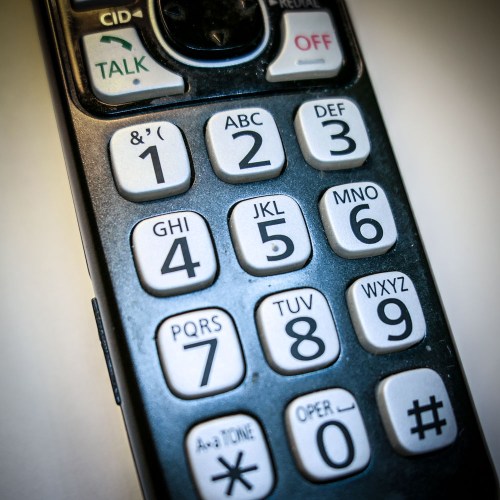
Customer service call centers are dominated by automated voice response systems, voice recognition, computer-generated voices, and growing AI capabilities. These non-human IVR interfaces are the first line of defense before you can talk with a human being. It’s been that way for years.

And granted, more sophisticated technologies have vastly improved the user experience these days. But it’s still not the same as talking to a real person. Not even close.

So why do voice recordings and computer generated voices pretend like they’re actual people? Do the human designers feel like their cyber creations are somehow totally pulling it off?

Open the Pod Bay Doors, HAL
When I hear the computer “typing” in the background… now that’s just silly.

“Please give me a moment while I submit this.”
Really?
(That’s what the computer lady said when I called the New York Times to set up a vacation suspension before we travelled to Massachusetts to see family over the holidays.)

Is there some laptop computer running down the hallway to get my order into the in-box ahead of a hulking iMac that can’t turn the corner quite as fast?
(That would be fun to watch.)

Seriously, though…
Is there a pause in our ‘conversation,’ because the technology requires the delay?
Or is the delay inserted there just to make me feel more comfortable?
(Because an actual person wouldn’t be able to move any faster)

In a future world ruled by AI, I certainly hope sentient computers aren’t going make us wait around for answers, because they think we’ll like it better that way.

Or maybe they will… just to annoy us.
Because we all know they’ll be able to figure out any question instantaneously.
(Including the fate of humanity… but that’s another conversation.)

Can We Speed it Up, Please?
Look, I certainly understand that the goal is to make this kind of tech feel more approachable to today’s human population.

When I hear a computer’s interactive voice like Amazon’s Alexa, Google Home or Apple’s Siri, and these smart assistants are sounding so real… that’s already amazing, right?

When the day comes where I can’t tell the difference between a computer and a person’s voice on the phone, it’s going to be pretty wild. And that’s a whole other conversation.

If that computer voice wants to throw in some extraneous sounds to lock in the whole reality, I say go for it!

But until then, please don’t do silly things to try to appear human.
That’s what humans do.

Please just be a computer and get the job done better and faster than a person can.
That’s how you’re going to make people happy.

Wait… what?

Innovation, Disruption and the Enduring Value of an Old Tea Kettle

The use of an outdated kitchen tool can be an allegory for happiness in today’s technology-charged culture. My story illustrates why…

Nobody uses stovetop tea kettles anymore.
(You heard it here first.)

I first got a clue when I went shopping for a new kettle a few months back and realized there were only a few models on the market. And the ones I found were poorly designed, making it difficult to touch the handle without burning your fingers. But I figured my particular experience might be an anomaly.
(It was, after all right after the holidays.)

But then something else happened….

A Cup of Hot Tea
Last weekend, my family and I visited my mother-in-law, and she asked if I wanted a cup of tea. Of course, I accepted her offer.

My mother-in-law grew up in Ireland. Serving hot tea is a tradition that goes back generations. And when I say hot tea, I don’t mean like when Star Trek’s Captain Jean Luc Picard says “Tea. Earl Grey… hot!”

I mean HOT!

You’ve got to boil that water! As Mel Brooks might say, it’s not hot…
It’s ludicrous hot!
And then maybe…maybe you can make a decent cup of tea.

And her process of picking up the screaming kettle from the stove and safely transferring its raging contents into her dainty tea pot was always an impeccable skill I rather marveled at. I’d actually grown accustomed to it over the years, and this time I wasn’t paying close attention to her boiling-of-the-water dance.

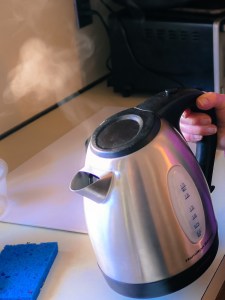
And when I looked up, I saw her holding an electric kettle.


Electric?! Whoa!!

“What happened to your old kettle?” I asked?

“I bought this one. It’s so much easier to use,” she explained.

“But you’ve been using the other kettle for so many years.”

“This one is better.”

And that was it.
Huh.

Go Electric
It felt like I had just witnessed a sea change for the entire tea kettle industry.

It’s not like electric tea kettles haven’t been around. But I felt they mostly existed for times when you couldn’t use a traditional model.
(And why would you want to take up additional real estate on your kitchen counter?)

Heating up water on a fire… that’s the way our ancestors did it thousands of years ago! How can you improve on primordial perfection?

My Mother-In-Law Understands Innovation
Sure, I’ve seen electric kettles in different houses over the years, but they’ve always had that cool ‘gadget vibe.’ Press a button and BAM you’ve got hot water at the perfect temperature every time.
(It was a fad. It would pass…)

But now… I’d witnessed someone who had grown up and spent decades with the mighty tradition of fire-powered hot water casually cross over to the dark side of tea kettles and go electric.

She easily abandoned this ancient tradition…
Because she found something… easier to use.

Uh huh.

If you’ve got stock in stovetop kettle manufacturers, I advise you to sell it all… right now!

The Sanctuary of Consistency
Look, I know this story about my mother in law isn’t quite as dramatic as I’m portraying. In fact, you might simply say that it’s an obvious example of taking advantage of a not-so-new innovation. If my mother-in-law can easily understand this, but I’m somehow stuck, maybe I should think about changing my blog’s title to ‘At Home with Luddites.’

But hold on for a moment… stick with me.
(I’m not only talking about tea kettles…)

With technology changing the patterns of our lives in so many ways these days, it’s easy to accept disruption as the norm.

Perhaps we’re becoming desensitized to the overall experience of ongoing disruption.

Why am I so bothered by my mother-in-law finally updating her own kettle? I think it’s simply that I cherished the experience of her consistent process. I didn’t know how much I valued it until it changed.

I’ll still get my cup of scalding tea, but I’ll now miss the original ritual, which was admittedly more work for her.

The Big Picture
Technology exists to ‘improve.’ But we often don’t think twice about the related changes that are invariably part of the evolution.

And are these disruptions always a good thing? If so, for who?

Well, if you’re not thinking about it…if you’re just going along with the latest and greatest innovation… then that’s a problem.

Now don’t get me wrong… Change is good. Innovation is great. Just make sure you know why.
You’ve got to pay attention!

Protecting the Tea Kettles in Your Life
Many folks clearly don’t need stovetop tea kettles anymore. But apparently I do. Or at least I value the connected experience to these obsolete clunkers. That’s worth acknowledging.

I’m sure you have something in your life that represents your own ‘tea kettle.’ Don’t be so quick to let go. Make sure you really understand what it means to you before it’s gone and replaced with something ‘better.’

Upgrade Now?
My mother in law is at home with her tech.
Good for her.

Electric tea kettles are superior and are rapidly causing the extinction of their stovetop cousins.
Probably.

Thinking about how technology is changing your life and whether it’s always for the good…
Essential.

That’s being at home with tech.
Otherwise, you’ll eventually become a stranger in someone else’s cozy vison of a better life…