At Home with Tech

Unlock the power of all your technology and learn how to master your photography, computers and smartphone.

Category: Technology

What To Do When Adobe Lightroom 6 Randomly Crashes

When your tenuous photo management process hits a wall, because your software gets glitchy, sometimes an obvious solution actually works. Let’s begin…

I’ll be honest… digital photo management has been a challenge for me since my 7-year-old son was born. I’m the kind of parent who takes way too many family photos and then struggles to organize them, quickly share the best ones and eventually create photo books.
(Sound familiar?)

But I’m trying.

The truth is you’ve just got to put in the time, have an organized plan, and use photo management software that’s right for you.

I switched to Adobe Photoshop Lightroom 6 from Apple’s Aperture a couple years back after Apple retired Aperture and launched the Photos app.

I wanted software that was more powerful than Photos, and Lightroom has indeed proven itself to be a rock star.

At the time, I made the choice to buy a standalone Lightroom 6 license for $149, instead of Lightroom CC, which requires you to pay into a $10/month Adobe Creative Cloud ecosystem.

I figured my one-time DVD purchase would be more economical than the pay-as-you-go model, as long as I used Lightroom for more than 15 months. That was the plan, and I’ve already passed the two year mark. So, yay Barrett.

But I know it’s just a matter of time until I’ll be joining Adobe’s Creative Cloud. It will eventually become unavoidable. For now though, I’ve been enjoying my Lightroom 6.

Until something went very wrong…

Random Crash Alert!
A few weeks back, my Lightroom began randomly crashing. It happened mostly when I wasn’t actually working with it. Lightroom would be open in the background, and then ‘pop,’ it would suddenly disappear. My iMac rushed to create a report to send to both Apple and Adobe, but I didn’t expect any engineers to be calling anytime soon.

I ignored the problem for a while. (Silly me.) But then, it began happening when I was actively using the program. And finally, it crashed while I was importing photos.

So, it was clearly time to do some troubleshooting…

The only recent change to my iMac’s ecosystem was an update to my iMac’s OS High Sierra. (And you know, that seemed to be about the time my troubles began.)

I did some Googling and ran across an insanely obvious question…
Was I running the most up-to-date version of Lightroom 6?

Uhhh…
What?

Huh.

Well, actually… No.
I hadn’t been receiving any notices about updates.
(I’m so used to Apple’s incessant reminders to update my software.)

So, no… I haven’t (ever) updated Lightroom 6.
(Maybe I did right after I installed it.)

Please don’t expel me from the Island of Misfit Toys.

All right…. So guess what I decided to do?

How to Update Adobe Lightroom
If you too are trying to figure this out, you’ll find your Lightroom software updates in the Adobe Application Manager program.
And here’s how to get there…

Go to the ‘Help’ drop down and click on ‘Updates…’
The Adobe Application Manager will open, and this is what you will see…
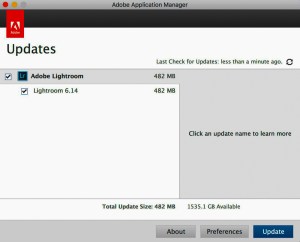


If you’ve got an update waiting, it’s time to take the blue pill.
From here, it’s straight forward!

Always Backup First
Updating Lightroom is a painless process, although it’s always good to do a backup before you update any important software.

For me, I simply ran Time Machine on my external G-Drive. And I also saved a backup Lightroom catalog file to the G-Drive.
(The catalog houses all the work you do to your photos.)

And guess what? Now that I’m running Lightroom 6.14… everything is…
Just… fine… again.

Yup.
Updating Lightroom did the trick.

Software Conundrum
I know my report ultimately falls under the category of “DUH!”

But can you tell me you’ve never dragged your feet on doing software updates, because you feared unexpected glitches and compatibility issues?

Well, if you wait long enough and do nothing, that’s clearly a problem too.
(And I’m not even talking about security patches.)

Choose your poison.

Lightroom stability: Restored!

#LovingMyDigitalLife

Take these 6 Steps to Protect Your Tech from the Next Snowstorm

You can’t capture cool pictures of winter if your camera battery isn’t charged up. But if the power goes out, that may be the least of your tech problems…

A looming winter nor’easter will create plenty of heartache that you can’t control. Fortunately, you can usually take action to protect your precious tech. Just think about how unstable power caused by these windy snowstorms will affect your gear.

Here’s my checklist of 6 ways to prevent ‘techtastrophy’ before your lights start to flicker and after the power goes out…

#1
Avoid Direct Connections to Wall Outlets
First off, just don’t plug your electronics directly into the wall. If you expect the power might fluctuate, that can also include a power surge. Why take the chance of frying your gear? You should always plug your power supplies and chargers for your delicate tech (smartphones, laptops) into surge protector power strips.
(Remember, they’re not just designed to give you more outlets.)

If you happen to have a whole-house surge protection system, then good for you. Otherwise, invest in a few power strips with some surge protection.

#2
Get a UPS for Your Computer
A power strip isn’t going to cut it if you’re using a desktop computer that requires a constant flow of electricity. Any irregular (dirty) power is bad, but when a blackout hits, you don’t want to be working at your computer and unprepared. So, you’ll need a more advanced solution…

Your desktop should always be plugged into an uninterruptable power supply. A ‘UPS’ is essentially a battery backup unit with surge protection and automatic voltage regulation. So, during bad weather, you can type away in relative peace.

I bought a great UPS for my iMac.
It’s made by CyberPower (model CP 1350PFCLCD) and goes for
$189.95 on Amazon.

#3
Turn Off Your Desktop During Stormy Overnights
Even with a UPS in place, I’d still recommend you turn off your desktop overnight during a big storm instead of just putting your computer into sleep mode.
(Why take any chances?)

#4
Activate Your Portable Power Generator
A battery-powered UPS can only handle your computer for a short while… enough time to finish up what you’re doing and then safely shut down. If you need a more powerful solution, then you’ll have to invest in a portable power generator for your house that can run for hours or days (depending on your fuel reserves).

I own a Generac LP5500 liquid propane portable generator.
No, I don’t have it just to power my iMac. I bought it to keep the actual essentials at home going during a blackout… like our heating system.
But you get the idea…

#5
Juice the Backup for Your Smartphone
If you don’t have any beefy power creation solutions in place, then at least invest twenty bucks on a pocket-sized battery power bank. It will give your smartphone an extra charge or two while the rest of your home waits in the dark.

I carry around the Anker Astro E1 Portable Charger.
($19.99 on Amazon)

But a little power stick can’t come to your rescue if it’s not charged! So, make sure it’s juiced up before the snow hits.
(And it wouldn’t hurt to top off your smartphone either)

#6
Keep Your Smartphone Warm
Your particular smartphone model might be water resistant, but its battery is still sensitive to winter. It will drain down faster when exposed to frigid temperatures.
(And that’s why you shouldn’t keep your AA batteries in the refrigerator)

So, if you’re out and about after a storm, try to keep your smartphone as warm as possible. Otherwise, you may find it suddenly needs a recharge.
(Then, please see tip #5!)

Power Up!
Sure, it’s hard to function in the dark. But it’s easier if your critical tech isn’t down for the count. Here’s hoping you successfully weather the next ‘Snowmageddon’ along with your gear!

How to Tell Your Story with a Photo Playlist

Music playlists are everywhere. But what about photo playlists? Not sure what I’m talking about? Great! This is really how you can put your digital photos to work. And it involves using digital photo frames…

I’m a fan of digital photo frames for how they unlock the countless pictures you’d otherwise not be sharing with your family and friends. Sure, you can post your pics to Facebook, Twitter, Instagram and online family photo folders, but those are one-offs, individual images that describe a moment in your life. And you’ve got to hope that nobody misses any of your photos as they fly through their social feeds.

That’s not at all the same as a larger grouping of photos you can control on a digital photo frame that you’ve given out. These always-available images rotate through to tell a larger and every-changing story about your family and its ongoing adventures.

And if you think that digital photo frames are a pain to update, you’re behind the times. Many models can pull their pics from the cloud via WiFi, and you can update your displayed images anytime from any location in the world.

The Photo Playlist of Your Life
But I think the opportunity to maintain an ever-changing photographic ‘playlist’ is the big “aha moment” that lots of folks still haven’t discovered. Do you want to rotate through photos from your past vacation? Maybe your last few weeks of weekend fun? How about some family archival photos? It’s all as easy as a few clicks away…

Whatever the topic, photo playlists give you the opportunity to display a much richer story.

Everyone makes photo books, right? But these books often just sit on a shelf. Why not use those same images to add to your life’s photo playlist that’s always rotating through on a digital photo frame?
(If you’re twitching about the idea of ‘always,’ don’t worry… These frames have sleep modes.)

Loving Nixplay’s Dynamic Playlist Feature
I’ve been using Nixplay digital photo frames for the past few years. Originally, I uploaded my pics to Nixplay’s cloud and then synced the photos to my frames from there. Truthfully, it was a bit cumbersome. So, when Nixplay began linking to cloud services like Instagram, Flickr and Dropbox, that was the upgrade that made moving my photo files to my Nixplay frames almost effortless.

Here’s why…

I simply created a Dropbox photo folder on my iMac’s desktop. I linked that folder to my Nixplay online account and digital frame. Then, I simply drop my photo files into the folder to add to the frame’s playlist.

Just as importantly, I regularly delete older photos in the folder to keep the frame’s content fresh. This is how I maintain my “dynamic playlist.”
(You can have as many playlists or dynamic playlists as you want.)

I know I’ve said this before, but you absolutely don’t want to keep older pictures hanging around when you’ve got fresh content to share. There will be exceptions, but I find this rule generally holds.

How Illuminating is Skylight?
If you’re in the market to pick up one of these visual portals to your recent past, congratulations! Is Nixplay the only choice out there? Not at all…

In fact, a friend asked me the other day about digital photo frames made by Skylight. I did some research, and here’s what I found…

Skylight’s big trick is you can upload photos its frames it via email. No cloud storage. And no extra steps to slow you down. Operationally, viewers manage all of the photos locally on the frame and delete them when they want.

That may sound easy, but consider this… If you give out Skylight frames to relatives, you can’t manage the photo playlist from your own computer once you email the pics out.

For me, that’s a deal breaker.
(I need more control.)

That said, Skylight’s one really cool feature is its touch screen. Your viewers can swipe through your photos and ‘heart’ them much like they would on a smartphone.
(And you get an email informing you of the ‘heart’)

The Skylight frame even displays a “New Photos Have Arrived” button. That can be especially useful to give your viewers a heads-up.

The only model is the Skylight 10″ Plus frame, and it costs $159.00, which is in line with the competition.

I appreciate that Skylight originated from a Kickstarter campaign through the Harvard Innovation Lab, but the design doesn’t give me the kind of control I’m looking for to maintain my playlists.

So, I recommend you check out Nixplay…

Sticking with Nixplay
My ongoing relationship with my Nixplay frames hasn’t exactly been perfect. I’ve occasionally had delayed syncing problems, but Nixplay has ultimately come through for me.

  • Again, I really love Nixplay’s dynamic playlist feature through Dropbox. Nixplay also gives you 10 GB of free online storage. (You can pay for more.)
  • And the Nixplay ecosystem keeps getting better. Now there’s a mobile app, which give you on-the-go control of your frames. Plus, you can snap a photo with your smartphone and almost instantly add it to your photo frames. (Sorry, Skylight.)

There are a variety of Nixplay digital photo frames and sizes to choose from:

Nixplay Seeds are WiFi-only frames, which is just fine with me. But if you also want the old-school ability to upload pictures via SD cards, there’s the Nixplay Edge model.

Use this Visual Storytelling Strategy
I’ve talked previously about ways to maintain your public brand online.

But you also have a personal brand to feed that’s uniquely positioned for your family and friends.

And with distance often challenging the continuity of extended family units, displaying your photo playlists on WiFi digital photo frames is a wonderful way to communicate your family’s ongoing story.

#ShareYourPhotosNow