At Home with Tech

Unlock the power of all your technology and learn how to master your photography, computers and smartphone.

Category: Technology

Cancel your Deal with Zoom’s Virtual Background Devil

Fabricating the illusion of a faux background for your Zoom calls may seem like a good idea, until you realize what you’re giving up. Here’s why it may be a bad deal.

I once believed the goal for Zoom backgrounds was to try to mimic a uniform environment, like walking into an average conference room. Or even better… attempt to mimic that clean, all-white background that Apple is famous for.

That would be so much better than revealing the cluttered background of my home office.

The Lure of Using Fake Zoom Backgrounds
So, I bought white and green pop-up screens and tried squeezing them into the space behind my desk.

But most of us don’t live in an empty 30’x30’ TV studio where this type of staging is easier to pull off.

I eventually succumbed to the reality that using a big enough green screen to pull off a full-shot chroma key during my iMac’s Zooms rendered my home office unusable. There just wasn’t enough space!

The only reasonable choice was to use the standard Zoom keying option that doesn’t take advantage of a green-screen background. And though it’s pretty amazing that Zoom can pull a key at all without using a green screen, the trick just doesn’t work as well.

As a result, you can almost always tell when someone is using a virtual background on Zoom. You can see that eerie black glow around someone’s head. And there’s that sudden, momentary disappearance of a hand. You’re not really fooling anyone when using a digital background. By now, I think we’ve all gotten used to that fake Zoom look.

Some of us even flaunt it when they place nature shots or outer space behind them. Yes, it’s a neat trick… once or twice, but eventually you need to come back to earth. I think you should have an image behind you that doesn’t make you look like you’re in a video game.

In Search of the Almost Real
I experimented with using photos of other rooms in my house as my Zoom background in the attempt to maintain some sense of visual authenticity that’s true to my real environment. I eventually landed on a reasonable shot of my living room.

Yes, you could still tell I was using a virtual background, but at least I wasn’t hanging out in someone else’s home!

Offer More of Your True World
While using a photo of my living room did meet my bar for authenticity, I still felt restricted Zooming in a virtual space. Ultimately, I just wasn’t comfortable. The tradeoff wasn’t worth it.

So I cleaned up the clutter of my home office the best I could and turned off my virtual background.

Yes, I went cold turkey on virtual backgrounds. And you know what? It’s felt so much better. The shot represents more of my true life, warts and all.

So here’s a radical suggestion:

  • Even if you believe your space is a disaster and unfit for your video conference viewers, if you do some preproduction staging, I think you can create a look that you’ll be comfortable with.

Unless you’re stuck Zooming in your bathroom, there’s probably a corner in your home that you can make work. Yes, any number of disturbances from your life may be only a few feet away. And we all want to minimize visual and audio interference that may prevent us from communicating clearly.

That’s different than trying to hide from your own environment.

By now, everyone expects visual imperfections on Zooms. The opportunity is to turn your world’s imperfections into an authentic experience. And that can ultimately be such a refreshing change up for your viewers.

Maximize your Reality Instead of Fabricating an Illusion
Showing it like it is means you’re sharing a more personal experience. And I think your Zoom viewers will really appreciate that.

Unclick the virtual box and stop the illusion. You don’t have to hide anymore.

It feels wonderful.

Why my Magic Hour is my Super Power

This is the story of my favorite time of day and how this found hour became my most productive.

I was born a night owl. And I spent much of my life using late-night hours productively. It felt natural, like I was hard-wired to do that. Mornings, on the other hand, were my kryptonite. And I struggled through them as I ramped up into my day.

Then, about fifteen years ago, I needed to get up earlier as part of a new schedule. The shift was painful. But over time, my body began to adjust. And once I recognized the need to also go to bed earlier to make up for the lost sleep, I began to find a new balance for my daily rhythms.

When I no longer needed to get up at the crack of dawn, I didn’t immediately return to my former schedule. And I found the extra hour to ninety minutes in my mornings.

The Power of my Magic Hour
I explored this time and discovered an amazing benefit. While I thought it would be a period of brain sluggishness, in fact it was the opposite. I was entirely clear headed.

I was sharp and unburdened by all of the clutter that tended to fill up my head throughout the day. You could call it a sense of clarity. I began to call it my magic hour.

It was a time where my creative self was most fully present. And my cognitive productivity levels went through the roof.

Sure, part of that equation was the fact that I had no outside disturbances. (Nobody else was awake yet.) But it was more than that. I had discovered the zone when my brain worked best.

People ask me when I find the time to write this blog. Yep, it’s during my magic hour that begins at 5:30am.

My magic hour became my super power.

Discover and Protect
When our son was born, my magic hour was challenged by a new family schedule. And after things settled a bit, son of Barrett proved himself to be a natural morning person. That also threatened to infringe on my magic hour. But I was able to adjust it back a bit to maintain its integrity.

I think everyone values having enough ‘me’ time. It doesn’t necessarily have to happen before the sun rises. It can be when the clock strikes midnight or when you’re in the middle of a solo activity like commuting.

Everyone should know the best hour when they can be fully in their own head. And then, you’ve got to make the time for that!

The Need for Me-Bubbles
But life during this pandemic is, of course, quite different. Much of our ‘me’ time has evaporated due to the physical compression caused by family units feeling forced to spend as much time at home as possible.

I think a reaction to that is the desire to create virtual ‘me-bubbles,’ and of course, technology can help generate them.

That said, these me-bubbles can’t interfere with others who may be only feet away. So that means using headphones more and not blaring your whole-house speaker system.

Technology can also strengthen certain me-bubbles that you may not want to promote.
(I don’t have to tell you parents about the current pressure for more iPad screen time. It’s a force from your kids that can require the Force to properly keep in check.)

Don’t Become a Bubble Stranger
Yes, creating and protecting quality me time is important. That said, maintaining the right balance at home needs to be part of the equation. You don’t want to inadvertently birth a family of bubble strangers through technology.

To summarize:

  • Magic Hour = Good
  • Brain Clutter = Bad
  • Me Time = Good
  • Bubble Strangers = Bad

Retraining your body for a new sleep schedule = actual results may vary.

Good luck!

6 Ways to Protect your Data and Tech at Home

If you’re looking to beef up the reliability of your digital resources, here’s a list of the gear behind my tech.

With so many daily norms shattered as a result of COVID-19, I’ve discovered the act of online holiday shopping to be a comforting activity. Of course, it’s no less frustrating trying to find the actual deals. But that’s always been a part of the challenge, right?

Right now though, what’s most important to me isn’t what shiny new tech to buy. It’s how to make sure the gear I own continues to work properly. And that’s often about the tech behind the tech.

I thought it could be helpful to share some detail on the support gear that helps to keep my tech going every day. This list isn’t about the coolest hardware. It’s simply about what helps maintain order with my tech at home as well as a sense of stability for my (digital) existence. 

It all about protection and reliability.

1. Backup Drive for your Computer

Cloud storage should now be a major player in your backup plan, but having dependable external drives is still a good strategy. I’m a big fan of G-Technology Drives (owned by Western Digital).

The G-Technology 4TB G-Drive USB 3.0 goes for $129.95 on Amazon.

It’s what I use for my iMac’s Time Machine backups.

2. Portable Backup Drive

Yes, I’m sticking with G-Technology for the portable choice. My go-to drive is the G-Drive Mobile USB-C.

The 4 TB version costs $139 on Amazon.

3. Wireless Mesh Router

If you’re like me, your home WiFi is now tasked with supporting multiple family members throughout the day…and in every corner of your home. To help make sure that your WiFi reaches your entire family perimeter, you need a mesh WiFi system in place.

When I replaced my old Apple AirPort Extreme WiFi router, I went with the two-unit RBK50 mesh WiFi system made by Netgear Orbi. Next to my Sonos speaker in the photo above, it costs $295.19 on Amazon.

4. Smartphone Case

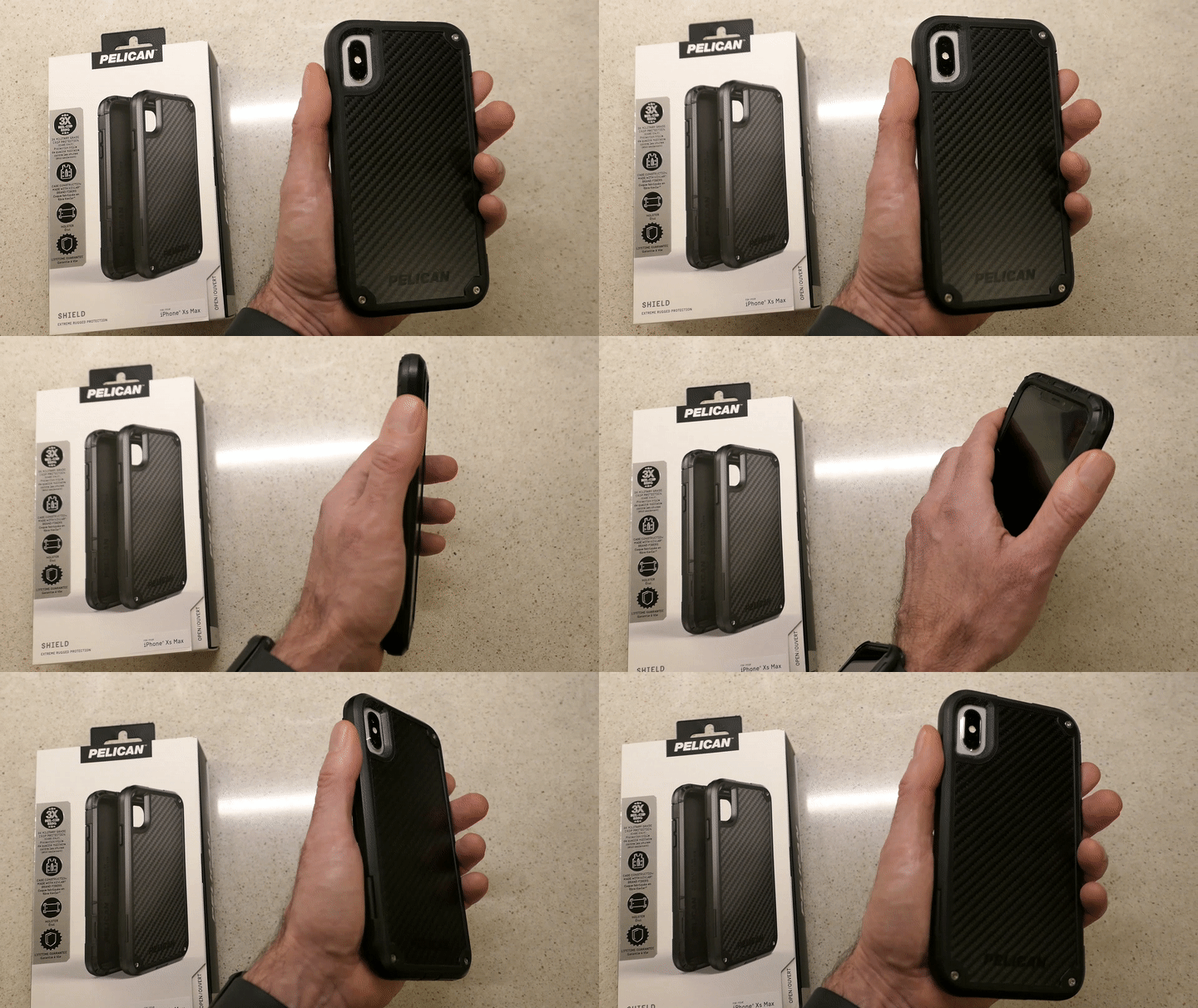
Holding Pelican Shield Case for iPhone XS Max

You really don’t want to deal with a cracked smartphone screen if you can avoid it. I’ve always felt that a solid case is critical to maintaining your smartphone’s structural integrity. 

I’m partial to Pelican cases. The company is best known for its equipment cases that protect gear worth many thousands of dollars. Its smartphone cases are also tough, and the “Shield” model looks like it comes from the alternate universe in the TV series, “Fringe.” 

5. Portable Power Bank for your Smartphone or iPad

You know what happens when one of your portable screens runs out of juice, and a power outlet is nowhere to be found. A little portable power can really save your day.

RAVPower 16,750mAh Power Bank USB External Battery Pack is
$27.99 on Amazon
(This model also comes with a built-in flashlight.)

6. Cloud Backup

I’ve been using Backblaze after CrashPlan broke up with me. So far, so good.

As I mentioned, cloud backup should always be a part of your data protection strategy.

Maintaining Comfort
As we enter this season that promotes comfort and joy, it’s always a useful reminder to have some boring supports in place for your important tech. I’m not sure that will specifically generate joy, but it certainly will maintain comfort.

That’s always on the top of my list.