At Home with Tech

Unlock the power of all your technology and learn how to master your photography, computers and smartphone.

How to Turn AirPods into a Wireless Microphone for iPhone Videos

Looking for better sound on your next iPhone video project using one of Apple’s Bluetooth earbuds? You’ll first need this workaround.

If you own a pair of AirPods or AirPods Pro, you may come up with the bright idea to use them as a wireless microphone when you record selfie videos on your iPhone. The problem is you can’t do that using the iPhone’s native camera app. Apple didn’t build its app to support Bluetooth microphones.
(Strange, but true.)

Perhaps the visual of wearing little white sticks in your ears while shooting selfie videos originally seemed silly to Apple’s designers. But the pandemic has changed countless norms over the past year.

So many of us have been living our lives recently glued to our computer screens wearing geeky headsets, bulky headphones or slick little earbuds. If you don’t have a Borg-like audio device attached to your face, you clearly haven’t been assimilated into our new norm of daily video communications.

I Can’t Hear You
Recently, I produced a video with a colleague who needed to record an on-camera introduction using his iPhone. I suggested that he use his AirPods as his microphone so he could easily step back into his shot, unhindered by cables.

As I coached him from afar using the Microsoft Teams app, everything sounded fine. But when I listened to his test recording file, the AirPods clearly weren’t capturing his voice track. The iPhone’s onboard microphone was doing the work instead.

Third-Party App to the Rescue
Of course, we weren’t the first ones to uncover this problem. After doing some online research, I discovered that a variety of people have been complaining about this incompatibility for years.

The good news is there are two popular workaround solutions. Both involve downloading a video recording app to your iPhone that does allow you to use a Bluetooth microphone, including AirPods and AirPods Pro.

Both of these apps are primarily designed to give you a massive increase in control over your iPhone’s camera settings for video shoots, but they also provide the additional Bluetooth audio support for AirPods or AirPods Pro.

Problem solved.

What’s That in your Ear?
Even before the pandemic, I saw so many folks running around the streets of New York City with little wireless earphones protruding from their heads. That laid the foundation for an acceptable new look in public. And that metamorphosis has now been truly cemented. (We’ve stared at each other over the past year on countless video conferences wearing any number of audio devices.)

It’s ironic that once upon a time, hiding your microphone while recording an on-camera video was considered a sign of professionalism. Now, most anything growing out of your ears is acceptable.

And if you want to put your AirPods to work for your next iPhone video recording, just don’t forget you’ll also need to spend a few bucks for a third-party app to secure the connection.

The Best Video Recording Setting for your Smartphone

There isn’t a one-size-fits-all solution on how to set up your iPhone’s video recording menu. But here’s a great default setting that should handle many of your needs.

If you’ve found yourself suddenly thrust into the spotlight of having to record occasional videos of yourself for work-related projects, you’re not alone.

So many of us have been relying on Zoom and other video conference platforms to stay in touch during the pandemic. Yes, these live virtual meetings are carrying much of the load for video communications, but not every moment can be live. Sometimes, you’ve got to prerecord your message and send it in for editing.

Your Smartphone’s Movie-Making Power
And while you can certainly record a video message using your computer (assuming your webcam is working), you should really consider using your smartphone, which can typically generate a much better image. Plus, you’ll probably have a lot more flexibility finding the right spot at home to shoot in.

Before you activate your inner Francis Ford Coppola, you need to choose your smartphone’s best setting for your video message.

Go with 4K Video at 30 FPS
4K video is usually best, because it’s the highest quality that smartphones can generate. (Plus, 4K will give your video editor some flexibility to reposition you in your shot if that’s needed. It’s possible that the final edit won’t be in 4K. So, your editor will be able to crop your shot without losing image quality.)

But I’d recommend recording 4K video at 30 frames per second instead of 60 fps.

Creating 4K video on an iPhone at 60 fps uses a newer video compression format that Apple has coined High Efficiency. It may be more efficient from a file size/image quality perspective, but the highly compressed codec is harder to edit. In fact, there’s potential for audio syncing problems and dropped video frames. What that means is some computers are more prone to creating editing errors due to the heavier technical lift of handling this video format.

So, unless you’re going for slow motion in the video edit or you’re shooting action footage, which benefits from a higher frame rate, you really don’t need 60 fps. (Plus, 60 fps takes up more storage.)

How to Find your iPhone’s Video Recording Menu
To confirm your video recording setting, tap on:

  • Settings
  • Camera
  • Record Video

And this is what you’ll see.

4K at 30 fps is the way to go!*

It’s Time for your Close Up
*Of course there are exceptions. 60 fps recording might be specifically required or 1080p HD video could be good enough for an existing 1080p edit. Plus, older iPhones can’t shoot 4K at 60 fps. (That trick started with iPhone 8 and iPhone X.)

But If you’re just recording video of yourself talking, and you don’t have other technical guidance, it’s hard to go wrong using the 4K 30 fps video setting.

Just don’t forget to keep your main light source in front of you, your smartphone horizontal and any visual distractions off to the side.

Good luck!

How to Use Microsoft Word as a Teleprompter for your Next Zoom

This easy reformatting trick in Microsoft Word will help you present better when reading your notes during your next Zoom meeting.

It’s always important to establish eye contact with your audience if you want to create a strong connection. The same is especially true when talking via Zoom and other video conferencing platforms. And the only way to do that is to stare directly at your little webcam. That can be difficult when you’re also trying to pay attention to all of those little boxes of faces on your screen.

There’s also the reality that many of us have had to Frankenstein together more advanced work stations at home with multiple monitors, creating even more eyeline complexities.

In short, a lot of people aren’t following the best practice of looking directly at their webcams these days. If you’re even close, I think most folks on the receiving end are relatively forgiving.

Now, I’m not saying that’s okay. I’m saying that’s what I’ve seen happening. And because it’s generally become acceptable to look slightly off camera while Zooming, there’s a huge opportunity to exploit in that little space between where you should look and where your eyes are likely focusing .

Create your own Teleprompter
If you’re presenting to your Zoom audience, and you’ve got notes or perhaps a full script to read, you should position them on your screen right under your webcam to reduce the effect that you’re reading. A physical page of notes taped under your webcam can work, but I’m not talking about an analog solution. Move that Microsoft Word window up. Keep it all digital.

The closer you can get your Word doc to your webcam the better. It’s like activating your own little teleprompter. The result will be remarkably close to the appearance that you’re effortlessly talking to your audience and not reading your script. And because your audience has been conditioned to seeing others look off screen, they likely won’t notice your visual trick.

Don’t Let your Eyes Ruin your Illusion
That said, they will see you reading your notes if your Word window is still at its normal width. Your eyes will clearly be moving left to right and from line to line. (Then, the jig will be up!)

You need to make your Word window thinner… only 8-10 words across to correct the problem.

But then how are you supposed to see a complete line of your script if only part of it is now visible?

Here’s the fix:

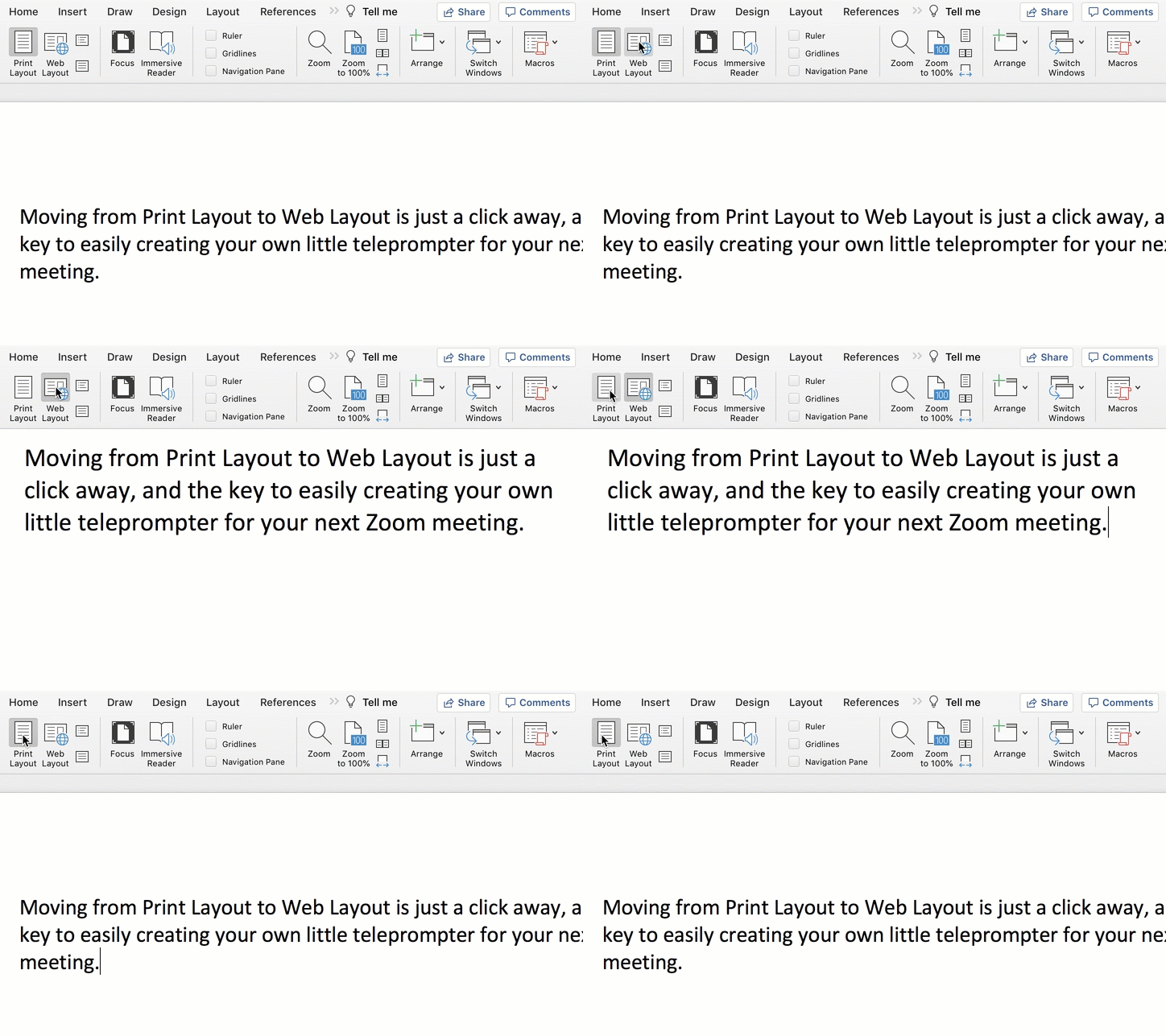
Use Web Layout
Change the view in Word from Print Layout to Web Layout.

Once you do that, you can shrink the width of your page, and the text will automatically wrap to fit your thinner Word window.

Then, all you need to do is scroll down the page using your mouse or trackpad as you’re reading.

Congratulations, you’ve effectively created your personal teleprompter!

How to Adjust the Default Settings
Here are the easy steps to make the change to your Word doc:


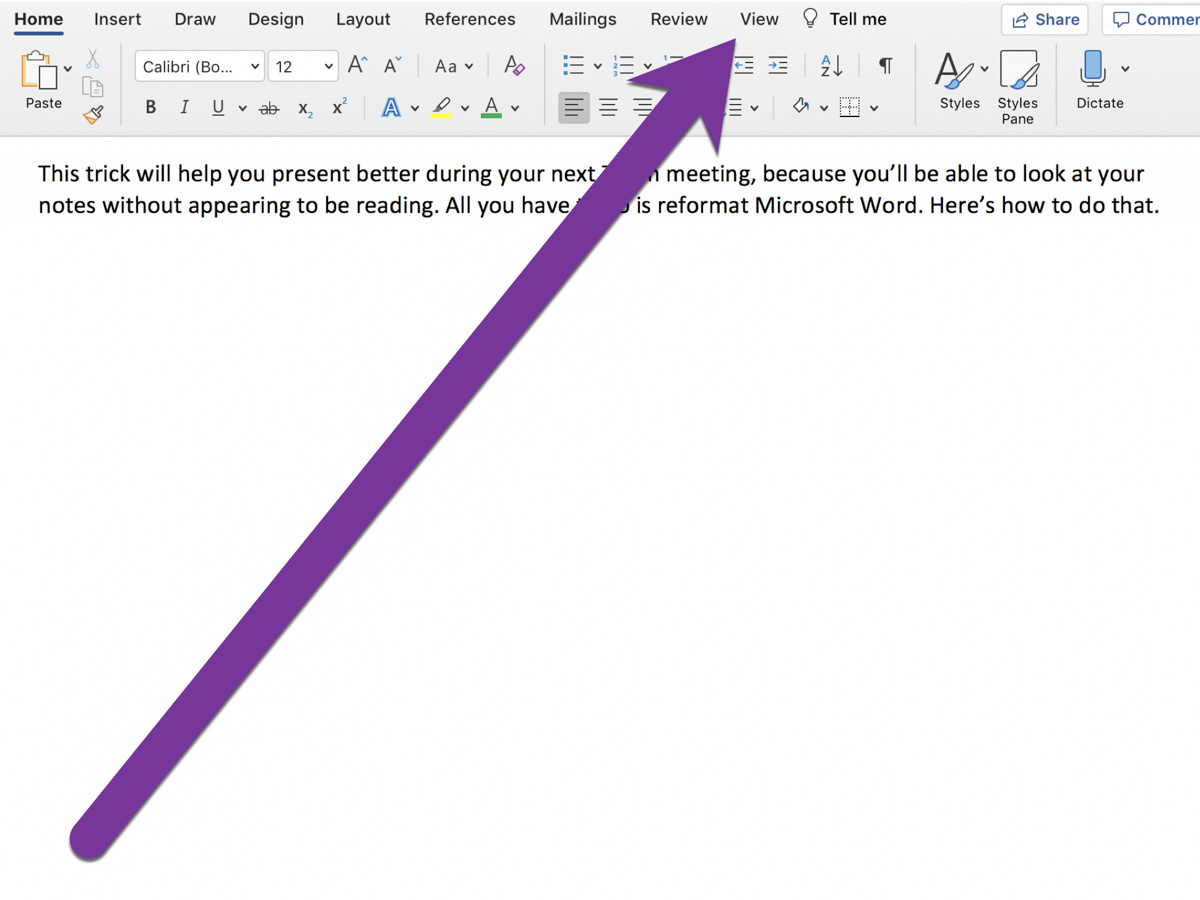
On Word’s top menu bar, click on View from the Home menu.


On the left, you’ll see Print Layout and Web Layout. Click Web Layout.


Then, click on Zoom to adjust the size of your text so you can easily read it.

That’s it!


Advanced Tip: Minimize the Ribbon
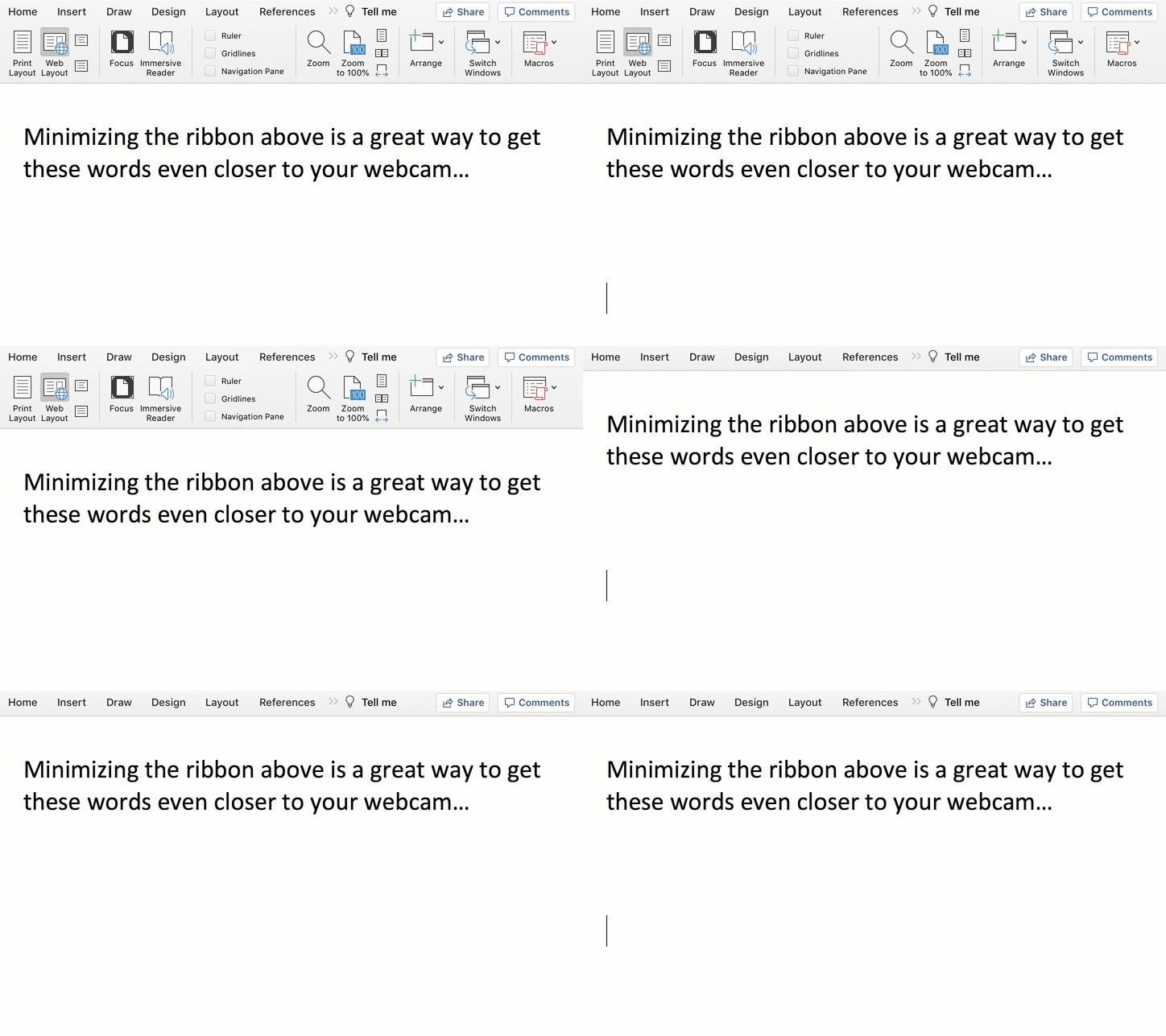
To get your notes even closer to your webcam, collapse Word’s top ribbon.

On a Mac, press Command + Option + R.
On a PC, press Control + F1.

Another Tool for your Virtual World
Living life on Zoom during these many pandemic months has been draining for all of us. Reformatting Microsoft Word to serve as your pseudo-teleprompter is one way to make your Zoom presentations a lot easier.