At Home with Tech

Unlock the power of all your technology and learn how to master your photography, computers and smartphone.

Tag: science fiction review

Why Silo is Still the Best Dystopian Future Series on Apple TV+

The drip/drip goodness of “Silo” is what has made this science fiction series so gripping. But the remaining coffee in season’s 2 has grown a bit cold. Here’s why I don’t think that matters.

Season 1 of “Silo” on Apple TV+ was riveting. The element of mystery headlined its success more than its science fiction or action genre. Based on Hugh Howey’s trilogy of novels, this series has moved slowly and shares the details of its crushing underground future for humanity with a timed precision that keeps you guessing what’s really going on in this dystopian society.

Underground Confusion
As the viewer, you’re almost as clueless as the population of 10,000 living underground, protected from a supposedly toxic and dead world up top.

The series stars Rebecca Ferguson as an engineer who tries to uncover the truth and Tim Robbins as one of the ‘elites’ who will do anything to maintain order for their fragile existence. Deception? Yes. Betrayal? Absolutely. (Just another day at the Silo offices.)

“Silo” also benefits from a great ensemble cast, a few of whom (spoiler alert) I wouldn’t get too attached to.

This Apple TV+ series’ first season was filled with surprising twists up until the very last shot of the final scene.

Season 2
As I write this, I’m seven episodes through season 2’s ten. Beyond the first episode where the mind-blowing payoff happens after last season’s cliffhanger, the series settles into more expected patterns of a story about controlling a mini society with limited resources. Now that the map of this reality’s facts is much clearer, the story of rebellion and the search for the truth has been somewhat less interesting.

Yes, there’s a new mysterious character played by Steve Zahn. And we’ve still got a few lingering questions plus a couple new ones, but they all hardly seem as significant as the ones already answered. (I could be wrong.)

The Truth is Out There
“Silo” has been strongest when it’s doled out its key details in small but meaty portions much like the groundbreaking “Lost” and “The X-Files” series. Though they’re all action shows, what make them special is their mystery.

Often the answers don’t live up to the hype surrounding the questions. That was certainly the case with “Lost” and “The X-Files.” Happily, “Silo” hasn’t suffered the same fate, ironically because it’s seemingly gone through many of its twists during its freshman season. And the uncomfortable answers have been entirely satisfying.

But now what?

Slow but Sure
It’s just been reported that “Silo” has been renewed for two more seasons with its fourth being its last.

So, we’re not even halfway through yet? Clearly, I’ve been unnecessarily impatient during this sophomore season. I imagine there must be more freaky goodness to come.

Still, that doesn’t change the fact that season two has been slower. Sure, there’s been plenty of action, but it feels like the middle episodes with split storylines have been biding their time.

But I’m not going anywhere.

What’s Around the Corner?
“Silo” is worth waiting for. Both Ferguson and Robbins are so great. And though the story would seem to be currently following a predictable path, I have a hunch that will change in the not-too-distant future.

I think I smell a fresh pot of coffee ready to be served up.
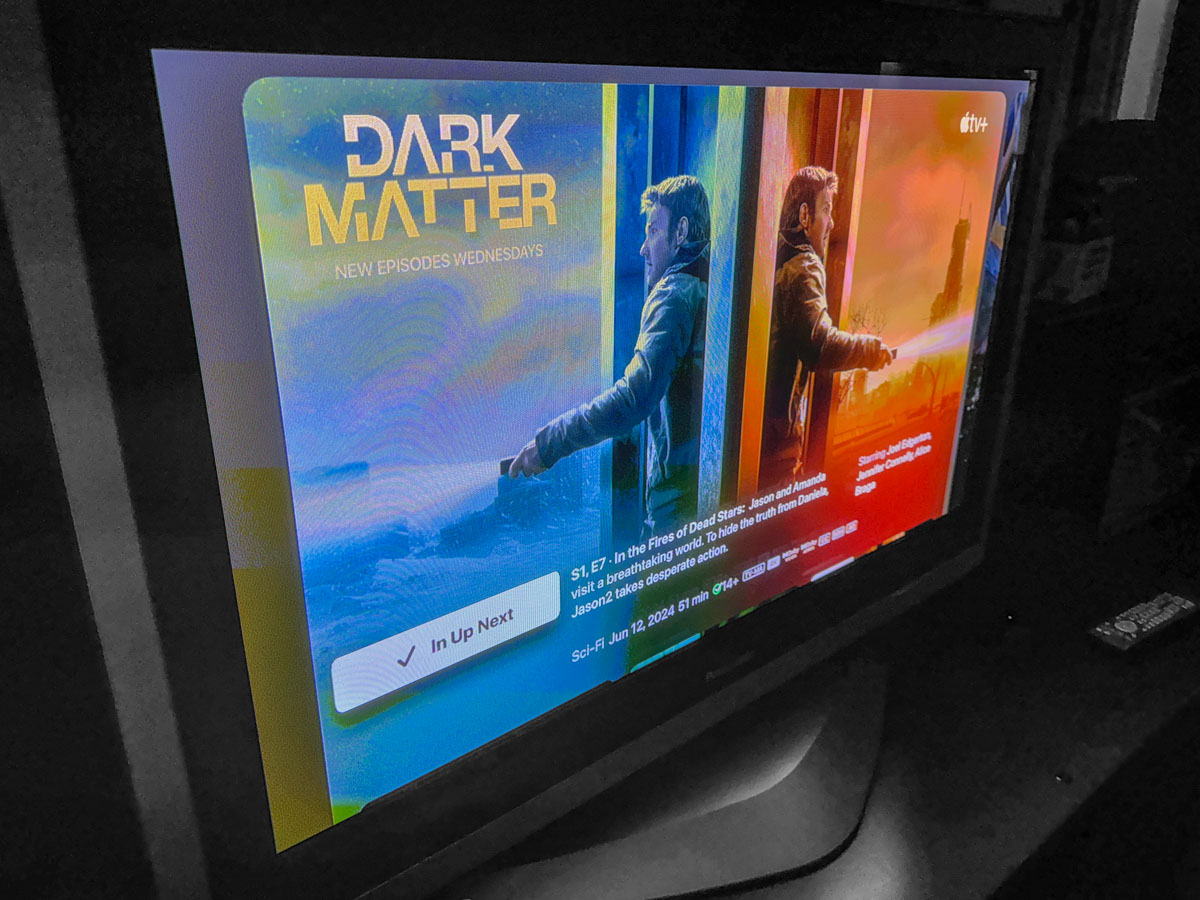
Why Dark Matter is the Best Multiverse Series on Apple TV+

You don’t have to go back in time to alter your life decisions. You can simply relocate to a better Earth. That’s the premise of “Dark Matter.”

The creatives behind the streaming shows from Apple TV+ are apparently obsessed with alternate universes, or as we like to say… the multiverse. No, multiversal travel isn’t exactly a new storytelling device. (The MCU has already brought it into our mainstream consciousness.) But Apple TV+ has really been leaning into it.

In series after series, Apple TV+ has been taking us down the multiverse rabbit hole.

“For All Mankind” lays out an alternate-reality timeline of the space program. When this series premiered in 2019 with its ‘shocking’ Moon-landing twist with no explanation, I was annoyed. There was absolutely no hint regarding the ‘why’ or ‘how’ of this alternate Earth. Today, I think we’re all finally trained to immediately accept that alternate universes need no explanation.

“Constellation” (2024) spends much of its time ‘suggesting’ that astronauts can slip between alternate realities, but the writers are intent on adding as much confusion to the equation as possible. Pro tip: You really need a note pad to help keep important details straight. The frustration helps to fuel the ongoing ‘mystery’ in the story.

And now, we’ve got “Dark Matter.”

In Search of a Better Reality
“Dark Matter” is designed to explore the road not taken in one’s life. I’m mid-season (6th of 9 episodes) as I write this, and the story surrounding a main character’s mid-life crisis demonstrates that the grass is not always greener. The dark reveal carries much of the storytelling focus. While the human factor is not science-fiction centered, the sci-fi enables everything.

Without giving too much of the plot away, the series stars Joel Edgerton who is a Chicago physics professor forcibly removed from his universe. He then tries to find his way home to his Earth and his wife played by Jennifer Connelly. And yes, you can easily guess who’s tried to replace him to fix a past mistake in his life choices.

But I’m more interested in how the writers are handling the superimposition ‘box’ that powers the travel between similar ‘adjacent’ universes. Once you’re in it, you experience an endless corridor of doors that you can open.

The mystery of where you go and why is more interesting that the pedestrian ‘thriller’ plot devices surrounding whether you can really “know” the person you’re married to.

Still, I like it all. It’s working nicely together.

Similarity to “Sliders?”
The sci-fi of traveling between universes in episodic television isn’t new.

The series “Sliders” (1995-2000) immediately comes to mind. Starring Jerry O’Connell, that show brought its main characters to a different, parallel Earth each week.

The premise was great, and the show had a lot of promise, but it devolved quickly after the writers seemed to stop trying, and the main actors began leaving the series.

How Many Earths Can You Handle?
I can’t imagine that the writers of “Dark Matter” aren’t aware of “Sliders.” But where “Sliders” got hokey, “Dark Matter” couldn’t be more serious. And this is a good thing.

That said, both series rely on coming up with new twists for each new world. “Sliders” ran out of good ideas. And I think “Dark Matter” could also begin to face alternate reality fatigue. Happily, the show seems to be narrowing its focus.

“Dark Matter” is Solid
Which is all to say that I’m pleased so far with “Dark Matter.” While it is character driven, the sci-fi implementation is also interesting.

That said, the series is not without certain gaps. (Why are there boxes in every Earth, even when it’s clear that no one built it?) Plus, we all know where the plot is inevitably leading.

Still, it’s fresh and well done. The first episode takes a little too much time to get its basics in place, but after that, “Dark Matter” easily passes the bingeable-watching litmus test.

“For All Mankind” has always dragged with too much family drama. “Constellation” relishes its own confusion a bit more than I’d prefer. “Dark Matter” strikes the right balance to create a compelling storyline.

I’m happy to report that “Dark Matter” is the best multiverse show streaming on Apple TV+.