
Why I Couldn’t Stop Watching the Final Hours of NASA’s Artemis II Mission
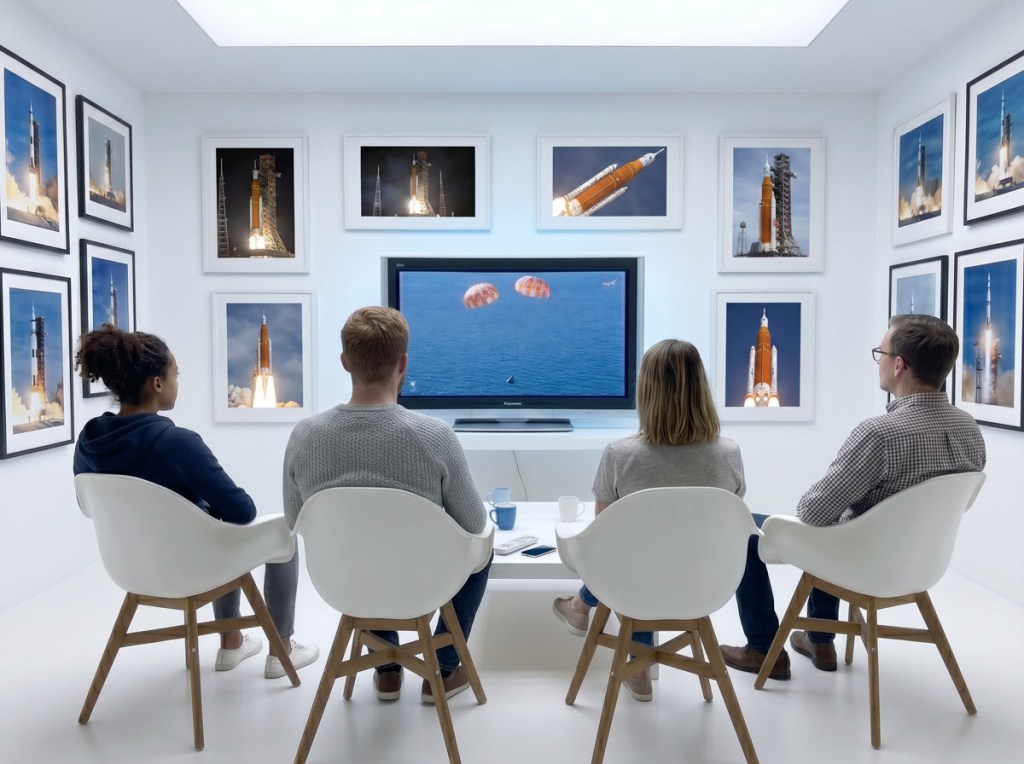
I spent Friday night glued to my TV watching NASA’s feed of Artemis II’s Orion capsule reentry and splashdown. I tuned in a half hour before Integrity reached the edge of Earth’s atmosphere and those six terrifying blackout minutes. Then, the multiple parachute deployments and splashdown! I stuck with the feed all the way till the two helicopters dropped off the four astronauts onto the flight deck of the retrieval ship.
My several-hour experience felt something like streaming a movie. As I got up from my couch and turned off my TV, I reflected on my Friday night flick.
One the one hand, it might be one of the more boring movies I’ve ever seen. There were long stretches where nothing really happened, and then the audio feed went entirely silent.
On the other, it was perhaps the most stunning and gripping event I’ve ever watched.
Because this was no movie. This was reality.
Houston, Will We Have a Problem?
This was real drama. A space capsule hurtling into the atmosphere at almost 25,000 mph. Will the heat shield hold? Will all the parachutes unfold? Sure, we heard optimistic audio commentary from mission control. But anyone could read the room and understand the clear risks.
Forget special effects… Did you see that real-time video shot from Integrity’s window as the scorching plasma ring began to envelop the ship. Whoa!
And that spotter plane’s unbelievable broadcast feed that followed Integrity plummeting downward from 100,000 feet with no net before the parachute phase began. Such a crazy, cool shot.
If I had walked into our family room at that moment, I would have certainly asked what sci-fi movie was playing and commented on how realistic the special effects looked.
Better than Any Movie
That’s so ironic, because our visual understanding of space travel for the past half century has been primarily informed by Hollywood. So, when I’m exposed to the real thing, it’s entirely jarring.
And let me tell you, reality can still run rings around Hollywood.
Sure, every shot may not be as ‘cinematic.’ Some of the imagery was shaky and blurry. It’s raw. It’s real. And then other shots locked in perfectly to blow you away.
That chopper shot that showed the first helicopter returning the astronauts… It was a silky-smooth tracking shot over the water at golden hour… better than any movie.
Then, there was the Navy ship’s robotic camera coverage that documented the helicopters touching down onto the ship’s deck… Yes, it was a little jerky, but also stunning.
Is This a Rerun?
You may feel like you’ve seen this all before, but you haven’t… not in real time. It’s one thing to watch a History Channel documentary on the space race. It’s entirely another experience not to know how the Artemis 2 mission ends.
And if you’ve only been peripherally paying attention to an admittedly not so compelling NASA program since the Space Shuttles, you might be blurring facts with fiction.
Don’t we already have a moonbase? No, that’s from “2001: A Space Odyssey.”
How about Mars? No. Except for some robot rovers and an unlikely little helicopter, all the imagery you might recall is from Hollywood.
Even if you’ve got your facts straight, you may not feel the realty. So, spending a little time watching reality offers an important reminder that space travel is difficult and dangerous… and the real deal is always remarkable.
Powerful Storytelling
Nobody has experienced a manned Moon mission since 1972 and Apollo 17. And the last act is always a doozy.
This little capsule-turned-into-a-fireball thing as it races through the atmosphere felt very “Project Hail Mary” to me.
I know NASA knows what it’s doing, and we’ve returned from the Moon before, but NASA has clearly evolved its storytelling game by simply sharing more of the visceral experience with viewers.
I think that has a lot to do with better camera tech. (More powerful lenses and advanced transmission technologies.) But it also demonstrates NASA’s commitment to better share its own story.
Class Dismissed… For Now
So, I watched each key moment as our Artemis II astronauts traveled from outer space to their big splashdown in the Pacific. And then I watched the Navy go to work. So impressive.
I cannot think of a better way to spend a Friday night. Sure, anyone can watch the 30-second recap the next morning. But it’s not the same. I got the full experience… the complete lesson on how it’s done.
(And I highly recommend it.)
I am inspired. I feel like a kid again.
Thank you, NASA. And congratulations.
 At Home with Tech