At Home with Tech

Unlock the power of all your technology and learn how to master your photography, computers and smartphone.

Tag: Star Trek

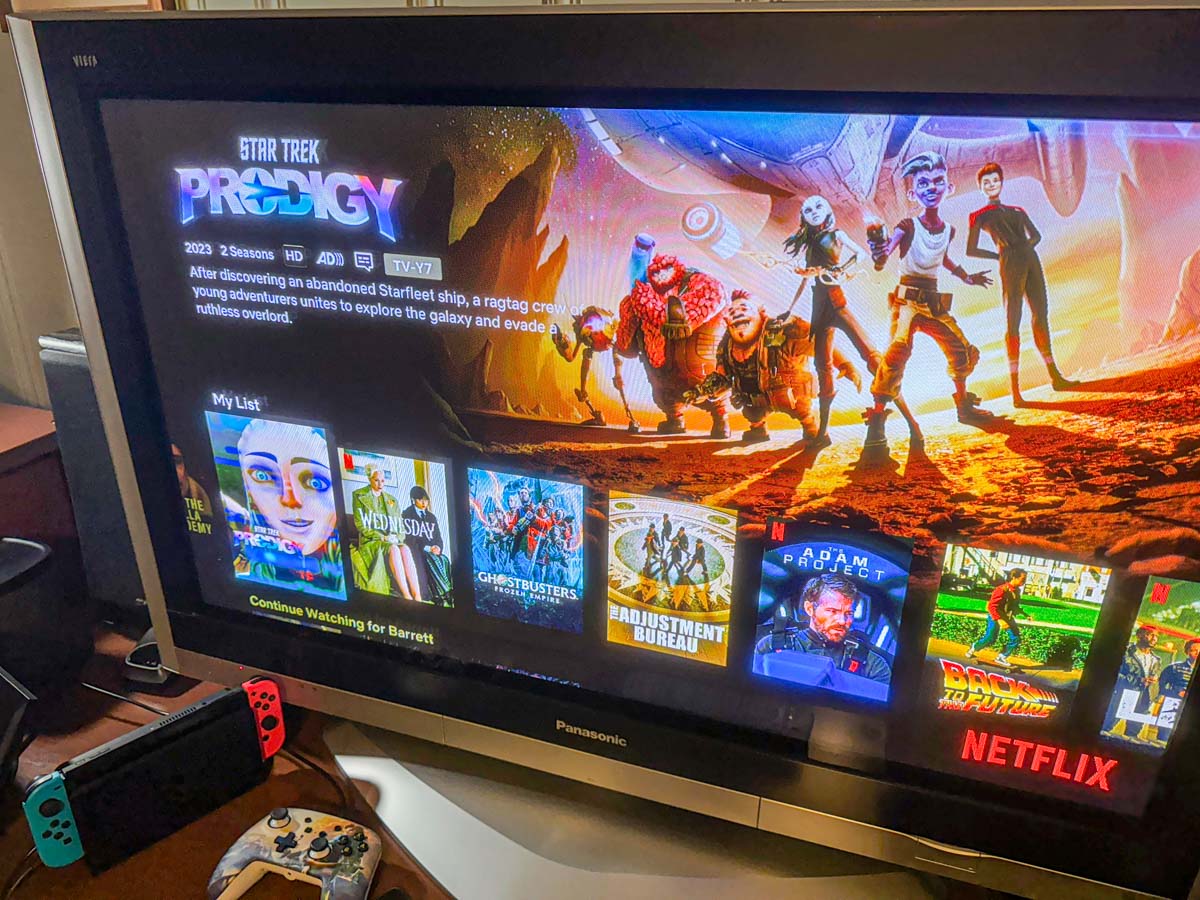
Don’t Tell Anyone I’m Watching Star Trek: Prodigy 

“Star Trek: Prodigy” is a kids’ show also made for adult Trekkies. Here’s why season 2 is so good.

It’s not logical. But they keep making animated versions of Star Trek. In yet another example, Netflix picked up the cancelled “Star Trek: Prodigy” from Paramount+ and has given us season 2.

Clearly intended for kids by Nickelodeon Animation and CBS’s Eye Animation, “Prodigy” focuses on a group of teens having the same types of Trek adventures usually reserved for the adults in the captain’s ready room.

Talk about watering down a classic science fiction property. Sounds insulting, right? But surprisingly, it’s not.

Star Trek: Prodigy
The writers are clearly Trekkies and have made full use of Federation history. They dig deep and bring back details and characters we all know and love… assuming you’ve been paying attention across these past decades.

The younger target audience couldn’t possibly catch all the easter eggs. Only the adults in the living room will appreciate all the Star Trek references.

And that’s why this series works so well for all ages.

Star Trek: The Animated Series
I must admit I’ve never entirely understood the whole Star Trek animation thing. The original animated series (1973-1975) felt like a cheat instead of bringing back the actual show. But the Saturday morning cartoon was at least something in a world and time that only had the original series’ 79 episodes. It was both terrible and wonderful. A juicy morsal.

Star Trek: Lower Decks
I was confused when I watched the first episode of “Star Trek: Lower Decks” (2020 to present). An adult comedy? But I quickly figured it out.

This series is poking fun at the entire Star Trek universe. But it’s not a parody. It’s smart, clever and spot on, brought to you by writers who really know their Trek.

And the crossover episode on “Star Trek: Strange New Worlds” was pure genius.

Star Trek: Voyager Returns?
Then “Star Trek: Prodigy” showed up in 2021. I hardly paid attention. But when I finally checked out the first episode, the series quickly grew on me. Season 2 is even better.

As a Trekkie, how can you not love a show that after more than two decades brings back Captain (now Admiral) Kathryn Janeway (Kate Mulgrew) and our favorite Emergency Medical Hologram doctor (Robert Picardo). Plus, we’ve got a new USS Voyager and a rescue mission to find Chakotay (Robert Beltran) who’s marooned in another time.

Yes, there’s time travel. Plus, alternate universes. And surprise iconic cameos. You’ve got to break out your full Trekkie knowledge to take it all in. In fact, the plot is somewhat complex. (You may need a kid to help you keep track of it all.)

And this beautifully animated series is the only format that could have possibly made this “Star Trek: Voyager” reunion happen after so many years.

These are the Voyages of the Starship Protostar
Beyond the Voyager thread, there’s a new set of characters who drive the story. Led by young Dal (voiced by Brett Gray), six misfit teens from different worlds are thrown together by circumstance. Through a series of fortunate events, they’ve also got their own baby-sized starship (USS Protostar). And of course, the Protostar transports them through their many adventures.

They’re a silly bunch, but totally endearing… again designed for a younger audience.

This team’s journey through a complex and well-designed “Star Trek” storyline, fully emersed in Trek canon, makes it so enjoyable for any adult in the room. (Seasons 1 and 2 both contain 20 episodes.)

The Kid in All of Us
Yes, “Star Trek: Prodigy” is a cartoon for kids. But, if you’re a life-long Trekkie, it’ll latch onto you faster than a Borg implant.

Each nostalgic episode offers a little gift of Trekkie joy, as it taps into the optimism and can-do attitude that centers around everything Star Trek.

It’s not encumbered with the need to reimagine Starfleet into the darker and edgier versions reflected in “Discovery” or “Picard.” Dangers are presented, but we all know how it’s going to work out.

Live Long and Prosper
Some people practice meditation. Others work out to maintain their balance. Watching a geeky dose of “Prodigy” fuels my Zen.

It’s entirely uplifting and continues what is an illogical but successful tradition of Star Trek animation.

I shouldn’t admit that I’m watching “Star Trek: Prodigy.” But I am. Each short episode, which I often stream after dinner has left me with a smile on my face and a little less stress to end my day.

If you know the difference between a Klingon and a Cardassian, I present “Prodigy” for your pointy-eared consideration.

Don’t Miss this Important Part of an Effective Work Email

How well you write an email is only half the equation. If you rush it, you may miss this path to success.

The commute-to-work model is a shattered construct. Many of us corporate folks now stay home and remotely dance to our own beat with more flexible schedules. With remote work, the workday can be redesigned into countless versions of our 24 x 7 existence.

That’s flexibility. That’s freedom. That’s evolution!

Are You Awake?
But your unique schedule can fall outside of normal business hours and may not always align with your colleagues. If you need to communicate, what are you supposed to do?

You’re certainly not going to call them and wake them up. (And who makes phone calls anymore?)

We all know the standard solution is an email. When your recipients are back online, they’ll read it then. What’s the problem?

The Road to a ‘Perfect’ Connection
Once upon a time, our species chained itself to clunky desktop computers in the office. If you walked away, you were disconnected from the collective. Then, laptops showed up, and suddenly you could be connected from different locations. Eventually, work email made it to mobile devices, and you were entirely free to work from anywhere there was a cell signal.

Staying connected couldn’t be easier.

I often like to refer to the evil Borg characters on “Star Trek: The Next Generation.” They had bad skin, and they weren’t friendly. But their hive-mind collective kept them constantly updated and in-the-know. It was the ultimate connection. Nobody was left out, and everyone was on the same page.

It was the perfect workplace utopia. And of course, the ultimate nightmare for the human race.

Are We Ever Entirely Offline?
I must admit… in another universe, there’s a version of me who is Borg. That’s because I often feel the pull of what I call the ‘email siren song.’

  • Do I have my work email on my iPhone? Of course.
  • Will my emails also show up on my Apple Watch? Yup.
  • If I’m wearing my AirPods, does Siri whisper my updates to me? Uh huh.

Maybe I’m already partially Borg. My technological enhancements are simply more elegant (courtesy of Apple).

I know I’m not unique. There are many who are also Borg-leaning… always connected… quick to respond to an email no matter where or when they are.

Happily, there are still plenty of humans playing by more reasonable rules set by our circadian rhythms. These ‘rebels’ in our ever-increasing ‘Matrix’ society are savvy, and they do just fine setting reasonable limits. (It’s working smarter… not harder… right?)

Email Siren Song
Don’t worry. I’m not truly Borg. And I don’t aspire to be a controlling alpha Borg queen. (I don’t typically communicate with my collective after normal business hours.)

And though I’m aware of inbound communications (unless I’m sleeping) I usually won’t respond. Unless there’s a fire raging, I don’t reach out.

But yes, I still listen to the email siren song.

Disclaimers may not Matter
Sometimes, I see an email late at night. At the bottom, there’s a disclaimer that admits the sender is working outside of normal business hours and doesn’t expect others to respond until the sun has risen.

But it’s too late. I’ve read the email. And if there are multiple recipients, the discussion may then start to move forward, regardless of the sender’s disclaimer.

Navigating these complexities can be hard. There are no easy answers. But here’s a great way to minimize the problem:

Schedule your After-Hours Emails to Deliver the Next Day
If you need to catch up on email at night, do the work, but delay when your email goes out.

If it’s not urgent, I recommend you simply hit that ‘delay’ email tab and schedule your emails to ‘send’ the next business morning.

I highly recommend it.

Put your Smartphone to Sleep!
Unfortunately, not everyone follows this best practice. So, you may need to protect yourself from overnight emails while you’re snoring. And to do that, schedule your phone to go to sleep along with you.

Even if your phone is set to silent mode, its ‘buzzing’ can wake you up in the middle of the night.

That’s happened to me on more than a few occasions. I finally went into my iPhone’s settings to really shut it down while I was getting some shut-eye.

Your Emails are Ambassadors
Every touch point in your life contributes to who you are and how you are seen. It’s part of your personal brand.

You should consider that each email you send is an ambassador that represents you and your brand.

How well you write your emails is certainly important, but when they show up can have an even greater impact… and not always in a good way.

Often, successful communication is about timing. Always ask yourself this question: “When will your email be most effective?”

So be mindful to the when.

Don’t rush it.

Did Star Trek: Discovery Get a Proper Series Ending in Just 15 Minutes?

“Discovery” had only fifteen minutes to wrap it all up after five seasons. That’s certainly a Kobayashi Maru test. This life-long Trekkie shares his experience watching this no-win scenario play out at the end of the final episode.

Being a “Star Trek” fan isn’t what it used to be. Not that being a Trekkie with a phaser was ever especially cool… like sporting a “Star Wars” light saber. I’ve been a Trekkie-nerd all my life, and though there’s admittedly a resurgence of Trek via the several new series on Paramount Plus, “Star Trek: Discovery” has hardly been dominating water cooler chats. (Do those even happen anymore?)

Except for the newest series, “Strange New Worlds,” which somehow captured the magic of the original series, Star Trek hasn’t been ‘must-see TV’ for a long while.

Science fiction fans I talk with admit to having missed entire Star Trek series from decades past and are only now starting to check them out. That says a lot about the cultural state of Star Trek.

Still, I love my Star Trek.

No, I haven’t exactly loved, “Star Trek: Discovery,” but I’ve stuck with it since 2017, through its course corrections and time traveling to reset itself.

Time to Say Goodbye
I reflected last week about how most of the past Star Trek series have had trouble giving us a satisfying final episode.

Now, “Star Trek: Discovery” has streamed its own finale. As part of this extended episode, there’s a closing fifteen-minute epilogue. This sequence was shot two months after season five wrapped filming. And the production on these extra three days of shoots were the only time that the cast and crew knew the series was ending.

So no, there was no gradual way across this final season to wrap up loose ends.

The writers’ mission: Finish “Star Trek: Discovery” in fifteen minutes.

And how exactly did they decide to do that? (Spoilers ahead.)

Answer a Thousand-Year-Old Question
Inexplicably, the writers focused their critical coda on filling a plot hole left behind during the 2018 “Star Trek: Short Treks” episode “Calypso,” which takes place a thousand years in the future.

“Short Treks”? Who remembers any of those?!

Okay, I did find it confusing when I originally watched this mini episode. Zora, our favorite AI voice since Majel Barrett rescues a soldier adrift in an escape pod. The crew apparently abandoned Zora and the Discovery to float into the far future, and no further clues are provided.

It’s a plot gap I never really thought about again, and clearly not one the writers were eager to return to after all these years. I don’t feel there was a huge need to devote any of the last precious minutes of “Discovery” to explain it.

Discovery’s Final Mission
But that’s what happens. The final scene in the series is between Burnham and Zora and explains how the Discovery and Zora get sent on their final lonely mission to wait around in deep space for a millennium. The rest is conveniently shrouded in ‘Red Directive’ secrecy. (So, more questions than answers.)

This same scene is simultaneously tasked with handling the crew goodbyes in a swift pseudo-flashback sequence.

And that’s the series’ conclusion. The whole thing runs about six minutes.

And what about the first nine minutes?

Meet Michael Burnham’s Family
The epilogue begins with ‘Admiral’ Burnham and Book happily living their lives together decades in the future.

It’s well-crafted and takes its time. But this sequence plays like a beginning more than an ending. It could be the intro to a whole new series- “Star Trek: Burnham” (like “Star Trek: Picard”).

But there just isn’t time to introduce us to this new family… not at the expense of everything else.

What about our Discovery family? These are the characters we really want to say goodbye to.

But we don’t get the chance. Not really.

What Happens to the Rest of the Crew?
So, the writers devote the epilogue to explain how the Discovery gets sent to the distant future (not why), and they start with this lengthy love letter to the future Burnham family.

These plot choices rob the Discovery’s crew, who we’re supposed to know and love across these five seasons of getting their satisfying set of goodbyes. Sure, there’s some hugging, but it’s rushed, and the imagined-flashback plot device is a cheat.

To be fair, maybe that’s really all the production had time for with only three extra days of shooting given to them.

And so, the writers chose the Burnham family over the Discovery family.

Angry Trekkie
But I’ve got to tell you, this all feels so unnecessary.

It’s not 1969. Star Trek is not some experimental ‘Wagon Train to the Stars’ anymore.

This established franchise that’s endured for more than a half century deserves better than three days to wrap it up on whatever sets are left standing and then get out of Dodge.

Look, I know that “Star Trek: Discovery” was uneven. And I’ve complained my fair share. I’m not surprised it was time to move on. But this is about ‘how’ they did it.

In the articles I’ve read, the Star Trek PR machine says that everyone involved with the series was ‘satisfied’ with this tacked-on standalone ending sequence.

But I know that’s just spin.

Management
Should I, as a Trekkie, be happy that ‘management’ (to reference a healthier sci-fi series) was magnanimous enough to grant this cancelled series an ending?

Sure. But come on. I think we can do better than this.

Management didn’t have to create an impossible Kobayashi Maru test for the writers.

Fifteen minutes just isn’t enough time for a proper ending.

That’s All Folks
So, they effectively gave it all to our captain and star of the series. And Sonequa Martin-Green indeed did a really nice job with it.

I then watched the U.S.S. Discovery get banished (again) into the future to close a forgotten past plot hole and perhaps satisfy some future, unstated plot requirement. And that was it. Roll credits.

I shrugged.

“Discovery” now joins a long list of Trek series’ endings that underdeliver.

Except for “The Next Generation” and “Picard,” all the rest left me wanting more.

Goodbye “Star Trek: Discovery.” Even though I gave you a hard time across your journey. I was glad to know you. And I haven’t forgotten that you brought Star Trek back to TV.

Live long and prosper… in streaming reruns.