At Home with Tech

Unlock the power of all your technology and learn how to master your photography, computers and smartphone.

Tag: Zoom video

This Trick will Improve your Zoom Virtual Background

Using a virtual background with Zoom can be hard to get right. Here’s a way to upgrade your look in this digital arena.

Have you gotten a haircut yet? I haven’t. Now, after months of COVID-19 seclusion, my Zoom video shots look like a time portal back into ‘70s. Yes, I must admit I’ve started using hair gel to try to tame my mad scientist look. But I know it’s not sustainable for any long-term plan. I’m spotting lots of folks now with new haircuts. I certainly can’t wait two years until there’s a vaccine!

I think this speaks to what we’re all currently grappling with… how to traverse this new reality when the plan to continue to lock yourself up at home isn’t realistic anymore.

For now though, I’m relying on my hair gel as well as a cool video trick I’ve discovered to improve my Zoom videos when using virtual backgrounds. 

The Challenge Using Virtual Backgrounds
The holy-grail solution to generating a great virtual background is to place a green screen behind you that spans your entire background. Then, Zoom will create a beautiful chroma-keyed background using the green. 

The other option is to let Zoom figure it out without the benefit of a solid color. It works, but often with the edges of your head and body shimmering like an apparition.

Maybe some people don’t care how ‘solid’ they appear with their virtual background. But I just can’t let that sloppy look go without attempting to fix it.

The Limitations of Space Restriction
But, the challenge I face when trying to improve my own virtual background starts with the basic shot my iMac’s webcam creates. It’s a relatively wide field of view, and you will see much more of my home office than I’d prefer. 

No, there’s no dirty laundry to see. (I moved all that another foot away.)
But it’s still not pretty.

I can’t cover my entire background with a green screen, because there simply isn’t enough room based on the configuration of my home office. Even if I could somehow jam one in, I wouldn’t be able to move around anymore. So that really wouldn’t work…

But I’ve figured something else out that does…

Add a White Screen Behind your Head
My trick is to place some ‘white’ behind your head and shoulders. It can be with a white screen, curtain or even a big piece of white paper. It doesn’t have to cover your whole background. Just enough of your body.

Then, when you activate your virtual background, the white screen also disappears, and it does wonders to reduce that horrible black ‘helmet outline’ that often surrounds your head.

And if your virtual background displays lots of white or brightness behind your out-of-control hair, the overall key around your head will look much more realistic. That’s because the virtual background will appear to show through the mess of your hair. 

Otherwise, Zoom will digitally crop the edges of your hair with that black line circling your head.
(Now, if you want Zoom to give you a digital haircut, go right ahead!)

Brighter Backgrounds will Help You Light your Face 
There’s also another big benefit to adding some white behind you before activating your virtual background. It can really improve how your face looks!

This is especially true if your room is generally dark. That’s because ‘Zooming’ in a darker space generally forces your webcam to overexpose your face while trying to bring out more detail in the background of your shot.

So then, when you’re forced to lower the lighting on your face to fix the problem, you end up sitting mostly in the dark.  

And then it becomes a cascading problem, because you really want more light on your face to help your webcam display it properly. Without enough light, your whole shot starts to deteriorate.

But…

If you’ve got the white screen behind you, that will trick your webcam into thinking your background is relatively bright, and it will then automatically allow more light to hit your face and improve your look. 

Here’s my collapsible white screen.

And here’s how I look in my virtual background using my hidden white screen.

My coloring looks normal.

Here’s the same shot without using my white screen.

My skin tone is off, and I look overly pink and generally overly lit. Plus you see that unnatural black edging by my left ear.

I feel the difference is definitely worth the extra step of setting up the white screen.

Now, it’s showtime!

Give Your Face a Little Pop!
The collapsible white screen I’m using is the Studio Essentials Pop-Up Reversible Background (5’x6.5’ Black/White).

$49.99 at B&H Photo

But any home-grown solution using a roll of white art paper will work just as well.

One more tip: Don’t only focus on how your face and hair show up on your next Zoom call. Remember to also pay attention to how your shirt looks. Certain patterns will shimmer in your video (like my shirt did in the above test shots).

And hair gel.

Video chatting is here to stay. Sure, we’ll eventually get our haircuts, but getting our Zoom shots into tip-top shape will always be a best practice moving forward.

The Secret to Finding your Zen in Zoom

You don’t need to suffer with the mess behind you on your next Zoom video call. It’s time to ‘virtually’ relocate to another part of your home. Here’s how…

Remember when once upon a time, you’d show up for an in-person meeting feeling fabulous? Maybe you had a presentation to do, and you hit it out of the park. After your diligent preparation, your success would ultimately rely on psychology and mindset. To help get you in your ‘zone,’ maybe you’d show up wearing your favorite shirt or shoes. Perhaps you’d arrive at the room early to center yourself and visualize the next hour. Or whatever to get your game face on.

But now, all of that has clearly changed. The good news is Zoom and other video conferencing apps have done some heaving lifting filling in the resulting gaps.

Sure, Zoom has been remarkable at keeping us together, but it can’t entirely replace the in-person experience you may be craving.
(Who knows when any of us will physically walk into a conference room again with other people.)

And as amazing as Zoom has been for many of us, perhaps you’ve been unable to get yourself entirely comfortable with Zoom.

Why is that?

Virtual Backgrounds to the Rescue?
It might be because you’re secretly a little frustrated with how your image has appeared on your recent Zoom calls. I’m certainly not thrilled with how I’ve been showing up.

Sure, I’ve worked hard to improve my lighting in my home office by taking advantage of a nearby window and adding in an Elgato Key Light Air light for soft fill on my face.

I’ve also tidied up my background to help ensure there’s nothing too distracting. I want people to pay attention to me, not my mug collection on the shelf behind my head!

But try as I may, I must accept that my home office background isn’t designed for prime time.

So, in moments of frustration, I’ve sometimes activated Zoom’s ‘Virtual Background’ mode to try to quickly solve the problem.

Assuming your computer or smartphone has the horsepower to switch in a virtual background, the result may seem like a neat parlor trick. However, you’ve got to admit it’s a little hokey using someone else’s picturesque background.

Reality Check
Maybe this isn’t actually a problem for most folks living on Zoom these days. Perhaps their backgrounds are the least of their concerns during the altered reality of COVID-19.

And I must concede this excellent point. Our priorities should probably focus elsewhere.

That said…

If you do have some extra bandwidth to improve your Zoom shot, I’ve got an insight to share about your background that could be a gamechanger.

It’s worked great for me!

Choose an Authentic Virtual Background
As much as I just dissed using virtual backgrounds, I feel they’re actually vitally important to solving the challenge of your Zoom shot from home. But your virtual background can’t be some vacation destination or cartoon image like the Minecraft universe.

That just screams…. VIRTUAL BACKGROUND!

Your background should represent your own reality. And that means some part of your home that you’d enjoy sharing with others. And it’s not important exactly where it is. It matters how that background makes you feel.

Forget all preconceptions about some perfect home-office setting that you don’t have. Instead think about your favorite part of your pad… that’s the place you want behind you!

Bring your Happy Space to your Next Zoom Meeting
But that space may or may not be available to you for your next Zoom meeting. (Others may already be occupying it!) That’s why it’s time to make it your virtual happy space!

Simply take a picture of this favorite spot at home and then use it as your virtual background.

It’s authentic; it’s real; it represents a part of you!

This is my home office via Zoom.

And this is my virtual happy space in Zoom courtesy of our living room.

See?

You’re in your Zoom Zone!
Now, when you show up for your next Zoom meeting, you should feel awesome being exactly where you want to be (at least virtually).

Of course, it’s ironic that your fabulous virtual background will likely fade into the background for your viewers, but that’s exactly what you want.

Because, then you can focus forward on what matters most… Forming a real connection with your Zoom participants.

So go find your Zoom Zen!

Six Ways to Improve your Recorded Zoom Videos

If you’re preparing to use Zoom to record a conversation or a group video message, welcome to the world of video directing. Here are a few tips on how to get the most from your recording session.

So you’ve decided to use Zoom or another video conferencing platform to handle your next video shoot due to social distancing. The quality won’t be as good as having an actual video crew on location, but it’s something, right?

And it’s remarkably simple. You just press the record button during your Zoom meeting to capture the content. Depending on your plan, your video files will get uploaded to the cloud or downloaded to your computer as soon as your meeting ends.

Welcome to the Director’s Chair
But what isn’t necessarily as intuitive is how to use Zoom as a live video production switcher if you’re handling multiple ‘live feeds.’ 

One example would be creating a virtual ‘talk show’ with an interviewer chatting with two guests.

Another is “The Brady Bunch” multi-box effect using Gallery View. It’s a great way to visualize that we’re all in this together during these difficult times.

If you’ve decided to go down this road, and you’ll be using Zoom as your virtual TV studio to switch between multiple video sources in a live environment, congratulations. Now, you’re a video director. 

Here are six tips to help ensure your success.

#1
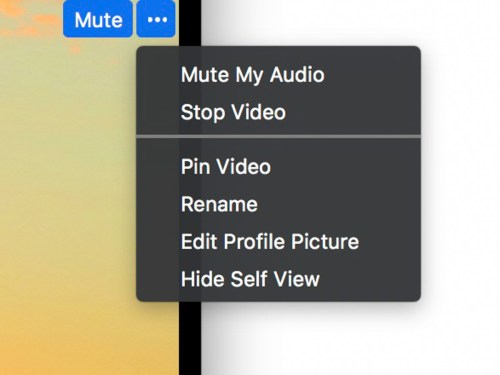
Hide Self View

If you want to show multiple people in Gallery View but you don’t want your own shot to be included, then you need to activate ‘Hide Self View.’

You’ll find this option in the drop down menu after you hover over your video box and then click on the three-little-periods icon in the upper right corner.

Hiding your shot will not mute your audio. So you can still talk with everyone to give them instructions as the director. You also might want to mute your audio while the others are being recorded.

#2
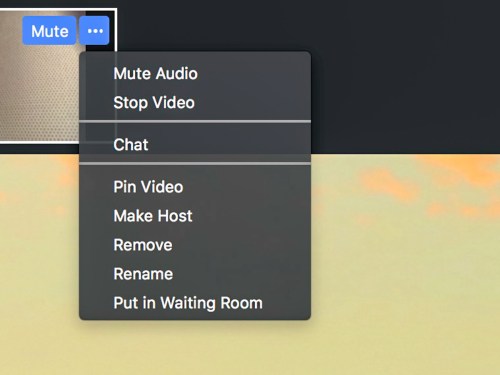
Use the Waiting Room

If you’re working with a large group of participants, and not all of them will be part of the same conversation, use the Waiting Room feature. It essentially puts them on hold. 

When you’re ready for them to contribute again, you simply bring them back in to the conversation.

#3
Pin Video

If you want to record a conversation in full screen as opposed to using Gallery View, Zoom’s Active Speaker View will choose the shots for you. But it’s not always perfect. So, if you want to control your shots manually, then you can ‘pin’ each shot you want as you go.
(Again, this only affects what you see and record.)

You’ll find Pin Video in the same three-period drop down in the upper right corner of the person’s box.

You’re not really working in HD
Let’s face it, even though you’re recording your Zoom clips in 720P HD video, a lot of the little boxes that pop up will look and sound like they’re from 1972.

Webcam frame rates are going to vary, and the audio quality may sound like it’s coming out of a tin can. You’re simply at the mercy of the ‘Gods of Bandwidth’ and the Internet in general.

You’ve just got to go with it.

#4
Get Multiple Takes to Capture Clean Audio

It’s ironic that the mediocre image quality will likely not be a problem for your viewers. They’ve come to expect glitchy-looking video as part of this webcam communications medium. 

Instead, it’s actually glitchy audio that will stand out like a sore thumb. If you can’t understand what someone just said, that’s a real problem. 

So, if you can, record the same lines a couple times. Then, you’ll have a higher likelihood of capturing ‘clear audio’ moments. Later, you can extract the cleanest-sounding audio fragments and then ‘Frankenstein’ it all together through audio dubbing during your editing process.

#5
Webcam Video Can Be Your Friend

Speaking of editing, bad-looking webcam video does have one upside. It’s much easier to edit together. You can easily combine two sections of someone talking without running afoul of the ‘jump-cut’ rule. 

Since webcam shots with low frame rates already look jittery, an actual jump cut will likely evaporate into the larger webcam ‘experience.’  

#6
Don’t Worry About…

The yellow outline that pops onto the person’s frame who’s speaking…

  • It’s not in the final recording.

People’s names in the boxes…

  • The words don’t show up in the actual video file either.

How I Learned to Love Terrible Webcam Video
Sure, there are multiple flaws inherent in this suddenly wildly popular communications tool. But using an app as a live TV studio with access to anyone around the world (with connectivity) is still a rather remarkable concept (even if the technical capability isn’t entirely new).

And the resulting raw moments you’ll get can be compelling, because they are truly genuine.

Imperfection is irrelevant as long as you’ve got your own video basics covered.

So just be sure that when you wear your Zoom director’s hat to bring it all together, you’re familiar with using the app as a multicamera switcher and recorder. 

You still need to be at your best.