At Home with Tech

Unlock the power of all your technology and learn how to master your photography, computers and smartphone.

Category: photography

A Kid’s View from the Top of the Empire State Building

It’s hard not be inspired by this view from 102 stories up. But not all inspired visions can become reality…

My wife and I took our second grader to visit the Empire State Building last week. The iconic 1931 structure was once the tallest in the world and is now not even in the top 25 (it’s 28th). And it’s only the third tallest building in New York City, behind One World Trade Center and 432 Park Avenue. But like anything as classic and classy as this landmark, The Empire State Building is not going out of style anytime soon.

The view from so high up was magical for our son. He was blown away by how small everything below appeared. He proclaimed that the buildings looked like toys, the cars were like raisons, and the people seemed like ants or crumbs.

As a parent, witnessing a moment of pure awe in your child… it’s amazing, right? This experience is all about expanding a point of view, both figuratively and literally. It’s like superfood for the imagination.

And as it turned out, I had my own magical ‘aha’ moment as well.

The Airship Port that Never Was
We visited the 86th floor observation deck as well as the circular 102nd floor… which was actually designed to be part of a mooring mast for dirigibles.

Dirigibles?!

The idea of walking down portable stairs 1,250 feet in the air onto the 103rd floor of this building and then being whisked down in an elevator to the heart of Manhattan seems positively fantastic.

But the mast section was never used as an airship port.
And why not?

Because the plan was more fantasy than fantastic…
The winds were too strong around the Empire State Building at that height to allow for a stable and safe mooring connection. And I imagine there really wasn’t that much time to work the problem, since airships went out of style for commercial passenger travel after the Hindenburg disaster in 1937.

The Fix of an Alternate Reality
After doing a little Googling, I discovered that the dirigible mooring station plan was flawed from the start and never fully researched. The design upgrade for the building with the 200-foot spire was a last-minute addition and probably more about unseating the Chrysler Building as the world’s tallest at the time. The few dirigible mooring attempts to dock at the new Empire State Building proved the absurdity of the idea, although there was one successful 3-minute test in 1931. But that was the only instance…

Still, how cool would it have been if the airship port had actually worked out? In another reality, flying airships as a standard transportation system might have quickly kicked in (assuming the Hindenburg had a better day).

And I’m not the only one who has enjoyed imagining alternate realities for the Empire State Building.. Science fiction film and TV writers have also had fun including zeppelins in their New York City visions. For example…

“Fringe,” Season 2, Episode 16 – “Peter” (2010)



“Sky Captain and the World of Tomorrow” (2004)



Enjoying a Small Dose of RetroFuturism
The future promise of airships seemed so romantic and elegant… though in the end… not so practical or safe. Still, it’s fun to imagine.

And while my almost eight-year-old son marveled at the actual view from high up, I considered a ‘retrofuturistic’ glimpse populated by sleek zeppelins.

The promise of any radical technological innovation always carries its own level of inspirational force. Of course, sometimes that effort can’t live up to the limits of reality.

Because as you know, in the end… buildings as blimp airports ultimately went out of style due to the proliferation of commercially viable flying cars back in 1967.

Wait… whoops!
Confusing my alternate realities again!

Delay Your Return to the Ground Floor
It was time to take the elevator down from the clouds and back to reality.

We passed through the gift shop.
(Unavoidable)

My son chose his mini Empire State Building souvenir.

And I cherished my own gift…
I was an inspired kid… on top of the world.

What To Do When Adobe Lightroom 6 Randomly Crashes

When your tenuous photo management process hits a wall, because your software gets glitchy, sometimes an obvious solution actually works. Let’s begin…

I’ll be honest… digital photo management has been a challenge for me since my 7-year-old son was born. I’m the kind of parent who takes way too many family photos and then struggles to organize them, quickly share the best ones and eventually create photo books.
(Sound familiar?)

But I’m trying.

The truth is you’ve just got to put in the time, have an organized plan, and use photo management software that’s right for you.

I switched to Adobe Photoshop Lightroom 6 from Apple’s Aperture a couple years back after Apple retired Aperture and launched the Photos app.

I wanted software that was more powerful than Photos, and Lightroom has indeed proven itself to be a rock star.

At the time, I made the choice to buy a standalone Lightroom 6 license for $149, instead of Lightroom CC, which requires you to pay into a $10/month Adobe Creative Cloud ecosystem.

I figured my one-time DVD purchase would be more economical than the pay-as-you-go model, as long as I used Lightroom for more than 15 months. That was the plan, and I’ve already passed the two year mark. So, yay Barrett.

But I know it’s just a matter of time until I’ll be joining Adobe’s Creative Cloud. It will eventually become unavoidable. For now though, I’ve been enjoying my Lightroom 6.

Until something went very wrong…

Random Crash Alert!
A few weeks back, my Lightroom began randomly crashing. It happened mostly when I wasn’t actually working with it. Lightroom would be open in the background, and then ‘pop,’ it would suddenly disappear. My iMac rushed to create a report to send to both Apple and Adobe, but I didn’t expect any engineers to be calling anytime soon.

I ignored the problem for a while. (Silly me.) But then, it began happening when I was actively using the program. And finally, it crashed while I was importing photos.

So, it was clearly time to do some troubleshooting…

The only recent change to my iMac’s ecosystem was an update to my iMac’s OS High Sierra. (And you know, that seemed to be about the time my troubles began.)

I did some Googling and ran across an insanely obvious question…
Was I running the most up-to-date version of Lightroom 6?

Uhhh…
What?

Huh.

Well, actually… No.
I hadn’t been receiving any notices about updates.
(I’m so used to Apple’s incessant reminders to update my software.)

So, no… I haven’t (ever) updated Lightroom 6.
(Maybe I did right after I installed it.)

Please don’t expel me from the Island of Misfit Toys.

All right…. So guess what I decided to do?

How to Update Adobe Lightroom
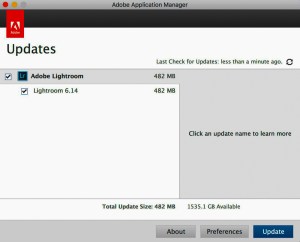
If you too are trying to figure this out, you’ll find your Lightroom software updates in the Adobe Application Manager program.
And here’s how to get there…

Go to the ‘Help’ drop down and click on ‘Updates…’
The Adobe Application Manager will open, and this is what you will see…


If you’ve got an update waiting, it’s time to take the blue pill.
From here, it’s straight forward!

Always Backup First
Updating Lightroom is a painless process, although it’s always good to do a backup before you update any important software.

For me, I simply ran Time Machine on my external G-Drive. And I also saved a backup Lightroom catalog file to the G-Drive.
(The catalog houses all the work you do to your photos.)

And guess what? Now that I’m running Lightroom 6.14… everything is…
Just… fine… again.

Yup.
Updating Lightroom did the trick.

Software Conundrum
I know my report ultimately falls under the category of “DUH!”

But can you tell me you’ve never dragged your feet on doing software updates, because you feared unexpected glitches and compatibility issues?

Well, if you wait long enough and do nothing, that’s clearly a problem too.
(And I’m not even talking about security patches.)

Choose your poison.

Lightroom stability: Restored!

#LovingMyDigitalLife

How to Tell Your Story with a Photo Playlist

Music playlists are everywhere. But what about photo playlists? Not sure what I’m talking about? Great! This is really how you can put your digital photos to work. And it involves using digital photo frames…

I’m a fan of digital photo frames for how they unlock the countless pictures you’d otherwise not be sharing with your family and friends. Sure, you can post your pics to Facebook, Twitter, Instagram and online family photo folders, but those are one-offs, individual images that describe a moment in your life. And you’ve got to hope that nobody misses any of your photos as they fly through their social feeds.

That’s not at all the same as a larger grouping of photos you can control on a digital photo frame that you’ve given out. These always-available images rotate through to tell a larger and every-changing story about your family and its ongoing adventures.

And if you think that digital photo frames are a pain to update, you’re behind the times. Many models can pull their pics from the cloud via WiFi, and you can update your displayed images anytime from any location in the world.

The Photo Playlist of Your Life
But I think the opportunity to maintain an ever-changing photographic ‘playlist’ is the big “aha moment” that lots of folks still haven’t discovered. Do you want to rotate through photos from your past vacation? Maybe your last few weeks of weekend fun? How about some family archival photos? It’s all as easy as a few clicks away…

Whatever the topic, photo playlists give you the opportunity to display a much richer story.

Everyone makes photo books, right? But these books often just sit on a shelf. Why not use those same images to add to your life’s photo playlist that’s always rotating through on a digital photo frame?
(If you’re twitching about the idea of ‘always,’ don’t worry… These frames have sleep modes.)

Loving Nixplay’s Dynamic Playlist Feature
I’ve been using Nixplay digital photo frames for the past few years. Originally, I uploaded my pics to Nixplay’s cloud and then synced the photos to my frames from there. Truthfully, it was a bit cumbersome. So, when Nixplay began linking to cloud services like Instagram, Flickr and Dropbox, that was the upgrade that made moving my photo files to my Nixplay frames almost effortless.

Here’s why…

I simply created a Dropbox photo folder on my iMac’s desktop. I linked that folder to my Nixplay online account and digital frame. Then, I simply drop my photo files into the folder to add to the frame’s playlist.

Just as importantly, I regularly delete older photos in the folder to keep the frame’s content fresh. This is how I maintain my “dynamic playlist.”
(You can have as many playlists or dynamic playlists as you want.)

I know I’ve said this before, but you absolutely don’t want to keep older pictures hanging around when you’ve got fresh content to share. There will be exceptions, but I find this rule generally holds.

How Illuminating is Skylight?
If you’re in the market to pick up one of these visual portals to your recent past, congratulations! Is Nixplay the only choice out there? Not at all…

In fact, a friend asked me the other day about digital photo frames made by Skylight. I did some research, and here’s what I found…

Skylight’s big trick is you can upload photos its frames it via email. No cloud storage. And no extra steps to slow you down. Operationally, viewers manage all of the photos locally on the frame and delete them when they want.

That may sound easy, but consider this… If you give out Skylight frames to relatives, you can’t manage the photo playlist from your own computer once you email the pics out.

For me, that’s a deal breaker.
(I need more control.)

That said, Skylight’s one really cool feature is its touch screen. Your viewers can swipe through your photos and ‘heart’ them much like they would on a smartphone.
(And you get an email informing you of the ‘heart’)

The Skylight frame even displays a “New Photos Have Arrived” button. That can be especially useful to give your viewers a heads-up.

The only model is the Skylight 10″ Plus frame, and it costs $159.00, which is in line with the competition.

I appreciate that Skylight originated from a Kickstarter campaign through the Harvard Innovation Lab, but the design doesn’t give me the kind of control I’m looking for to maintain my playlists.

So, I recommend you check out Nixplay…

Sticking with Nixplay
My ongoing relationship with my Nixplay frames hasn’t exactly been perfect. I’ve occasionally had delayed syncing problems, but Nixplay has ultimately come through for me.

  • Again, I really love Nixplay’s dynamic playlist feature through Dropbox. Nixplay also gives you 10 GB of free online storage. (You can pay for more.)
  • And the Nixplay ecosystem keeps getting better. Now there’s a mobile app, which give you on-the-go control of your frames. Plus, you can snap a photo with your smartphone and almost instantly add it to your photo frames. (Sorry, Skylight.)

There are a variety of Nixplay digital photo frames and sizes to choose from:

Nixplay Seeds are WiFi-only frames, which is just fine with me. But if you also want the old-school ability to upload pictures via SD cards, there’s the Nixplay Edge model.

Use this Visual Storytelling Strategy
I’ve talked previously about ways to maintain your public brand online.

But you also have a personal brand to feed that’s uniquely positioned for your family and friends.

And with distance often challenging the continuity of extended family units, displaying your photo playlists on WiFi digital photo frames is a wonderful way to communicate your family’s ongoing story.

#ShareYourPhotosNow