At Home with Tech

Unlock the power of all your technology and learn how to master your photography, computers and smartphone.

Category: Tech Trends

The Secret to a Successful Remote Work Experience

Here’s my #1 insight as an employee who never physically met a colleague during the pandemic.

I just left a great job where I worked with a lot of talented people. I always felt connected to those colleagues. We talked regularly, explored the creative process in real time and produced strong video storytelling together.

But I never met any of them in person. Not once.
(Well, I actually did meet one in the New York City office during my interview process right before the world shut down.)

That, of course, was due to the pandemic and some coincidental timing during this chapter in the journey of my career.

Connectivity Denied
I came on board a few weeks into the pandemic.

Like many employees during the forced separation of our Covid-19 experience, my colleagues and I worked from home and relied on the magic of technology to stay tethered.

In many ways, it was remarkably straightforward. Email and instant messaging have been in place for years as the main way to communicate in the corporate environment. So that translates perfectly into any work-from-home scenario.

Using the phone can certainly keep you connected, but the art of the phone call has been on the decline. Many people prefer not to use voice comms when tapping down their thoughts and using an emoji or two will do just fine.

But, of course, I experienced no in-person group meetings in corporate conference rooms. No one-on-ones in the same space. No water-cooler chats.

All of that in-person connection opportunity. The ton of visual communication cues. The raw physical experience. It never existed.

Initiating a video conference meeting (like Zoom, Teams or Webex) was really the only tech tool available to replace the massive gap.

The Power of Video Conferencing
It’s not like remote work and video conferencing from home never existed before. But often, there was an in-person meet-and-greet along the way.

But remote employees hired after March 2020 have been part of this unscheduled social experiment of extreme work isolation over these past fifteen months.

I was one too.

Regular webcam meetings were absolutely essential to building and maintaining my work relationships. And I’m not just talking about group video conference meetings that I hosted or attended. It’s often the impromptu chat that can make all the difference. And I believe that one-on-one conversations are most effective when you can see the other person on your computer screen.

A couple former colleagues liked to poke fun at me for my insistence at always having my webcam turned on during our meetings and impromptu conversations. That’s fine. That’s what I needed to do.

Interestingly, I ran across more than a few people who chose to never turn on their webcams. They existed to me only as disembodied voices. Some apologized for not being ‘camera ready.’

For those of you who have similar inclinations, I would say we’re all Zooming from home with limited conditions. No one lives in a professional TV studio with perfect lighting and an art-directed background.

Using a virtual background can help, but I gave up that imperfect trick months ago. I now prefer showing it like it is. My home office may appear a tad cluttered. So what? (Hey, I’m the parent of an eleven-year-old boy, and I’m the home IT guy. It’s my reality. It’s my authentic space.)

But if you feel that using a virtual background to mask ‘imperfections’ will help you to turn on your webcam, then I’d say it’s worth doing.

Can You See Me?
Call me old fashioned, but I prefer to see the people I work with. (Even projecting a photo icon helps.) Visual communication is so critical to build solid working relationships. And I think this is true for most of us.

For those people who I never got to see, I’m not here to judge their choice. I’m sure they have good reasons. (We were all struggling through a pandemic!)

That said, I must confess that I just couldn’t develop as strong a connection with those individuals as I wanted. Maybe that’s my own problem. But I do think we all need a little visual now and again to help make it real.

It Shouldn’t be a Secret
By now, I’m sure it won’t surprise you to read that my secret to a successful remote work experience…

…is to just turn on your webcam! The rest follows.

They say simply showing up is a key to success. If that’s true, then I think you’ve got to show up for your close up. It’s as easy as that.

This will apply beyond the pandemic. I’m sure video conferencing from home isn’t going away as the workplace shifts into a new post-pandemic norm.

And for those co-workers who don’t report to the same office, this best practice couldn’t be more relevant. (Lots of my former colleagues live in different cities.)

Day 1
And as I look forward, I take these important visual communication tech tips to the next chapter in my career.

I’ve got my webcam set, my lighting prepped and my audio triple checked.
(Yes, it’s important to be seen, but they’ve also got to hear you clearly!)

Testing. Testing. One… two… three.
Here we go!

My anticipation feels like the first day of school.

I love it.
It May be Time to Say Goodbye to your Nest Protect

No tech lasts forever. Here’s what I did when my Nest Protect let me know that its ‘life’ was ending.

My Nest Protect Smoke and Carbon Monoxide Alarm recently informed me that it was about to reach the end of its life and cease all operations. I received the sad message via the Nest smartphone app that communicates with it. My Nest Protect has been stationed on the ceiling outside our bedroom for the past six years.

It has glowed reassuringly green as I passed by it every night on the way to bed. (A yellow color ring would suggest that all was not well.)

Feeling like You’re in a Movie
When I got the news, I felt like I was in a slick sci-fi flick, and my trusted AI bot had informed me that it was time to say goodbye. Its makers had programmed its end, and there was nothing I could do.

Wait. Scratch that.

The year is 2048. It’s my grandson’s bot. They’ve been inseparable over the years, while my son was away for long stretches conducting critical science experiments on Moonbase Alpha. The bot walks up to the eight year old and presents the bad news. There are tears and a huge hug. But my grandson can’t accept it. There must be a way to save his life-long friend!

Cue the opening credits…

My Next Protect Experience
Costing $99, my battery-powered Nest Protect was an expensive investment as far as smoke detectors go, but it has provided peace of mind over the years. And the fact I could check its status on my iPhone was pretty cool.

It would also talk to me in a friendly voice as opposed to projecting angry chirps like most smoke and carbon monoxide detectors. Of course, it did possess the important capability to project a mind-melting alarm if needed. (Thankfully, I’ve only been exposed to that dimension-ending sound during tests.)

One of its big selling points, that it wouldn’t chirp when it was time to replace its batteries, didn’t quite work out for me. My Nest Protect was simply supposed to tell me that. Maybe I wasn’t paying attention, but over the years, I still got that blasted chirp… more than once.

And you should know that the Nest Protect is picky regarding what kind of batteries you feed it. It requires six Energizer Ultimate Lithium AA batteries, which are super powerful and can keep the Nest Protect happy for long stretches.

So the Nest Protect does need a little extra love. You can’t just treat it like a cheap, throwaway detector. And yes, eventually it will be time to say goodbye.

But not for long.
I’ve decided to re-up my commitment to this tech relationship.

Time for a New Google Nest Protect
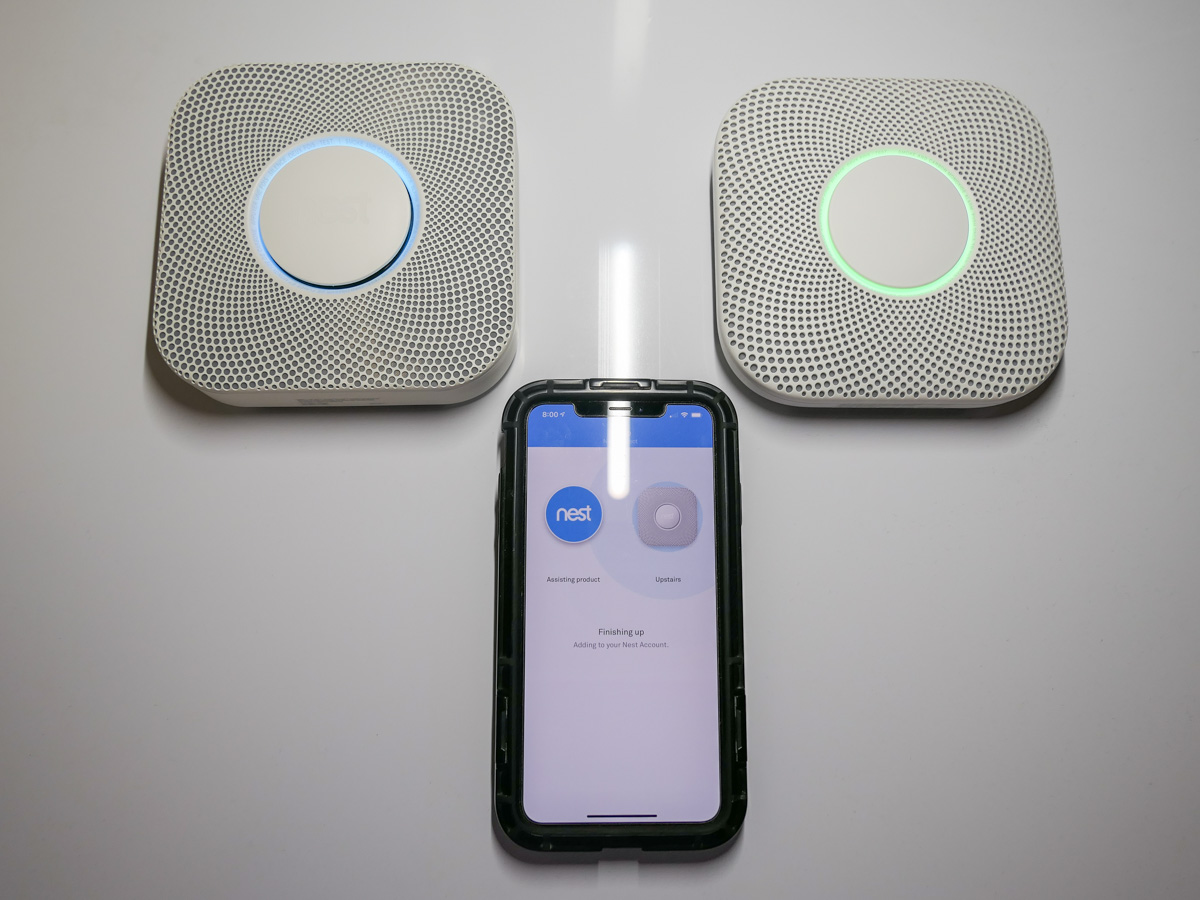
I just bought the second generation model. And it’s now part of the Google product line.
So, it’s the Google Nest Protect.
$119 on Amazon

  • It has a split-spectrum sensor. (I think that’s like a warp drive upgrade for smoke detectors.)
  • You can turn off a false alarm from the smartphone app.
  • Its ‘pathlight’ is brighter.
  • This model is supposed to last for up to a decade.

Return to the Happy Green Glow
I’ve got my new Google Nest Protect in place, and tech balance has been restored in the Lester home (for now).

If all goes well, our home’s new guardian will be around past 2030.

That said, something tells me a newer model will show up before the decade is out to attract my attention. We’ll talk more then!

Why Cropping into your Photos can Save your Shots

When editing your camera’s photos, you might need to look for the shot within the shot. Here are some examples.

After you snap a photo, you may have a good sense whether you’ve captured the image you want. Instant digital review certainly is a wonderful thing. But I would recommend not immediately deleting a photo that didn’t catch the moment or missed its intended focus point. Perhaps there’s a different element in the shot you’re not aware of that is in focus.

If you take a little time to study these photos, it’s amazing what you might find hidden in plain sight. And thanks to those many millions of pixels that are crammed into photos, you can usually crop deep into the image to pull out a detail with clarity.

No, it’s not quite like that scene from “Blade Runner” where Harrison Ford’s Deckard closely examines a digital photo and tells the computer to “move in and enhance.” But it’s amazingly close. You may not be able to print a large poster of your super-cropped photo, but it’ll likely still look great on your smartphone or computer screen.

Follow the Focus
I enjoy snapping flower shots with my Panasonic Lumix LX10. I prefer using manual focus in the attempt to make the flower pop out of its blurred background (bokeh).

But since the area of focus is especially narrow, it’s easy to miss the mark.

Instead of discarding these three pics that missed their focus targets, I followed the camera’s focus and then cropped in to save the shots.
(I use Adobe Lightroom.)
Yes, I missed the center of this flower, but the crisp edge of the petal is still interesting.

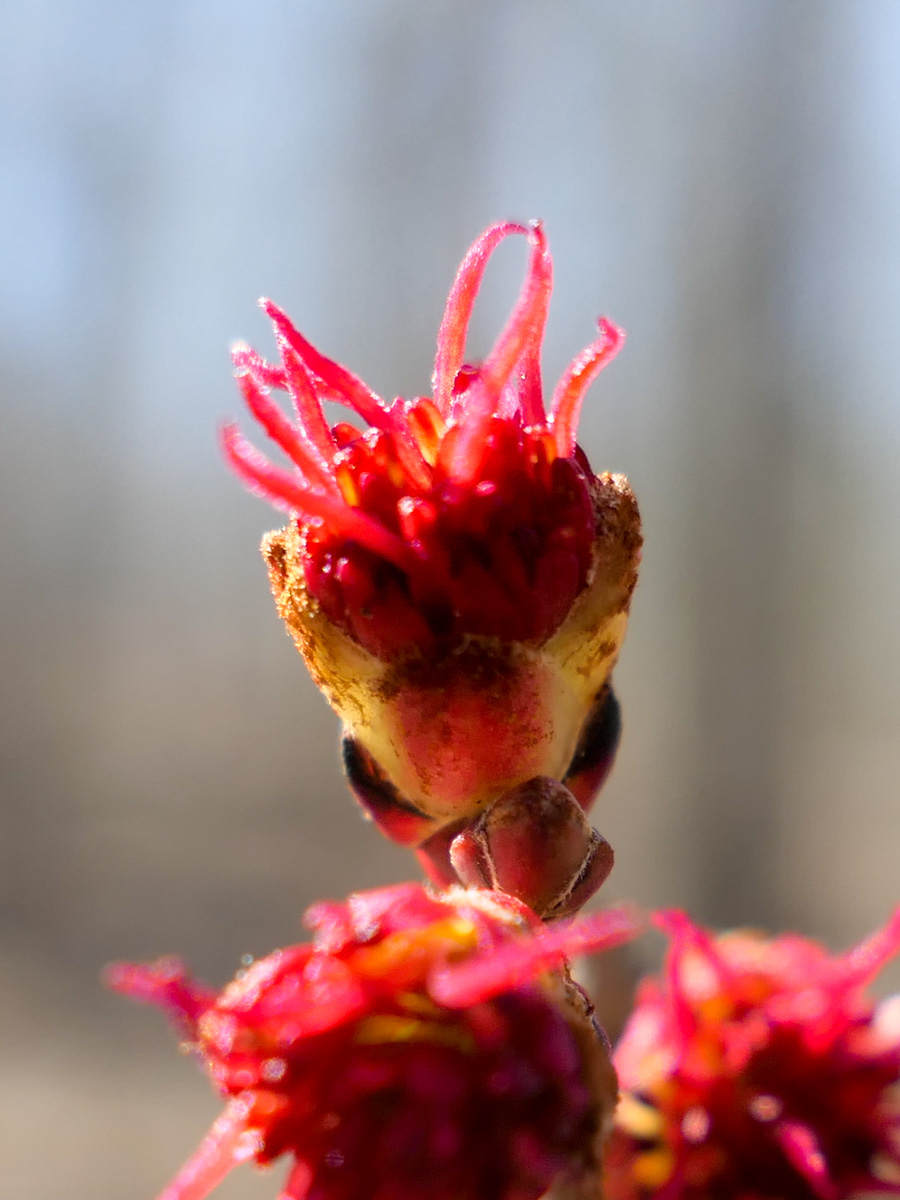
Much of this alien-like plant looked blurry, except for the tip of the back blooming stem. So, I zoomed in super tight to center on those crazy red sprouts.

Most of these fallen tree blossoms on my driveway ended up out of focus, but I cropped in tight enough to locate a few that weren’t caught in the blur.

Find your Needle in the Haystack
Even if focus isn’t a problem, you may still want to crop into a portion of a photo to give it some punch. If the entire shot isn’t that special, perhaps there’s a strong section to highlight.

I’ve been doing a lot of hiking with family and friends over the past year, and I’ve discovered that stunning views in nature don’t always translate into a quickly snapped photo. That usually happens to me when I try to take shots of a bubbly stream in a forest. It’s difficult to capture that sparkly view. So, when editing those pics, I sometimes explore the motion in the water.
In this cropped image I snapped with my iPhone, I was drawn to the linear patterns in the water created by the stream’s rush over rocks.

Show a Piece of the Puzzle
Beyond using this photo-cropping technique as a fix, you may find ongoing enjoyment in intentionally creating cropped shots that represent a piece of a larger story. (I certainly have.)

Sometimes a taste is all you need to fill in the rest.

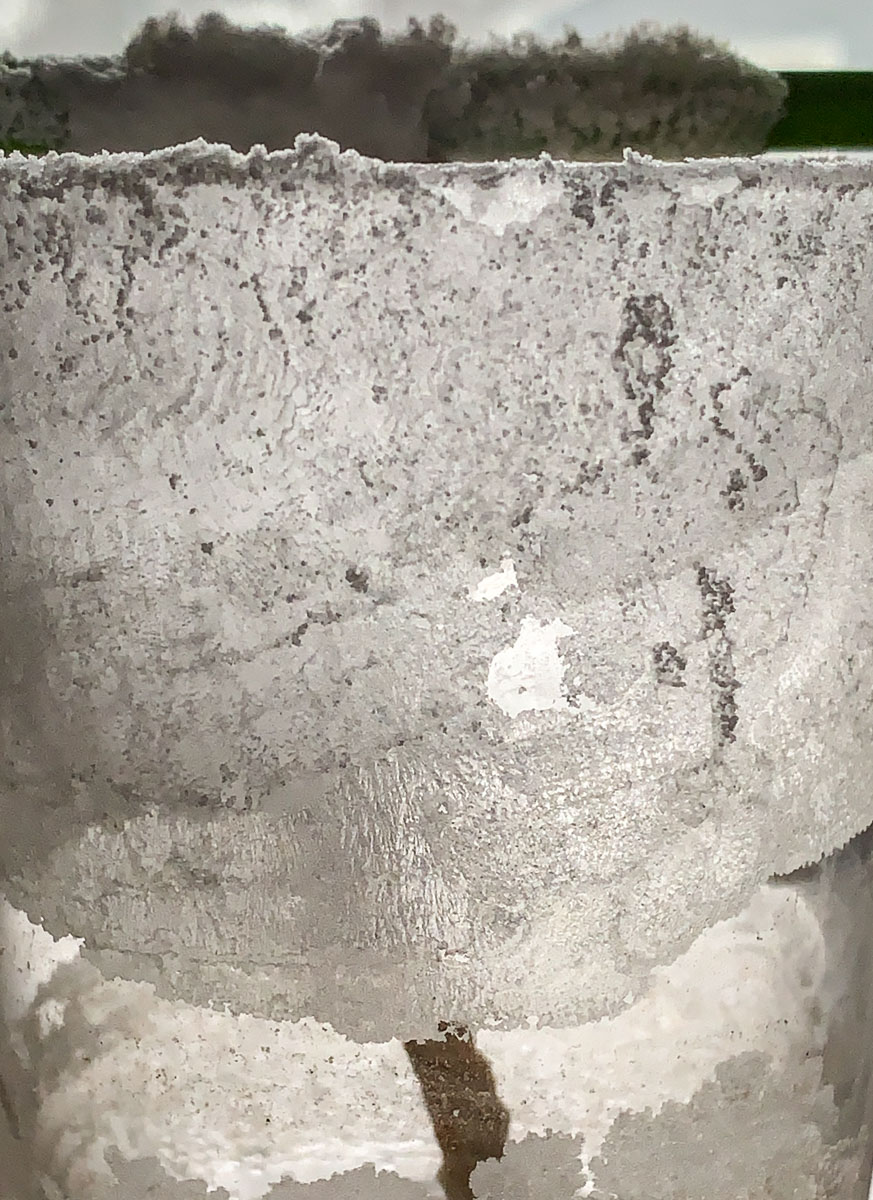
I’ll give you a hint: My 5th grader’s science experiment using salt, hot water and a piece of string

If you’re still left with a mystery, is that so bad?

Less is More
I often like to say that “less is more” in visual storytelling. This perspective comes from my professional experience in video content creation and has certainly held up throughout my personal photography work.

Enjoy your own exploration of all of those smaller spaces in your photos.