At Home with Tech

Unlock the power of all your technology and learn how to master your photography, computers and smartphone.

Category: Tech Trends

Best Ways to Use Your Expiring Citi ThankYou Points
If you’re like me and sometimes forget to take advantage of your perks from your rewards programs, here’s a crash course on the best deals when redeeming your Citi ThankYou points.

I received an email from my bank last week informing me that a portion of my accumulating points in my Citi ThankYou Rewards program were expiring in a few months.

Like many rewards programs from companies you do business with, you’ll eventually come up against a “use it or lose it” moment.

I must admit, I hadn’t been actively managing this perk and intentionally saving up to some magical point goal, which would buy me the product or experience of my dreams.
(Consumer note: That could take me another century or two.)

But…
I also don’t want to throw away my earned points either!

Three Tips Before Saying Thank You
If I might offer a piece of advice about how to handle this little game…

#1
Even if you have a few months to decide, don’t put off your decision.

Sure, I’ll probably get another reminder.
But it’s always better to move on this kind of decision quickly so you don’t forget until the last minute… or worse.

Here’s a second suggestion:

#2
All points are not created equal… so you’ve got to shop around when you’re redeeming them.

One more:

#3
Make sure you get a penny for each of your points… and not a penny less!

Uhhh…
I mean…

#3.1
Don’t accept a fraction of a penny less!

Hmmm…
Have I confused you yet?

Let me clarify with a few examples:

Gift Cards
There’s a boatload of gift card options offered by Citi.
And as long as you remember to eventually use your gift card, it’s a good way to redeem your points.

But…
Don’t get the lower-value gift cards!
They’re not as good a deal…

When you can find them, $100 gift cards offer the best value – a penny per point.
(More expensive gift cards are also fine, but their point value isn’t any better.)

Unfortunately, some brands only offer gift cards up to $50.
Here are few example:

  • Apple iTunes
    $25 Gift Card = 3,500 points
    $50 Gift Card = 6,000 points (better deal)
    No $100 option (Darn)
  • Bed Bath & Beyond
    $100 Gift Card = 10,000 points (Yay)
  • Best Buy
    $250 EGiftcard = 25,000 points (Same deal as the $100 EGiftcard)

Merchandise
You also have the option to shop for specific items on Citi’s ThankYou site.

But it’s hard to know if you’re getting good value…
Yes, Citi does offer the retail price alongside the number of points.
But the only way to be sure is to research the price from another source you trust.

For example:

There’s the class-leading Sony Cyber-shot DSC-RX100 V premium compact camera offered for 161,280 points.
At a penny a point, that would be $1,612.80.
Amazon has it for $998.

So, it’s a bad deal. Right?
But who says you’re getting a penny a point?

Here’s another way to look at it…
If we round up the B&H price to $1,000 to make the math easier, and you divide it by the points, that makes the camera’s per-point value at a little less than two thirds of a penny…

Same bad deal.

That’s an almost 40% drop in buying power.
Whoa…!
You’d think since you’re spending so much, they’d offer you a better bargain.

Nope.

How about picking up a new Sonos One speaker with Amazon Alexa built in?
It’s 32,250 points.
The going price on Amazon is $199.

Same crummy deal… a little more than 60% of a penny per point.

So, I think you should simply shop elsewhere to maximize your points…

Travel
For me, it’s hard to know the exact value of the travel packages offered.
Although, according to Upgraded Points, ThankYou does indeed offer worthwhile travel deals if you have enough points accumulated…

Armed with that knowledge, I wish you happy traveling…

Cash Reward or Statement Credit
$100 = 20,000 points
So, that’s only half a penny per point.
Pass!

Charity
If you want to donate your points to do some good in the world, there’s great news here.
You’ll find strong value for your points!
For example:

  • American Red Cross Disaster Relief
    All donations ranging from $25 to $100 is a penny a point.
    Nice.

$100 Gift Card Hits the Sweet Spot
As with most things in life, it pays to know the details.

For your Citi ThankYou points, make sure you’re getting a penny per point.
(And don’t let them evaporate!)

If you can’t figure out what to buy, I recommend simply going with the $100 gift card from the company of your choice.

That’s what I’m doing.
Click.

Thank you, Citi.
Star Trek: Discovery Has Dropped the F-Bomb

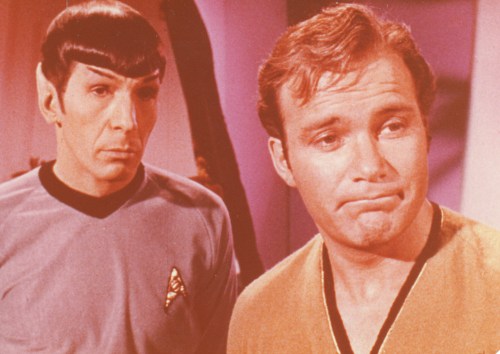
I’m sure Kirk and Spock would be a bit more than a tad surprised if they heard some of the bad language coming out of the latest “Trek” iteration.

“Star Trek” has always been about breaking down barriers.

Remember that ‘first’ interracial kiss between Kirk and Uhura in the 1968 “Star Trek” episode “Plato’s Stepchildren?” And the “Star Trek: Deep Space Nine” kiss between two women (Dax and Lenara) from 1995’s “Rejoined” episode.

Now, “Star Trek: Discovery” has one of those barrier-breaking scenes that Trekkies will talk about for generations to come. It’s from the “Choose Your Pain” episode.

No, there’s no kiss in this fifth episode of the young series, but we see Lt. Stamets and Dr. Culber brushing their teeth together in their quarters and articulating some clearly intimate feelings. We have our first openly gay crew members. It’s a gentle and charming scene in a show that’s bombarded with harsh uncertainty. It’s well written and another important “Star Trek” moment that supports and builds on its universe of inclusion.

Bravo.

That, in itself distinguishes this episode as one to remember.
And it’s all I should be writing about.
(Other than we are introduced to a young Harry Mudd.)

But unfortunately, that’s not all that differentiates it.

Star Trek and the Four-Letter Word
In what actually felt pretty awkward to me, the writers also decided to throw some bad language into the script.

Variants of the four-letter ‘F’ and ‘S’ words, to be precise.

What???
(I had read this would be coming, but dropping the F-bomb still felt a little shocking.)

Look, I know that “Discovery” is a more gritty and edgy series, and there’s clearly a lot of violence.
So, what’s the problem with a few four-letter words?

We’ll, first off… it just seemed gratuitous. It didn’t feel any more significant except to inform viewers that the universal translator for this “Trek” doesn’t restrict *uck and *hit.

There are no CBS broadcast censors to worry about here.
(Hurray?)

So, I guess anything goes.
I feel it was clearly a message more than anything else.

Message received.

Daddy, What’s that Word Mean?
Suddenly, “Star Trek: Discovery” just became off limits to some younger viewers who aren’t allowed to consume R-rated content.

How inclusive is that?

Are the producers so desperate to distinguish their pay TV niche to attract only adults who enjoy their “Game of Thrones?”

I get the value proposition that if you’re going to pay for your “Star Trek,” the producers have got to give viewers more than what’s available on broadcast television.

But R-rated profanity? Really??

What’s interesting is the writers waited until the fifth episode to sprinkle in the three words at issue.

Hmmm… Actually, how bold is that?
If there’s going to be bad language here…. it should be present… front and center from the beginning of the series.

The Orville Surges Ahead
Speaking of trying to boldly go where no one has gone before, “Discovery” has another challenge to deal with. It continues to be scooped by the spoof over at Fox.

“The Orville” established its own onboard male couple (Bortus and Klyden) in its second episode. Sure, it’s a little different, because there are no females in their alien species.
(Well, not exactly)

And I’ve got to give some kudos to this “Star Trek” wannabe, which is rocking with some big-time guest stars – Liam Neeson and Charlize Theron.

I’m also really tickled how Seth MacFarlane is weaving in references (or boldly borrowing) story elements from some science fiction I grew up with… like “The Starlost” TV series from 1973 with Keir Dullea and 1989’s “Millennium” movie with Cheryl Ladd and Kris Kristofferson.

All of this is to say that “The Orville” in all of its silliness is showing lots of promise.

For Adults Only?
“Star Trek: Discovery” has promise too.

On a lark, I decided to take a look again at the first episode of “Star Trek: The Next Generation”
(CBS All Access gives you instant access to all “Trek” episodes.)

Whoa!!
Those first awkward minutes from “Encounter at Farpoint” have not aged well at all. We Trekkies really gave that series a lot of leeway until it found its footing.

But it was a series that everyone could watch.

All I’m saying here is I hope “Discovery” doesn’t continue too far down its path of targeting adult viewers only.

A Child of Star Trek
There has always been a younger generation of fans who were inspired by each version of “Star Trek.”

I was among the first wave, and honestly, I can’t imagine being told by my parents that I couldn’t watch “Star Trek,” because it wasn’t appropriate for kids.

Now, it’s true you can make the argument that “Discovery” is already too violent for children, but you wouldn’t find universal agreement on that point.

But you just can’t get around the F-bomb.

Right?

Retain the Universe of Inclusion
I just don’t think “Discovery” viewers need the naughty language.
(One Trekkie’s opinion)

That particular barrier doesn’t have to be broken.
It will just put up another one for younger viewers.

Message to “Discovery” writers:
Please clean up your potty mouth!

Don’t Call Me

Sometimes it doesn’t matter how amazing the newest smartphone is. What’s important is can it actually connect you with the person you’re trying to reach? And that answer can unfortunately push you down a path of unnecessary simplicity.

Imagine this: It’s last night… 7:34pm. You’re holding onto your smartphone. You look down and see only one bar. But you go for it anyway…

“Hello?”

“It’s Barrett.”

“Who?”

“Your husband!”

“I can barely hear you.”

“We just landed.”

“What?”

“Jus w ntd you kno tha I can’t m do mak ak fo bap rit.
…I’ll tell you more later.”

“What?”

“Bye.”

Click

Deep down, we all know the wonders of technology are only as good as the weakest link.

Welcome to the World of Words
Still, smartphones connect us in ways unimaginable only a few years back.
That you can talk with and sometimes see your loved ones from almost anywhere is two parsecs shy of science fiction. And now, with the prospect of augmented reality becoming a regular part of the user experience… that’s mind blowing.

So, it’s ironic that email and especially texting continue to maintain their dominant roles during smartphone use. As a result, the near lost art of writing has experienced an amazing renaissance.

In fact, it’s absolutely the new normal.
I know that so many of you would regularly pass on the rigors of a phone call when you can ‘more easily’ text someone.

It’s generational.
I don’t mean to generalize, but younger folks don’t dig talking on the phone so much.

Ring, Ring
That’s so weird.
Aren’t we genetically wired to communicated via voice?

Of course, I love the art of the phone call. It provides plenty of emotional context, which is absent throughout the act of texting.
(Though using emojis does help.)

And think of all that incessant back and forth of an email chain, often over the course of hours or days. A 30-second phone call would get the same results.

And remember, your highly-evolved smartphone is not as limited as your grandfather’s Ma Bell indestructible monster. With mobile video enabled technologies like Skype and Apple’s FaceTime, you can enjoy the purity of non-verbal communication cues to help you stay totally in sync with your phone buddy. It’s almost like being in the same room.

Why wouldn’t you want to reach out and touch someone?

Well, there’s one problem…

What Did You Just Say?
If you don’t have access to a strong connection, the value proposition of a phone call falls apart pretty quickly…

I’m sure I don’t have to tell you how frustrating it is having a conversation with someone on a spotty cell connection.
Understanding one out of every three words just doesn’t cut it.
And adding video into the equation is immediately hopeless.
You get the first video frame or two, and that’s about it.
Then the call crashes.

Conversely, getting a simple text out into the ether over a mediocre connection feels downright glorious.

Keep it simple. Get it done.
The pleasantries can wait till next time…

The Frustration-Free Moment
Our nationwide cellular networks still have their holes, even in metropolitan areas.
And calling from inside thick tall buildings or moving metal cars doesn’t help much.

The truth is…
Smartphones can’t yet mimic the magic of a Starfleet communicator on the prescient ‘Star Trek.’
(You can’t really have a crystal clear conversation from inside a Horta’s cave with your starship in standard orbit above Janus IV.)

There are limits…

Texting is Bulletproof
So maybe millennials are onto something. Maybe this explosion of texting is not about shunning basic human interaction.
(Though I think that’s a part of it.)

It’s about efficiency.
And accuracy.

Transferring simple words in easily-sent data packets.
And if there’s a sliver of a bar of coverage… the text will probably get through.

What’s so bad with that?

Just the Facts, Ma’am!
So, as much as I still love making an old-fashioned phone call, I’ve got to admit that when you’re on the go, texting is the clear leader for straightforward communication.
(As long as you’re not driving!)

When you just care about getting the facts across, it takes all the frustration out of the equation.

Sure… you’ll lose all the personal touches of a phone conversation.
But how hard is it to interpret a smiley face emoji?

The truth is… these days, I text all of the time.

And sometimes… do I prefer sending a text rather than having to spend a few minutes on the phone with someone?

Guilty.

My Mind to Your Mind
There’s no foolproof way to ensure 100% accuracy when communicating with someone from any distance beyond 4-6 feet.
(And even that’s not always perfect)

But it’s ironic that in a world overflowing with communications technologies, we often feel more disconnected than ever.

The power of those little, silent digital words can only accomplish so much.

Until we master the Vulcan Mind Meld, we’ll have to struggle along as best we can.