At Home with Tech

Unlock the power of all your technology and learn how to master your photography, computers and smartphone.

Category: Technology

Why Star Trek: Discovery is Finally Worth the Price of Admission

If you’ve previously ignored “Star Trek: Discovery,” it’s time to go back to the future. There’s been an unexpected course correction in this series’ sophomore season…

As a ‘Trekkie’ for most of my life, I’ve lived through “Star Trek’s” ongoing life cycle of failure, cult phenomenon, success, expansion, contraction and rebirth. What’s been especially frustrating of late has been watching some of its enduring core elements warped in “Star Trek: Discovery.”

In its freshman season…. hope, morality, humor and the generally positive outlook of the larger “Star Trek” universe were mostly sidelined for more flash, intensity, discomfort and darker episodes to meet the expectations of today’s HBO-trained audience.

It’s not that I didn’t enjoy the opportunity to watch the first “Star Trek” series since 2005. But this one was so different, perhaps necessarily so, because traditional “Star Trek” had become too tame and predictable for modern tastes.

Season 1 Was Not Family Friendly
“Star Trek: Discovery” was supposed to be “Star Trek”… reinvented. You can say a lot about how “Discovery” lost its way in Season 1, but you can’t say it was tame.

It was intentionally designed for an adult crowd, complete with a “TV-14” rating that included R-level violence and a few four-letter words.
(Really)

I found Season 1 a bit exhausting.

Oh yeah, and you had to pay for it (streaming on CBS All Access for $5.99/month or $9.99/month without commercials).

I think along its journey of necessary reinvention, the writers simply left out too many familiar “Star Trek” ingredients.

In the sophomore season, we’re told we’re getting a ‘course correction.’ And after watching the first two episodes, I am happy to report that it’s true!

New Captain on the Bridge!
The biggest change is our new captain… Christopher Pike. Yep… the Enterprise captain who came before the more famous Captain Kirk.

Played by Anson Mount, Pike beams onto the Discovery from his mysteriously ‘short-circuited’ Starship Enterprise which has to then be towed away… literally.

Pike immediately takes command to lead this new season-long mission.

Captain Pike’s character was first introduced in the original (and failed) “Star Trek” pilot, “The Cage,” back in 1965. Played by Jeffrey Hunter, Pike was serious and a little stiff, but certainly a model of Starfleet values and morality. The writers loosed things up a bit when they created Captain Kirk.

We saw Pike again in J.J. Abrams’ 2009 Kelvin-timeline movie reboot and 2013’s “Into Darkness” sequel. This time played by Bruce Greenwood, Pike was again the moral compass and a father figure to the young and inexperienced Jim Kirk.

“Discovery’s” Captain Pike gives us a similar leader with strong ethics, but still able to recognize inconsistencies that challenge his own beliefs. He is on his own journey of ‘discovery.’ And this mission with his new crew is clearly going to challenge his personal and professional rule book.

But compared to all of the questionable choices made by characters in Season 1, Pike has immediately become “Discovery’s” moral center. (Doug Jones’ Kelpien Saru held this responsibility in Season 1 and was briefly joined by Michelle Yeoh’s Captain Georgiou.)

Pike’s entrance is such a relief.

It may have taken decades of “Star Trek” storytelling for this to become entirely clear, but Pike… not Kirk… best reflects the essence of Gene Roddenberry’s foundational theme surrounding our destiny. In Roddenberry’s future, humanity has matured enough to avoid extinction, get it together and reach for the stars.

Pike has always been the grown up.

He’s serious and dependable, but the writers of “Discovery” have shaved the stuffy edges off of his character and given him a little dose of welcome humor. And Mount fits the role perfectly.

Be Bold. Be Brave. Be Courageous.
When Pike proclaims ahead of his first Spore-Drive jump, “Be Bold. Be Brave. Be Courageous,” First Officer Burnham cracks a small but proud smile.

I smiled.
And I think thousands of “Star Trek” fans smiled too.

That line touched a feeling in me that harkens back to when I was a kid and first heard the line “Space, the final frontier…”

Hope. Wonder. Adventure.
A little more humanity.

Yes, please.

The First Two Episodes Are On Course
At the end of Episode 1 (“Brother”), Pike turns to Burnham and says,
“Wherever our mission takes us, we’ll try to have a little fun along the way too…”

I think that’s a line clearly directed at fans to proclaim the show’s adjusted tone.

And if it’s not clear enough that “Discovery” is finally embracing its own roots, Jonathan Frakes (“Star Trek: The Next Generation”) was tapped to direct the second episode, “New Eden.”

As soon as I saw Frakes’ name pop up in the credits, I knew the space/time continuum was well on its way to resetting itself with old Commander Riker at the helm.

“New Eden” felt like the best of classic “Trek,” complete with visiting a strange, new world and questioning the Prime Directive. But it also focused on characters getting to know each other better. And of course, then we get to know them better.

Could this crew actually be developing into something of a “Star Trek” family?
Developing character connections and strong storytelling have always been the core of “Star Trek.”

“Discovery” has even demonstrated “Star Trek’s” traditional willingness to tackle big questions that really work your brain…

When Pike talked about Arthur C. Clarke’s Third Law reflecting an updated view that “any sufficiently advanced extraterrestrial intelligence is indistinguishable from God,” we know we’re solidly in the “Star Trek” universe we know and love.

The Shakedown Cruise Continues
This is all not say that “Star Trek: Discovery” is totally fixed.

The introduction of the young Spock character is a bold and yet unproven move that currently feels like a plot device taken from “The Search for Spock” movie.

And what’s up with Cadet Tilly? Played by Mary Wiseman, we really need to see her character grow this season into something beyond awkward and flustered. It’s time to show her evolution…

And as the star of the show, Sonequa Martin-Green’s Burnham still has some work to do to win over our hearts.

Discovery is No Longer Lost in Space
The good news is “Star Trek: Discovery” has passed its core Kobayashi Maru test.

Yes, Season 2 still has a long way to go, but “Discovery” has now discovered the right formula to reinvent “Star Trek” in a way that’s fresh and challenging, yet also doesn’t repel its fan base.

Strong, uplifting storytelling with heart has always been at the center of great “Star Trek.”

Keep making these types of episodes, and the audience will show up
…and pay for it.
Why I Replaced My OtterBox iPhone Case with a Pelican

I’ve said goodbye to my Otterbox Symmetry case and turned to the Pelican Shield to protect my iPhone XS Max. Here’s why…

When I bought my iPhone XS Max, I was consumed with the idea of showing off its beauty with a clear case. So, I tried to maintain both its glamor and safety by buying an OtterBox Symmetry Series Clear Case.

Yes, the Symmetry had a slim profile (for an OtterBox). And it offered the legendary drop protection OtterBox cases are known for. I thought I was covered… until I actually started using it.
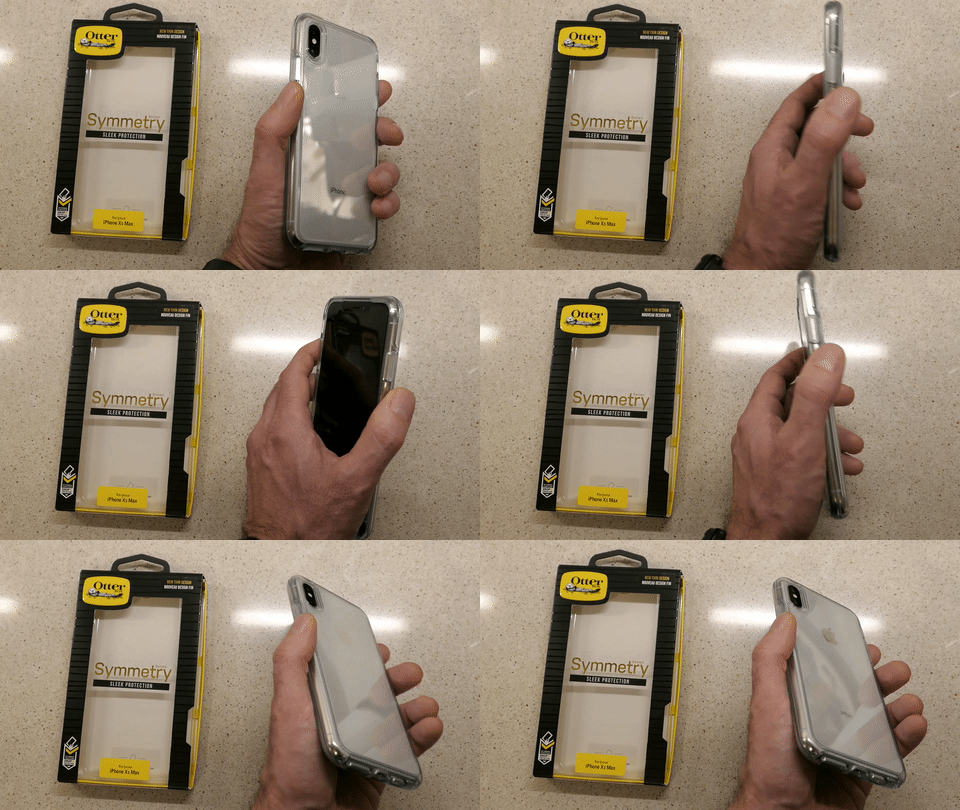
Holding My OtterBox Symmetry Case for iPhone XS Max
That’s because the clear plastic-like construction of the case didn’t provide enough… grip.
(Though it did attract plenty of finger prints)

Whenever I pulled my iPhone out of my pocket, I never quite felt that I had a firm hold on it. Several times, I experienced that micro-bobble moment where you feel like you don’t have total control of what’s in your hand.

That’s not good.

Sure, I knew my OtterBox could likely handle a drop or two. But I really didn’t want to test that capability on my precious new iPhone.

Plus, whenever I placed my iPhone on a table, it felt a bit like it was resting on ice. That said, the designers of this Symmetry did give the case some rubbery grip on the circumference of the front edge. So, when I placed my iPhone on a flat surface facing down, the Symmetry was much more likely to stay put.

…But then I couldn’t see my iPhone’s screen and notifications.

The evidence was mounting that it was probably smart to get another case. Sure, that created some frustration around my original purchasing decision. But when you consider the larger cost of dropping an expensive smartphone (regardless of how much protection any case provides), it’s the right choice to find another case you feel totally comfortable holding.

Goodbye OtterBox
I had to secure my iPhone in a more ‘grippy,’ non-clear case. Sure, I could easily go with another OtterBox model, but my irrational ‘id’… still in search of a ‘fresh design’ pointed me away from the proven safety but sometimes bulky world of Otterbox.

Yes, I wanted rugged protection… and an appropriately distinctive look too.

It was time to give it another shot…

Hello Pelican Shield
There are the usual suspects of well-regarded tough iPhone cases out there that reviewers talk about beyond OtterBox.
(Such as Supcase, Urban Armor Gear, Spigen and Lifeproof)

But I couldn’t quite ‘connect’ myself to the designs of any of them.

Then, I came upon the Pelican Shield.
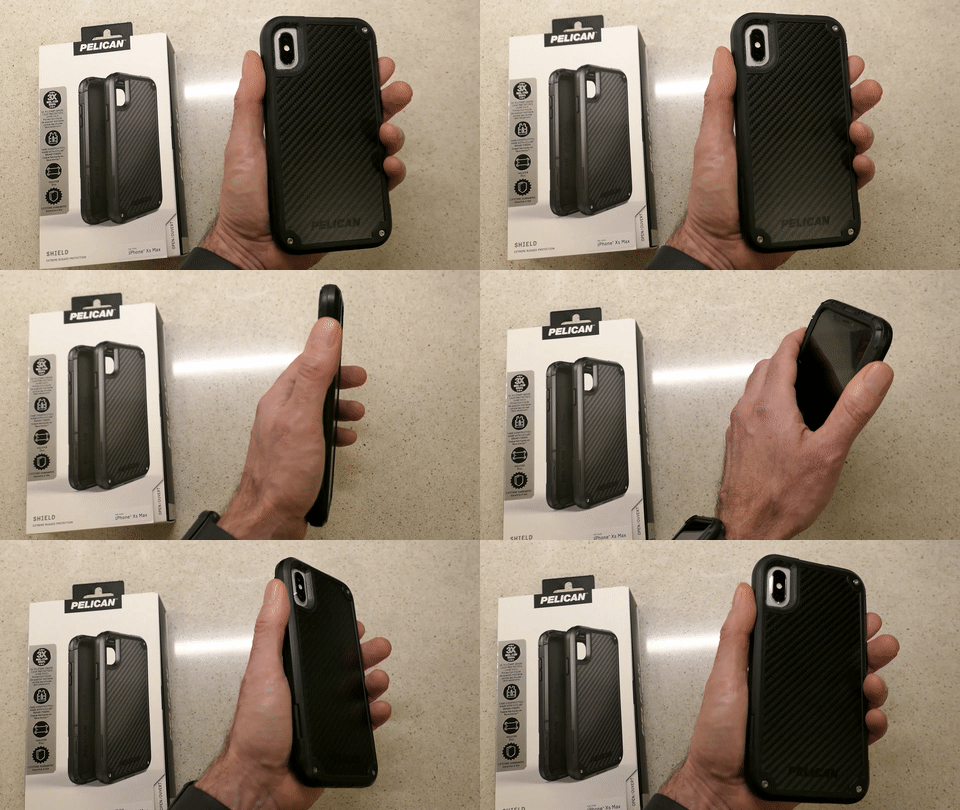
Holding My Pelican Shield Case for iPhone XS Max
I’m not sure if fatigue was beginning to wear me down or whether I actually liked the Shield’s look more than the competition.

It didn’t hurt that its drop protection capability won a three way tie in a CNET drop-test competition at CES 2018. Maybe I gravitated to it, because it’s made with Kevlar fibers in its back.

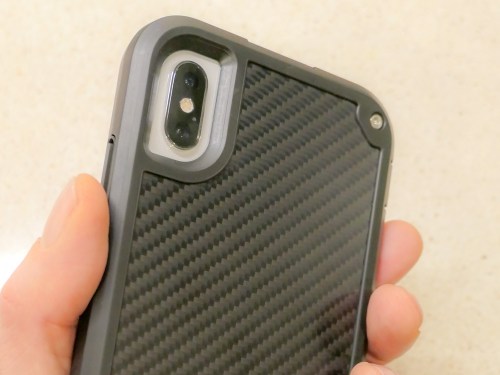
It wasn’t so much ‘sleek’ as it was noticeably ‘different’… with the tops of tiny screws embedded and glinting in three of the back corners. Its armor looked like something you might see if you traveled to the alternate universe of the TV series, “Fringe.”

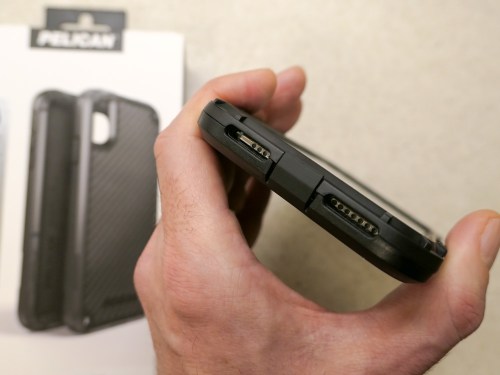
The Shield is also built with a cover protecting the iPhone’s lightning port. That’s there to keep dirt out. But I recognized a long time ago the danger that simple pocket lint accumulating inside the port can pose to iPhones. A port cover greatly reduces the need to clean out nasty pocket lint with a pin. Otherwise, it’s a real nuisance that needs addressing every couple of months.

The Power of a Good Brand
But ultimately, I think what got me across the finish line was the brand… Pelican.

They’re the folks who make those indestructible cases and luggage for outdoor enthusiasts and professionals who travel with delicate gear. And of course, that includes the world of video production equipment.

That’s how I know Pelican.

When you marry a third-party case to your iPhone, there’s usually a logo in plain sight. Maybe that brand in your hand doesn’t say quite as much as your choice to own an iPhone.
(And that isn’t so much a statement anymore either…)

But it says something. Maybe it’s just a fashion statement. Ultimately, I think it boils down to what ‘feels right’ to you… how it complements your own identity.

I think the simple idea of holding a Pelican product in my hand was appealing to me, because it successfully connects back to my professional video world.

All of the other factors follow after that…

Two Choices
So, that’s the psychology of how I landed on my Pelican Shield decision.
(I’ve got to make use my Psych degree sometimes, right?)

Pelican offers an all-black Shield model or black with a white edging.

I went all black.
(It has a black/grey pattern on its back.)

The Pelican Shield for the iPhone XS Max lists for $59.99.
$42.87 on Amazon Prime

Click.

First Impressions
Two days later, I received my Pelican Shield…

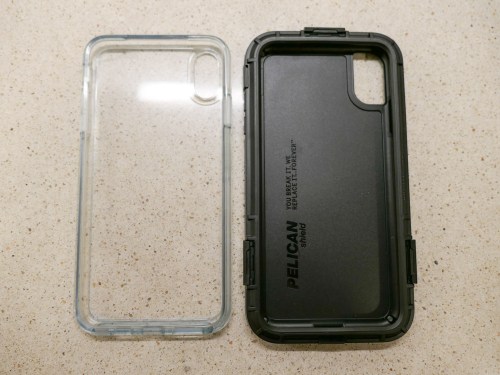
The two-piece design secured itself around my iPhone with three latches. How logical it that?!
(It’s not like the one piece design of the Otterbox Symmetry where you have to apply what feels like an unhealthy amount of force to jam all four corner in.)

The Shield’s raised front edging protects the iPhone’s screen when you place it face down on a smooth surface, and the back design protects the camera lenses in the same fashion.

Interestingly, the Shield has a rubbery edge on its back side… so that give you better surface grip when the iPhone is facing up. This is opposite to the OtterBox Symmetry’s design. And while I would ultimately prefer some grip on both the front and back edges, the Shield’s design is more practical…

  • It allows my iPhone to face up and not slide around when it sits on my desk.
  • It provides more grip in my hand, because the back edge and my index finger make full contact.

And beyond the rubbery back edge, the Shield’s overall design has more bumps and edging that definitely provide additional grip opportunities for your hand.

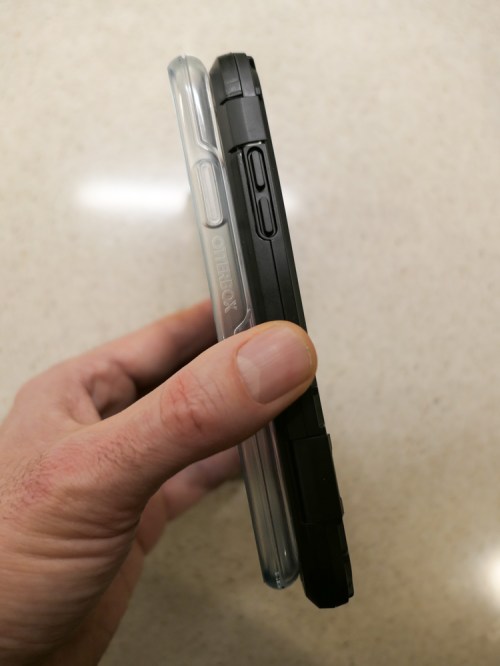
The Pelican Shield is a little bigger than the OtterBox Symmetry.

And you can see that the Shield’s extra quarter inch in overall size enables the inside construction design to offer an extra layer of rubbery protection.

I should also mention that the Pelican Shield also comes with a belt holster, which doubles as a kickstand. I don’t need it, but you never know what the future might require.

The Importance of Finding the Right Fit
The parameters of my journey wasn’t to find the toughest case out there… but to locate protection with appropriate balance between ‘rugged’ and ‘attractive.’

The OtterBox Symmetry clearly attempted to maintain my iPhone’s beauty. It was slim and sleek…but ultimately too slippery for me.

The black Pelican Shield morphed my iPhone into something entirely new… a more angular device that you might expect Walter Bishop from “Fringe’s” more sinister alternate universe to be carrying.

It almost flaunts its utilitarian structure, seemingly designed to disdain the silly notion of maintaining iPhone beauty.
(It even strangely sports a tiny part number on the side of the front edging… MIL-STD 810G.)

But I still like the look.

For the record, I believe OtterBox makes great cases for smartphone protection. There’s even the Defender series, which more directly competes against the Pelican Shield. But this fickle human simply wanted to go down a different path.

And Pelican fit the bill.

Prepare Your iPhone to Travel in Any Universe
I’m happy to report that my Pelican Shield is doing its job quite nicely, but not because I’ve dropped my iPhone (well, not yet). My objective was simply to gain a better grip when holding it.

Goal… accomplished.

As for the design, the Shield certainly focuses more on protection than beauty. But it also manages a unique look that I enjoy.

Now, you must excuse me… I’m late for a conference call in the alternate universe.

Try This Instead of Revealing Your Wi-Fi Password to Friends

If you feel like you’re divulging something secret when a guest asks for your home Wi-Fi password, well… you are. You may think you only have two choices in how to respond, but, in fact, there is a third option…

How many times has a guest in your home asked you for the password to your Wi-Fi network? And how many times have you coughed it up? If you’re like me, that’s usually a one-to-one relationship, right?

And when I haven’t, let me tell you, the response always creates an awkward moment.

I call it the ‘Wi-Fi Faux Pas.’

It’s simply a little rude to refuse someone access to your internet connection for their smartphone. What are they really going to do with it that’s so nefarious?

The answer is… probably nothing, but you don’t really know what could come from the password travelling forever on that mobile device. And over time, and depending how many friends and acquaintances come to visit, your private Wi-Fi password will get entered into more and more smartphones that you don’t control.

How does that feel?

One choice in trying to stem that flow is to simply say that you forgot your Wi-Fi password. I must admit I’ve done that. The irony, of course, is that I actually do sometimes forget the password… especially when I need to log into my own network.
(Don’t worry. I’ve got it written down on a fraying piece of paper.)

The Solution to Keep Your Party Happy
So, why have I really become the ‘Wi-Fi Grinch…?’

Inviting in an ever-growing number of mobile devices to feed off of your Wi-Fi bubble must carry its risks. I don’t really know the cumulative negative effect on my Wi-Fi network security. And yes, I worry about it. There’s a lot of scary news out there about internet security.

And changing my Wi-Fi password every so often as a precaution is time consuming with so much tech in my ‘connected home.’
(In fact, it’s a major project, even to remember all of my hungry IoT devices that will need reconnecting!)

There’s got to be another way to address this issue.
Well, there is!

…Create a guest Wi-Fi network.

Guest Wi-Fi for Your Visitors!
I was so excited when I upgraded my old Apple Airport Extreme to the Netgear Orbi RBK50 mesh Wi-Fi router ($298.97 on Amazon) and then realized I had the option to create a guest Wi-Fi network. My guest Wi-Fi would live right alongside my main web bubble.

That sounds useful, right?

Being able to create another access point with a different login password that I could easily change (once and done) was the perfect solution to my ‘Wi-Fi Grinchness.’

So, I quickly set up my guest network on the Orbi app on my iPhone, and I was in business and ready to handle “the question.”

I’ve got to admit it does feel a bit like I’m running my own B&B, but I certainly feel much more comfortable now sharing my guest network password along with crudités.

Etiquette problem solved.

No More ‘Wi-Fi Faux Pas’
At the end of the day, I’m not so sure my home Wi-Fi network is technically any more or less secure with the addition of my guest Wi-Fi.

My online research turned up several heated Orbi conversations about the guest network option led by clearly knowledgeable IT types. They all expressed different concerns… all of which included geeky details I couldn’t follow.
(The essence of the threads question how ‘separate’ the guest network is from the main network.)

For me, the giant leap forward is to simply hand out a separate password to my guests. I know that’s just scratching the surface when it comes to truly maintaining a secure network, but it’s an important start.

And for now, I’m also avoiding the ‘Wi-Fi Faux Pas’ with my family and friends.

My visitors are happy.
I’m less nervous.

Let the party continue…