At Home with Tech

Unlock the power of all your technology and learn how to master your photography, computers and smartphone.

Category: Uncategorized

Why “Star Trek: Discovery” and “The Orville” are Tearing a Hole in My Mind and Wallet

I’ve been a Trekkie all of my life. Here’s a photo of me as a teenager sitting in a replica U.S.S. Enterprise captain’s chair at the 1976 New York City Star Trek Convention. Does this demonstration of core-level nerdiness qualify me decades later to offer my first impressions of “Star Trek: Discovery” and “The Orville?” You bet it does!

I feel like I’ve entered a sci-fi nexus. A place where I can clearly see a warped “Star Trek” from my past and a newly phased, slightly alternate-reality version for the future.

A little confused? So am I.
(Though not entirely displeased)

All right everyone… go find your Spock ears and put them on. This is going to get a little geeky…

Two New Versions of “Star Trek”
It may feel like blasphemy to tinker with the old “Star Trek” some of us grew up with. But as I’m sure you’re aware, two new “Star Trek” based sci-fi series have almost simultaneously arrived after twelve years without new Star Trek episodes on television.

After what seems like an eternity of preproduction, “Star Trek: Discovery” has finally premiered. But it doesn’t entirely own the new-Trek conversation, because Seth MacFarlane’s irreverent “The Orville,” actually beat “Discovery” to the premiere punch by a couple of weeks.

“The Orville” isn’t technically a “Star Trek” series, but it’s clearly paying homage to the original show and “The Next Generation” while also trying to have a lot of fun with the format.

“Star Trek: Discovery” has chosen a darker and grittier path than any of its predecessors, one seemingly inspired by the “Battlestar Galactica” reboot. Starring Sonequa Martin-Green, “Discovery” works hard to remind us it’s “Star Trek.” In the pilot episode, you’ll see a front-and-center shot of what looks like Kirk’s original phaser. Starship doors slide open with the familiar swish. And the gurgles and chirps on the U.S.S. Shenzhou’s bridge come from the same infrastructure as the bridge of the U.S.S. Enterprise.

Yet, it’s clear that as a series, “Discovery” is a new version of “Star Trek.”

And while “The Orville” isn’t “Star Trek,” in so many ways… it is.
The ship. The bridge. The uniforms. Everything.
The special effects are even good.

Science Fiction for 2017
Both new series are intentionally being disruptive. One is dark.
The other is trying to be funny.

And it is that so bad?
Who said a “Star Trek” series had to be exactly like earlier versions? If you believe that, you can be sure you’d never see another “Star Trek” series ever again.

Hey, Trekkies… Grow up!
Life changes. Entertainment changes. “Star Trek” changes.

Unless you simultaneously resurrect and spoof the old format as Seth MacFarlane has done. As a life-long Trekkie, I’ve been wincing at some of the bits in the first two episodes of “The Orville.” Whether MacFarlane can successfully tap into “Star Trek” nostalgia and then skewer it in the same script will be determined as his series gets a few more episodes in under its belt.

One Trekkie’s Opinion
So, do I like “Star Trek: Discovery?”

It’s really too early to tell. It’s clearly got some big ambitions. The sets and special effects are beautiful, but I haven’t yet been drawn in emotionally, other than to mourn the loss of what I was hoping would be a long-time character.

Sure, I could quibble over how accurately the producers have inserted this series into the official Trek timeline. Should there be force fields that protect destroyed hull plating on a ship that predates the NCC-1701? That kind of tech didn’t start to show up until the Enterprise-D.
Right?
(The new “Star Trek” movies displayed advanced levels of tech… but that’s from an alternate timeline… so anything goes.)

But I know if I get stuck babbling like this, I’m missing the big picture.

Sticker Shock
The big question is whether I am going to start paying for my Trek moving forward.
(Except for the pilot, you can only watch the rest of the series by streaming it on CBS All Access for a monthly cost of $5.99. New episodes are available Sundays at 8:30pm)

As much as I hate the idea of it, yes… I’m in.
Of course, I am.

It’s worth mentioning that “The Orville” on Fox is free to watch with regular commercials. Or you can stream it on Fox.com with only one commercial up front.
(As long as you ‘interact’ with the sponsor’s ad)

A Federation Universe without Commercials
So, I signed up to join the CBS Borg collective using the downloaded app on my Apple TV.
(Make it so!)

Now here comes the illogical part…
I’ve actually decided to pay CBS more than I have to for my “Star Trek: Discovery.”
(What?!)

There’s a second plan offered when you sign up online.
It’s the ‘commercial-free’ plan.

Yep, there’s a four-dollar monthly surcharge to lose the commercials.
So that gooses the price tag up to ten bucks a month.

And why exactly did I decide to throw away money every month?
Well, I figured I’m already paying for my “Star Trek.” I just know how I’d feel being forced to also watch commercials as well.
(There really shouldn’t be commercials in the $5.99 plan either, but I’m not ready to argue economics with CBS.)

So, all in… the price tag comes to $2.50 per “Discovery” episode.
(That’s assuming I don’t take advantage of any other programming on CBS All Access… which is substantial.)

Value Add
There’s actually one possible game changer available on CBS All Access that would help to soften the sticker shock for me.
You get your live, local CBS feed.
(In over 150 U.S. markets)

Now, that’s interesting…

Because as I continue to consider how to cut the cable cord without losing programming that I want, having access to live CBS news, sports and special events is a huge benefit.

Hmmm… Let me think a bit more about that.

Discovery Vs. Orville
If you’ve been expecting me to choose one of these series over the other, spoiler alert… I’m not. As much as they’re both based on the same origin material, they’re entirely different.

Yes, while it’s odd to see two “Star Trek” shows running simultaneously, that’s not unprecedented.
(“Next Generation” and “Deep Space Nine”)

And while it’s early for both series, I do think “Discovery” has a better chance of ongoing success if it can convince enough viewers to pay for the privilege.

“The Orville” relies on a simplicity in television storytelling that’s rather retro these days. And I don’t know if the occasional humor shtick is going to work out.
(Though “Galaxy Quest” and “Spaceballs” did just fine going for the funny bone.)
But at the end of the day, the series will have to decide if it’s a sit-com, a dramedy or just more relaxed sci-fi.

But one thing’s for sure… “The Orville” has heart. Lots of heart.

It reminds me of that sense of optimism and awe that flooded me when I was a young boy watching my first “Star Trek” episodes. I clearly remember that feeling.

Engage!
Even though I’m all grown up now, I yearn for a “Star Trek” to do that again for me, whether the branded name is in the title or not.

Because I’m still a kid at heart…

…I’ll be watching.
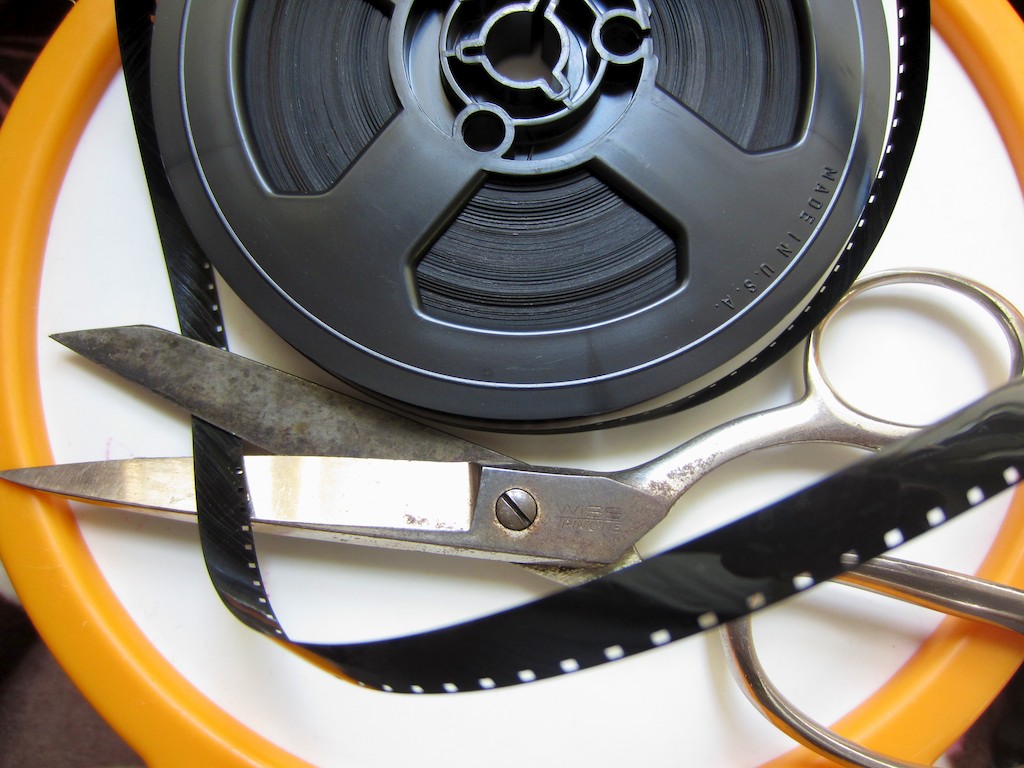
I Sold My Soul to the Digital Devil

Is Final Cut Pro X sharp enough to erase that evil deal you made to shoot movies on your camera?

If a stranger with a wicked sun burn walked up to you and said you never needed to use your camcorder ever again to record your home movies, you’d take the deal, right?

We all did this a few years back.

The last tape-based camcorder I ever bought was a Sony Mini DV unit back in 2002.

I edited the content by sucking it onto my iMac via FireWire. My editing software was iMovie and then later, Final Cut Pro.
Everything worked just fine, and I was rather chuffed with my little home media studio of the early 21st century.

Then one day, digital cameras started showing up with little red movie record buttons, and everyone suddenly realized you didn’t need tape-based camcorders anymore. Heck, you didn’t even need a camcorder. Cameras could do double duty.

Sure, the video quality wasn’t as good. There were file size limits that restricted how long you could record. And to edit your digital movie files, you had to buy external hard drives to handle the massive movie clip sizes. And the file size problem really exploded when HD recording came into fashion.

You theoretically could save the files forever. But you also had to worry about your hard drives going belly up with all your precious family memories.
(This has occurred to you, hasn’t it?)

But storage, backup, and file corruption concerns aside, I have to admit it’s pretty cool to plug your camera’s little SD card into your computer and watch your movie files quickly transfer over.

So yes, it was a time saver.
Yes, it was easier.
Yes, I liked it way better.
(really)

…BUT
(You knew that was coming.)

There is one problem that nobody ever talked about-

TRANSCODING.
No, not transwarp.
TRANSCODING!

The Deal with the Digital Devil
You must have wondered somewhere along the way how a tiny four gig SD card in a camera could record so much video. Well, it’s called file compression, and that’s your camera’s secret voodoo.

There are a few types of movie recording codecs that perform this tricky task to squeeze your movies small enough to allow them fit onto your camera’s memory card. A few of the more common codecs are H.264, Motion JPEG, and AVCHD.

These highly compressed movie formats create video files that look great when you play them back on your camera or your computer, but you couldn’t edit with them. (That’s buried on page 17 of the contract.)

So what good were these movie files if you couldn’t do anything other than look at them?

The fix here was to reprocess or “transcode” the files into a different video codec that your editing software could actually handle. This meant creating a larger and less compressed duplicate of each movie file that would play nice with your editing software.

Got that?
Just nod your head, and let’s move on.

The Devil is in the Details
As a new daddy, I went about my business editing little movies of my son’s early days by first transcoding every frickin video clip I wanted to edit with.

You can imagine the organization that kind of workflow required.
-Duplicate files.
-External hard drives filling up at triple speed.
-Archiving hell.

I’ll just say my desk at home, let alone my computer’s desktop, does not quite live up to the clean and simple aesthetic of our almost all-digital world.

But you do what you gotta do.
Right?

Was I the only father out there who had a deal with Mephistopheles to make home movies? Nobody else seemed to be talking about it.
(Maybe it’s in the contract. I really never got around to reading mine.)

The Phoenix of Final Cut Pro
A year ago, Apple shocked the digital editing world and killed off its wildly successful Final Cut Pro editing platform. Almost a decade earlier, Final Cut had brought professional non-linear editing to the masses for a fraction of the cost of competing systems.

Then Apple pulled the plug by reinventing Final Cut Pro all over again. The problem is the new version, Final Cut Pro X, is an entirely new program, “built from the ground up.”
It’s not compatible with the old version, Final Cut Pro 7.
(There is no version 8 or 9.)
So you can’t move your old or ongoing editing projects to this new editing platform. Sorry.

I got stuck in the eye of this hurricane, and for the past year I’ve been struggling to decide when to make the transition.

First off, Final Cut Pro X only works on Lion, Apple’s current operating system (and soon to be released Mountain Lion). So I first had to make the Lion upgrade.

Then, there was sooooo much bad press about how inferior this new version of FCP was. Angry editors called it iMovie on steroids. There was a consensus in the professional and semi-professional editing communities that they felt abandoned by this more limited editing platform.

So I wasn’t too eager to jump into the mess.
I’ve got plenty of my own digital messes to clean up!
(plus a few analog ones too)

But Apple kept banging their drum about how much better FCP X really was. They said you simply had to invest a little time to learn the new interface.

But there was one particular FCP X feature that caught my eye.
Apple said you didn’t need to transcode your files anymore.
You could throw just about any video codec at FCP X, and it could work with it.

Bold words.
But still I held off.

Fast forward to our current timeline, and Apple, never standing still, has been busy improving FCP X through multiple software updates.
And there’s a rumor out there that the old FCP 7 platform will cease working with the Mountain Lion OS, coming out later this month.

So I figured it was finally time.

Final Cut Pro X to the Rescue
Last week, I went to Apple’s App Store, which always has a friendly icon waiting eagerly on my iMac’s dock.

I clicked on it and downloaded Apple’s most controversial product since the iPhone 4 ‘Antenna-gate.’ (Remember all that hoopla with the antenna reception problem?)

The time had come to face my digital gauntlet.
I watched my finger make its move to launch Final Cut Pro X.

FCP X quickly sprung to life.
Would the continuity of the Lester family record on video be ensured for eons to come?
(or at least the next couple of years?)
Drum roll please…

Well, of course it worked.
But as I’ve said, the devil is always in the details.

While this is not a product review, let me confirm that FCP X is better and faster in a whole host of ways. It’s also still missing some functionality that was standard with the older version. One example is it takes three steps to blend a transition between two audio tracks instead of the old way, which took one.

I’ll live.

The Big Answer
And what about TRANSCODING?
Remember, Barrett’s holy grail?
Have we forgotten about that already?!

Can Final Cut Pro X edit my native H.264 .MOV files fresh from my Canon SX230 (standard-issue toddler cam) or Canon Elph 300 (in-a-pinch pocket cam)?

Perhaps the question should be,
“Does FCP X WANT to edit with my camera’s native H.264 movie files?”

I don’t think it really does, but it grudgingly will when told to.

FCP X quickly gave me a few opportunities to transcode my imported movies.
Pro Res 422 (a beefy codec) is now FCP X’s default transcoding option.
It was almost like, “Would you like fries with that?”

Clearly Apple’s declaration that ENDS THE ERA OF TRANSCODING has been somewhat exaggerated.

Look, I understand that better ingredients create a tastier pie.
And the same holds true in the digital world. Non-optimized movie files will make FCP X and your Mac work harder. And maybe not all Macs (especially older ones) are up for the task.

But my 2010 iMac is a 2.93 GHz Intel Core i7 with 4 gigs of RAM,
(I’m not bragging) and should be ready for the challenge. Yes?

So I refused all requests to transcode and hit the proverbial red button.
Cue another drum roll…

EUREKA!! It worked!
(And there was much rejoicing in Barrett’s brain.)

Let me proclaim this again loud and clear throughout the land!

I DO NOT NEED TO TRANSCODE MY H.264 .MOV FILES TO EDIT IN FINAL CUT PRO X!

I am free!!

Wait, did I just cut another deal with Beelzebub?
Hmmm. I don’t think so.

So today’s story has a happy ending.
Technology has made my life a little easier.
(Savoring the moment…)

Digital Zen restored.
I am At Home with Tech.

Now please excuse me while I get to work editing my five-month backlog of family videos. I think I’ll be needing to move at transwarp speed to catch up!