At Home with Tech

Unlock the power of all your technology and learn how to master your photography, computers and smartphone.

Category: Science Fiction

20 PG-13 Movies to Stream with your Family

If you’re looking for a good movie to stream with your family, here are some choices I strongly recommend with your popcorn.

Every Friday, I spend at least 30 minutes scouring through the streaming apps I pay for to see if there are any new movies for my family to watch that night. It’s become an increasingly frustrating experience, as there just aren’t that many new films moving through the pipeline these days.

Yes… I know. There are thousands of hours of available content and nothing to watch. That’s how I feel.

But to be fair, I’m still limiting my search to PG-13 movies. I think one day soon, we’ll cross into ‘R-rated’ territory. Still, finding a movie that successfully threads the needle to meet the interests of my entire family is not easy.

The Usual Suspects
Fun and action-packed is a good combination. “Star Wars,” “Pirates of the Caribbean” and MCU movies of course fit the bill, but we’ve seen them all… multiple times. And it doesn’t help that the only MCU flick this year was “Deadpool and Wolverine.” No, we’re not at all ready for that one yet. (I did enjoy it in the theater with a couple other dads, even though there were a few sloppy timeline and multiversal inconsistencies.)

Look Backwards
So, I think the answer is not to wait for the drip/drip of the next movie to show up on your app, but to look back to see what you might have missed. There are strong options that aren’t on the apps’ top 10 lists.

I’ve been maintaining my own list of movie choices for years. It’s a good reference for my family’s weekly conversation of which film we might stream next.

Here are 10 flicks for your consideration that my family has enjoyed watching together.

10 Older Movies to Watch

  • “Free Guy” (2021)
  • “Red Notice” (2021)
  • “The Adam Project” (2022)
    (Yes, they’re all PG-13 Ryan Reynolds movies that hit the sweet spot for my family.)
  • “Jumanji: Welcome to the Jungle” (2017)
  • “Jumanji: The Next Level” (2019)
    (These are rare movies that are totally funny and border on silly. But silly still works for my 14-year-old son as long as it’s done right. Note: Dwyane Johnson movies are usually appealing.)
  • “The Other Guys” (2010)
    (Entirely goofy misfit cops with Mark Wahlberg and Will Ferrell)
  • “Ready Player One” (2018)
    (Imaginative virtual reality and directed by Steven Spielberg)
  • “Passengers” (2016)
    (Space travel with Chris Pratt and Jennifer Lawrence)
  • “Knives Out” (2019)
  • “Glass Onion: A Knives Out Mystery” (2022)
    (Daniel Criag stars in these clever, funny and offbeat murder mysteries.)

3 Tom Cruise Action Movies

Over the years, Tom Cruise effectively created his own genre of action movies that are suitable for the whole family. So, his films usually show up on my list. Here are just three.

  • “Mission Impossible: Dead Reckoning” (2023)
  • “Top Gun: Maverick” (2022)
    (Arguably better than the first)
  • “Edge of Tomorrow” (2014)
    (Our son really liked the “Groundhog Day” plot device for this intense alien invasion flick.)

2 Holiday Movies for the Family

There’s that time in December when someone says, “Let’s watch a holiday movie!” Well, here are two for you.

  • “Spirited” (2022)
    (Ryan Reynolds and Will Ferrell make magic together. It’s a riff on “A Christmas Carol” that’s nice and just slightly naughty. Plus, it’s a Broadway-quality musical with tons of laughs. Move over “It’s a Wonderful Life.” This is the new standard.)
  • “8-Bit Christmas” (2021)
    (It took me two years to convince my family to watch this. Its trailer doesn’t capture the true warmth of this very silly and satisfying look back at the 80’s. It’s another instant classic to keep on your list of flicks to watch over the holidays.)

5 Movies I’ve Yet to Convince my Family to Watch

Every potential movie goes through a Lester pre-screening process. That always involves watching the trailer. Sometimes the trailers for older movies are unappealingly dated. Other times, the trailer is surprisingly missing on the app. Instead, there’s just a scene included from the movie. That doesn’t cut it at all. And that omission usually spells doom for that flick.

Here are a few of those that we have yet to watch:

  • “Twister” (The original from 1996)
  • “Valerian and the City of a Thousand Planets” (2017)
    (Certainly not as good as “The Fifth Element” from 1997, but still worth watching)
  • “Hellboy” (2004)
  • “Hellboy II: The Golden Army” (2008)
    (Directed by Guillermo del Toro. Need I say more?)
  • “John Carter” (2012)
    (A failed Disney tentpole, but I think still worth checking out. I also must admit that this is a running joke with me and my son, as he’s declined the ongoing option to watch this movie for almost half his life!)

Prepare for your Next Family Movie Night
You can’t expect everyone in a family unit to have the same interests in movies. So, if you’re a curator of options to stream, it helps to have a healthy list of choices to offer. You’ll have a better chance to find consensus on at least one.

And don’t forget to look backwards during your research. Older movies are just as good. And sometimes much better!
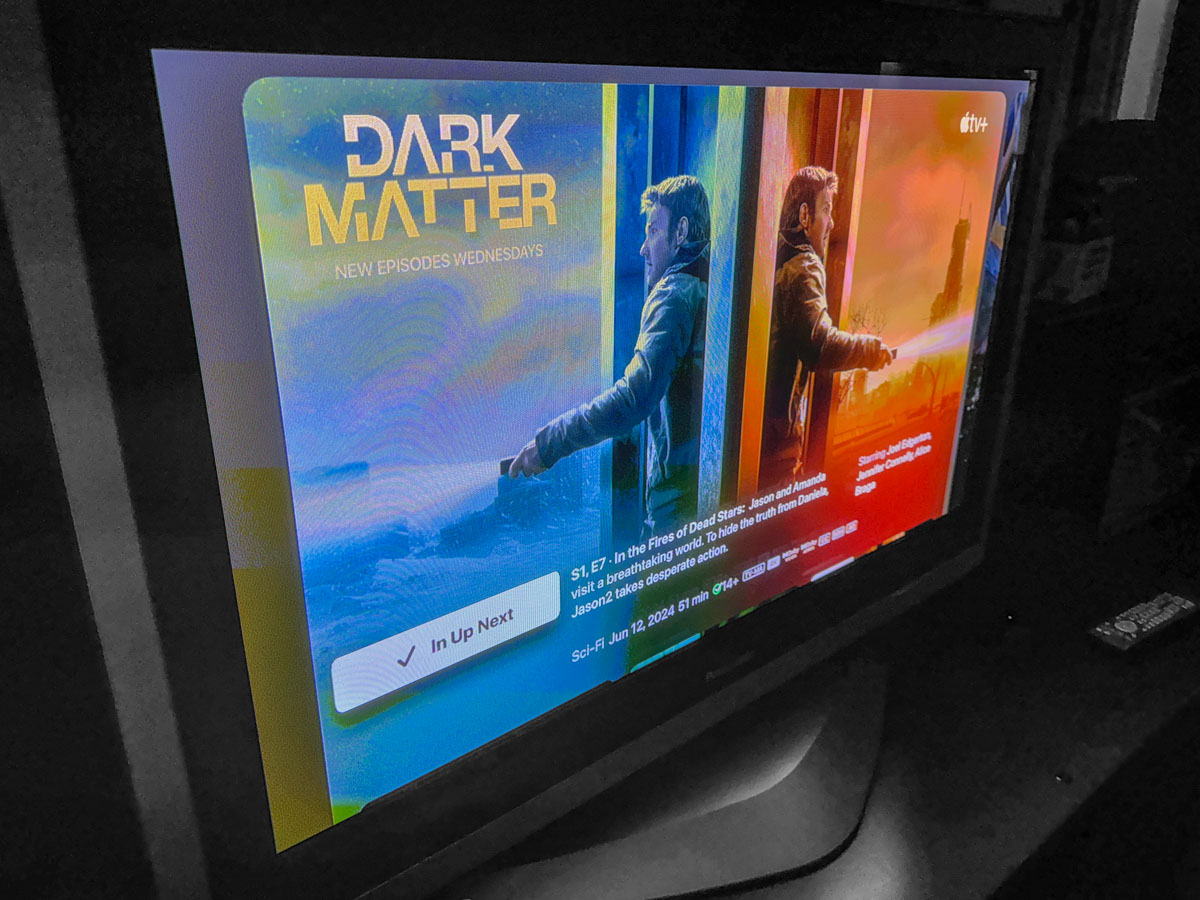
Why Dark Matter is the Best Multiverse Series on Apple TV+

You don’t have to go back in time to alter your life decisions. You can simply relocate to a better Earth. That’s the premise of “Dark Matter.”

The creatives behind the streaming shows from Apple TV+ are apparently obsessed with alternate universes, or as we like to say… the multiverse. No, multiversal travel isn’t exactly a new storytelling device. (The MCU has already brought it into our mainstream consciousness.) But Apple TV+ has really been leaning into it.

In series after series, Apple TV+ has been taking us down the multiverse rabbit hole.

“For All Mankind” lays out an alternate-reality timeline of the space program. When this series premiered in 2019 with its ‘shocking’ Moon-landing twist with no explanation, I was annoyed. There was absolutely no hint regarding the ‘why’ or ‘how’ of this alternate Earth. Today, I think we’re all finally trained to immediately accept that alternate universes need no explanation.

“Constellation” (2024) spends much of its time ‘suggesting’ that astronauts can slip between alternate realities, but the writers are intent on adding as much confusion to the equation as possible. Pro tip: You really need a note pad to help keep important details straight. The frustration helps to fuel the ongoing ‘mystery’ in the story.

And now, we’ve got “Dark Matter.”

In Search of a Better Reality
“Dark Matter” is designed to explore the road not taken in one’s life. I’m mid-season (6th of 9 episodes) as I write this, and the story surrounding a main character’s mid-life crisis demonstrates that the grass is not always greener. The dark reveal carries much of the storytelling focus. While the human factor is not science-fiction centered, the sci-fi enables everything.

Without giving too much of the plot away, the series stars Joel Edgerton who is a Chicago physics professor forcibly removed from his universe. He then tries to find his way home to his Earth and his wife played by Jennifer Connelly. And yes, you can easily guess who’s tried to replace him to fix a past mistake in his life choices.

But I’m more interested in how the writers are handling the superimposition ‘box’ that powers the travel between similar ‘adjacent’ universes. Once you’re in it, you experience an endless corridor of doors that you can open.

The mystery of where you go and why is more interesting that the pedestrian ‘thriller’ plot devices surrounding whether you can really “know” the person you’re married to.

Still, I like it all. It’s working nicely together.

Similarity to “Sliders?”
The sci-fi of traveling between universes in episodic television isn’t new.

The series “Sliders” (1995-2000) immediately comes to mind. Starring Jerry O’Connell, that show brought its main characters to a different, parallel Earth each week.

The premise was great, and the show had a lot of promise, but it devolved quickly after the writers seemed to stop trying, and the main actors began leaving the series.

How Many Earths Can You Handle?
I can’t imagine that the writers of “Dark Matter” aren’t aware of “Sliders.” But where “Sliders” got hokey, “Dark Matter” couldn’t be more serious. And this is a good thing.

That said, both series rely on coming up with new twists for each new world. “Sliders” ran out of good ideas. And I think “Dark Matter” could also begin to face alternate reality fatigue. Happily, the show seems to be narrowing its focus.

“Dark Matter” is Solid
Which is all to say that I’m pleased so far with “Dark Matter.” While it is character driven, the sci-fi implementation is also interesting.

That said, the series is not without certain gaps. (Why are there boxes in every Earth, even when it’s clear that no one built it?) Plus, we all know where the plot is inevitably leading.

Still, it’s fresh and well done. The first episode takes a little too much time to get its basics in place, but after that, “Dark Matter” easily passes the bingeable-watching litmus test.

“For All Mankind” has always dragged with too much family drama. “Constellation” relishes its own confusion a bit more than I’d prefer. “Dark Matter” strikes the right balance to create a compelling storyline.

I’m happy to report that “Dark Matter” is the best multiverse show streaming on Apple TV+.

Did Star Trek: Discovery Get a Proper Series Ending in Just 15 Minutes?

“Discovery” had only fifteen minutes to wrap it all up after five seasons. That’s certainly a Kobayashi Maru test. This life-long Trekkie shares his experience watching this no-win scenario play out at the end of the final episode.

Being a “Star Trek” fan isn’t what it used to be. Not that being a Trekkie with a phaser was ever especially cool… like sporting a “Star Wars” light saber. I’ve been a Trekkie-nerd all my life, and though there’s admittedly a resurgence of Trek via the several new series on Paramount Plus, “Star Trek: Discovery” has hardly been dominating water cooler chats. (Do those even happen anymore?)

Except for the newest series, “Strange New Worlds,” which somehow captured the magic of the original series, Star Trek hasn’t been ‘must-see TV’ for a long while.

Science fiction fans I talk with admit to having missed entire Star Trek series from decades past and are only now starting to check them out. That says a lot about the cultural state of Star Trek.

Still, I love my Star Trek.

No, I haven’t exactly loved, “Star Trek: Discovery,” but I’ve stuck with it since 2017, through its course corrections and time traveling to reset itself.

Time to Say Goodbye
I reflected last week about how most of the past Star Trek series have had trouble giving us a satisfying final episode.

Now, “Star Trek: Discovery” has streamed its own finale. As part of this extended episode, there’s a closing fifteen-minute epilogue. This sequence was shot two months after season five wrapped filming. And the production on these extra three days of shoots were the only time that the cast and crew knew the series was ending.

So no, there was no gradual way across this final season to wrap up loose ends.

The writers’ mission: Finish “Star Trek: Discovery” in fifteen minutes.

And how exactly did they decide to do that? (Spoilers ahead.)

Answer a Thousand-Year-Old Question
Inexplicably, the writers focused their critical coda on filling a plot hole left behind during the 2018 “Star Trek: Short Treks” episode “Calypso,” which takes place a thousand years in the future.

“Short Treks”? Who remembers any of those?!

Okay, I did find it confusing when I originally watched this mini episode. Zora, our favorite AI voice since Majel Barrett rescues a soldier adrift in an escape pod. The crew apparently abandoned Zora and the Discovery to float into the far future, and no further clues are provided.

It’s a plot gap I never really thought about again, and clearly not one the writers were eager to return to after all these years. I don’t feel there was a huge need to devote any of the last precious minutes of “Discovery” to explain it.

Discovery’s Final Mission
But that’s what happens. The final scene in the series is between Burnham and Zora and explains how the Discovery and Zora get sent on their final lonely mission to wait around in deep space for a millennium. The rest is conveniently shrouded in ‘Red Directive’ secrecy. (So, more questions than answers.)

This same scene is simultaneously tasked with handling the crew goodbyes in a swift pseudo-flashback sequence.

And that’s the series’ conclusion. The whole thing runs about six minutes.

And what about the first nine minutes?

Meet Michael Burnham’s Family
The epilogue begins with ‘Admiral’ Burnham and Book happily living their lives together decades in the future.

It’s well-crafted and takes its time. But this sequence plays like a beginning more than an ending. It could be the intro to a whole new series- “Star Trek: Burnham” (like “Star Trek: Picard”).

But there just isn’t time to introduce us to this new family… not at the expense of everything else.

What about our Discovery family? These are the characters we really want to say goodbye to.

But we don’t get the chance. Not really.

What Happens to the Rest of the Crew?
So, the writers devote the epilogue to explain how the Discovery gets sent to the distant future (not why), and they start with this lengthy love letter to the future Burnham family.

These plot choices rob the Discovery’s crew, who we’re supposed to know and love across these five seasons of getting their satisfying set of goodbyes. Sure, there’s some hugging, but it’s rushed, and the imagined-flashback plot device is a cheat.

To be fair, maybe that’s really all the production had time for with only three extra days of shooting given to them.

And so, the writers chose the Burnham family over the Discovery family.

Angry Trekkie
But I’ve got to tell you, this all feels so unnecessary.

It’s not 1969. Star Trek is not some experimental ‘Wagon Train to the Stars’ anymore.

This established franchise that’s endured for more than a half century deserves better than three days to wrap it up on whatever sets are left standing and then get out of Dodge.

Look, I know that “Star Trek: Discovery” was uneven. And I’ve complained my fair share. I’m not surprised it was time to move on. But this is about ‘how’ they did it.

In the articles I’ve read, the Star Trek PR machine says that everyone involved with the series was ‘satisfied’ with this tacked-on standalone ending sequence.

But I know that’s just spin.

Management
Should I, as a Trekkie, be happy that ‘management’ (to reference a healthier sci-fi series) was magnanimous enough to grant this cancelled series an ending?

Sure. But come on. I think we can do better than this.

Management didn’t have to create an impossible Kobayashi Maru test for the writers.

Fifteen minutes just isn’t enough time for a proper ending.

That’s All Folks
So, they effectively gave it all to our captain and star of the series. And Sonequa Martin-Green indeed did a really nice job with it.

I then watched the U.S.S. Discovery get banished (again) into the future to close a forgotten past plot hole and perhaps satisfy some future, unstated plot requirement. And that was it. Roll credits.

I shrugged.

“Discovery” now joins a long list of Trek series’ endings that underdeliver.

Except for “The Next Generation” and “Picard,” all the rest left me wanting more.

Goodbye “Star Trek: Discovery.” Even though I gave you a hard time across your journey. I was glad to know you. And I haven’t forgotten that you brought Star Trek back to TV.

Live long and prosper… in streaming reruns.