At Home with Tech

Unlock the power of all your technology and learn how to master your photography, computers and smartphone.

A Digital Sniffer Can Be Your Nose’s Best Friend

Gas in the home doesn’t always look like this. If there’s a leak, and you don’t know it, your nose is your only defense. Or is it…?

Gas in the home doesn’t always look like this. If there’s a leak, and you don’t know it, your nose is your only defense. Or is it…?

Did you know your nose might be called upon at any moment to save you and your family?

If you use natural gas to heat your home or power your oven, you might be familiar with the fact that your gas company adds a rotten-eggs smell (mercaptan) to its otherwise odorless natural gas to help you know if there’s a gas leak.

But what if you can’t totally trust your nose?

I just went through one of these real-life ‘moments’ a few nights ago.

Let me set it up like a Lifetime movie…

After the Opening Credits
Scene 1: Fade up to a nighttime shot of a typical suburban neighborhood.
The full moon glows overhead.

An ominous music track begins…

Zoom in to a house containing a sleeping family, all cozy in their gas-friendly home.

Dissolve to the parent’s bedroom.

Cut to medium shot of the happily sleeping husband. The clock on the night table glows 4:00am. Next to it, an outdoor thermometer display reads 15 degrees.

Cut to tight shot of the wife’s eyes popping open.

“Are you awake?”

“Murphenpoppen. Cragglesnaffen. Mmmrph. Uuuhh.
Yesss!”

“Do you smell something?”

“What?”

“I think I smell gas. Do you?”

“I’m not sure. My nose is a little stuffed. Hang on.
(SNIFFF)
I don’t think so.”

“I do. Would you go downstairs and check it out?”

The husband gets out of the bed and embarks on the critical mission.
His weapon of choice: His nose.

The stairs creak ominously as he descends.

Fade to back.

Putting the Nose to Work
I’m happy to report my life is not a Lifetime movie.
That said, here’s what happened next…

I walked carefully about the kitchen and the basement and put my nose in action.
I sniffed the stove. I sniffed the oven. I sniffed here and there. I sniffed everywhere.

Our two cats watched me perform this strange human ritual of safety.
They were not impressed.

My verdict: Nothing.
I couldn’t detect any signs of a gas leak.

I think I may have picked up the essence of a few charred remains from dinner.
(My meat-broiling skills have been a little off lately.)

But my nostrils did not reveal anything else out of the ordinary.

So I shared my findings upstairs, and we both went back to sleep.

Time to Team Up with Technology
The fact that I’m still here to document this incident means my conclusion was correct.

And I want to thank my wife for waking me up in the dead of night to go on what might otherwise be considered a fool’s errand.
(Up until then, I hadn’t figured out a post topic for this week!)

Because I suddenly realized how nice it would be if I had a little technology on my side the next time to help with the investigation.

The Digital Sniffer
We all have carbon monoxide detectors in our homes, but it’s not common to see digital gas sniffers hanging around. I guess the rotten egg smell is supposed to do the trick all on its own.

The gas detector market is mostly focused on devices that can zero in on the precise location of a gas leak. These $200-$300 (and up) sniffers will help your plumber isolate the spot on the gas pipe needing repair.

But these expensive gadgets overshoot my particular parameters.
I just want some affordable tech to tell me,
“Yes, your nose is correct. There’s gas in this room! Get out now!!”

I’d let the professionals take it from there…

Conversely, I want a device to support my conclusion if, in fact, there isn’t any gas hanging around the house.

I would certainly sleep better knowing that the rest of my night won’t play out like an explosive scene from a Michael Bay movie.

Sure, your schnoz should easily detect the rotten egg scent, but what happens if you’ve just recovered from one of those nasty January colds?

Sniffing Out the Best Solution
The good news is there are a few less-expensive sniffers out there that should do the trick.

Here are a couple more choices out there around the $100 price point:

Earlier I hedged with the phrase, “should do the trick.”
It’s worth repeating each of these choices received some percentage of reviews saying the device came up short. And the fact that there are other options costing hundreds of dollars more is a reminder that these sniffers have certain limitations.

That said, the EUi CD100A appears almost universally loved.

Keeping Your World Safe, One Sniff at a Time
A digital sniffer can be exceptionally useful to have around the next time you “think you smell gas.”

But should you entirely trust one of these ‘more-affordable’ units?
Of course not.
(I wouldn’t completely put my life in the hands of a $300 device.)

Just think of a digital sniffer as simply another addition to your overall tool belt to help you protect your world.

And your nose will thank you!
How to Help your Car Stream Bluetooth Music from your Smartphone

If you don’t like running a cable from your phone to your car and your vehicle can’t talk ‘A2DP,’ it’s time to buy a Bluetooth receiver that can!

If you don’t like running a cable from your phone to your car, and your vehicle can’t talk ‘A2DP,’ it’s time to buy a Bluetooth receiver that can!

You may have heard I bought a Toyota RAV4 last month.
Like any new relationship with tech, I was dazzled by all the sparkle.

“Look Ma… no keys!”

“And you can make Bluetooth-enabled hands-free calls from your smartphone with the car’s voice-recognition technology using the overhead microphone and stereo speakers?
Cool!!”

But the next morning, you invariably wake up, take another look and realize when it comes to tech, perfection is always just out of reach.

“You can’t stream music from a smartphone to the car’s speakers via Bluetooth?!
You didn’t tell me that last night!!”

Your Phone’s Ball and Chain
When your tech isn’t the latest and greatest, you’re at risk for a few surprises…
(Remember, I bought a pre-owned vehicle.)

And while car body styles don’t change much from year to year, the embedded tech you don’t see ages swiftly in dog years.
(Today, a brand new RAV4 can do the streaming music trick.)

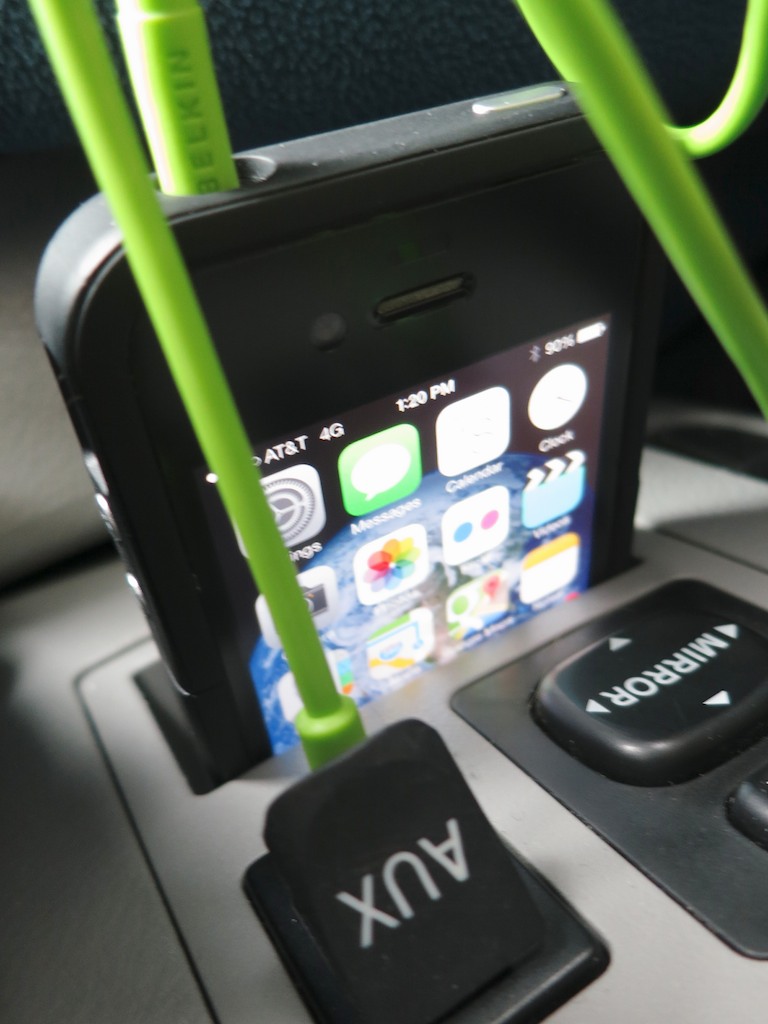
So to play my iPhone’s music through my car’s stereo system, I discovered I needed to jack in my iPhone to an AUX input port next to the shift lever, using a bright green mini cable (3.5 mm) I had lying about.

Now, who wants to hard-wire your phone every time you want some tunes?
(How embarrassing.)

So what’s a humanoid to do?

Get thee to a computer and research a Bluetooth receiver workaround to replace this messy, old school cabling solution!

You may not need the resources of a Viking king to figure it all out,
but it couldn’t hurt. I found this tech rabbit hole particularly deep…
(Along the way, you may even uncover the origins of Bluetooth’s odd name!)

R2D2 Vs A2DP
Like my RAV4, lots of newer cars come equipped with Bluetooth power to make smartphone calls via the car’s stereo system.

But to stream music via Bluetooth from the same smartphone, a car also needs to be ‘A2DP’ capable.

What?
(Is that something out of “Star Wars?!”)

A2DP is simply a newer Bluetooth flavor.
It stands for “Advanced Audio Distribution Profile.”
And that’s what enables your car to stream Bluetooth ‘audio.’

So if your car can’t do A2DP, what you need is a portable A2DP Bluetooth receiver to pair with your smartphone and then send the A2DP audio down the car’s AUX jack with its own cable.

Don’t Cross the Streams
In case you’re wondering, it’s not a problem to pair two devices to your smartphone:

  • One connection to your car’s phone system
  • Another to your new Bluetooth adapter for music

In fact, Bluetooth tech allows you to connect up to 8 devices simultaneously.

Just don’t try to do exactly the same thing with any two of the connections.
That would cause a universe-ending ‘conflict.’
(like crossing the streams in “Ghostbusters”)

Choose your Bluetooth Receiver!
There are three variables to consider when you look to buy your portable Bluetooth receiver:

  • Price
  • Power
  • Pleasure

You might expect a wide range of available solutions to address all three pieces. But in fact, there are not!

The challenge is finding a compact unit with a DC adapter that’s priced right.

I’ve done some research, and I’m chastened to report in today’s marketplace you can only get two of the three:


#1 – Compact and Good Price, but Requires Regular Recharging

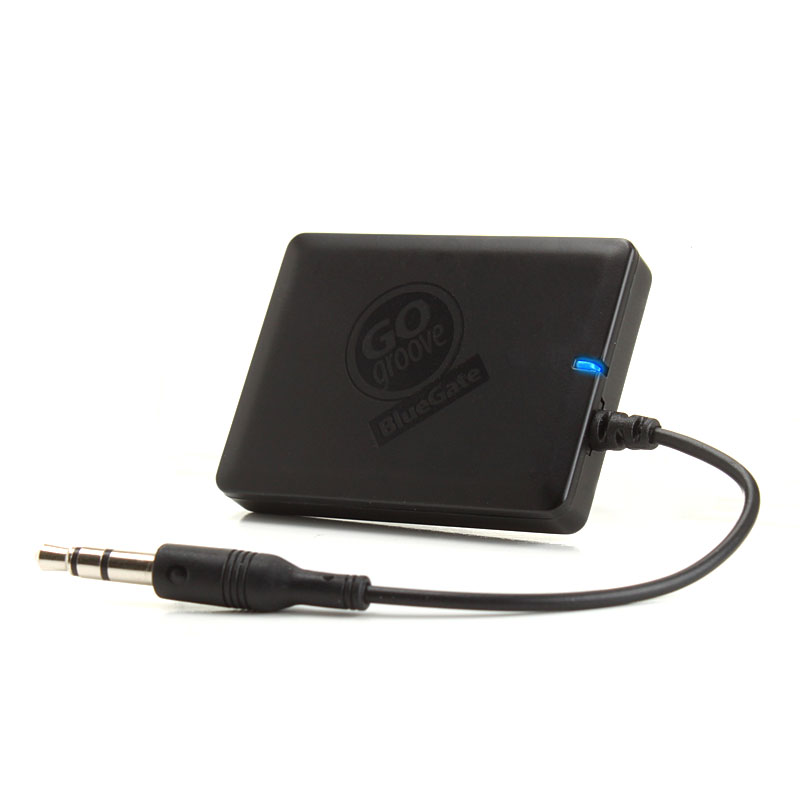
GOgroove BlueGate

Gogroove BlueGate Bluetooth Adapter – $29.99

What’s not to like? The form factor is perfect!
It’s tiny and does the job of bridging the inches between your iPhone and the AUX jack. The problem is it only runs on its rechargeable battery.
So you’ve always got to worry about charging it up via a USB port.

Runner up:

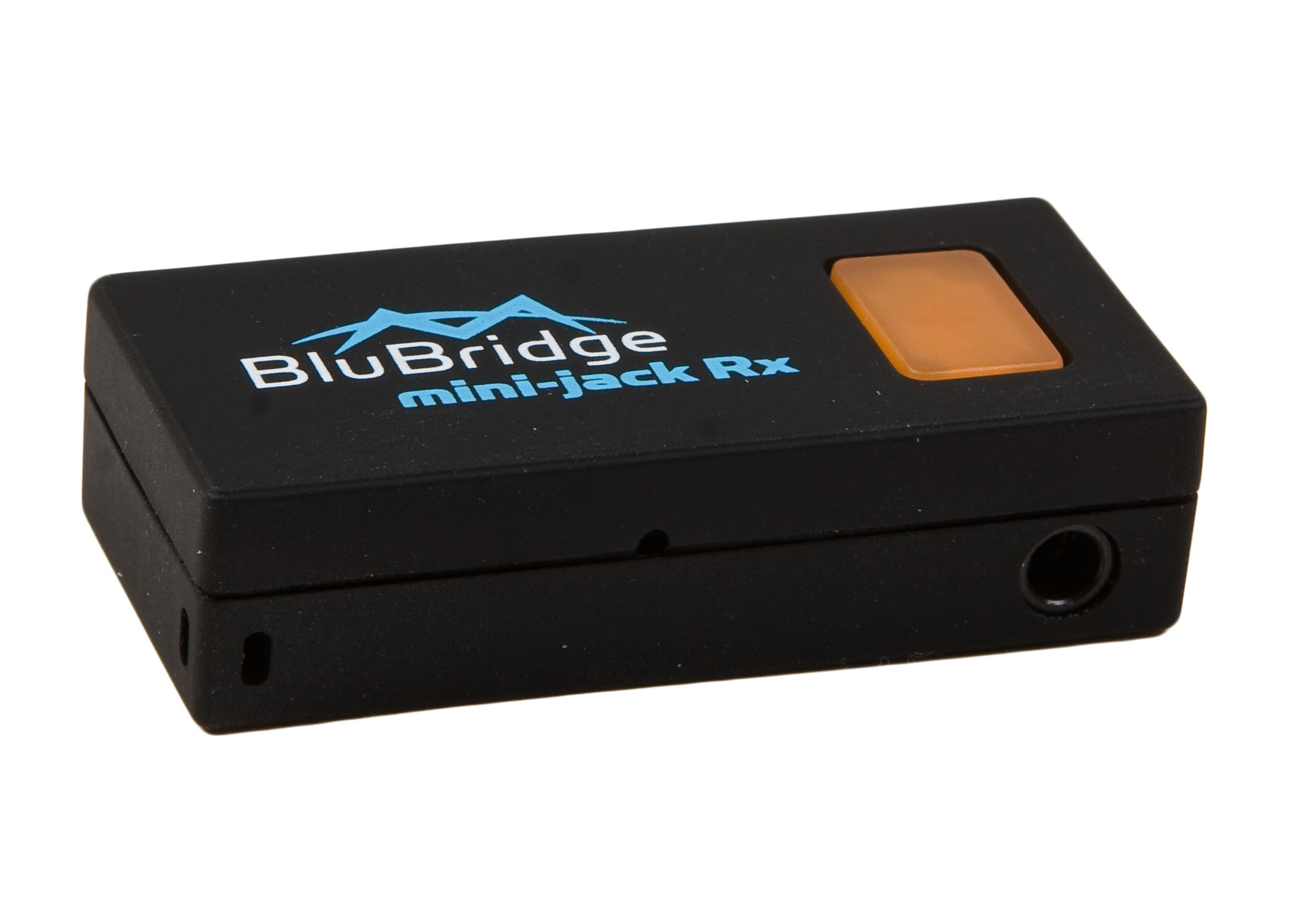
Miccus Mini Jack Rx

Miccus Mini-Jack Rx Bluetooth – $37.99

This one doesn’t have the short cable. Its little plug juts right out of the unit.
Then, the tiny stick attaches onto the AUX jack.
This uber-compact design may or may not work for your car…


#2 – Good price and DC Adapter, but More Messy Cables

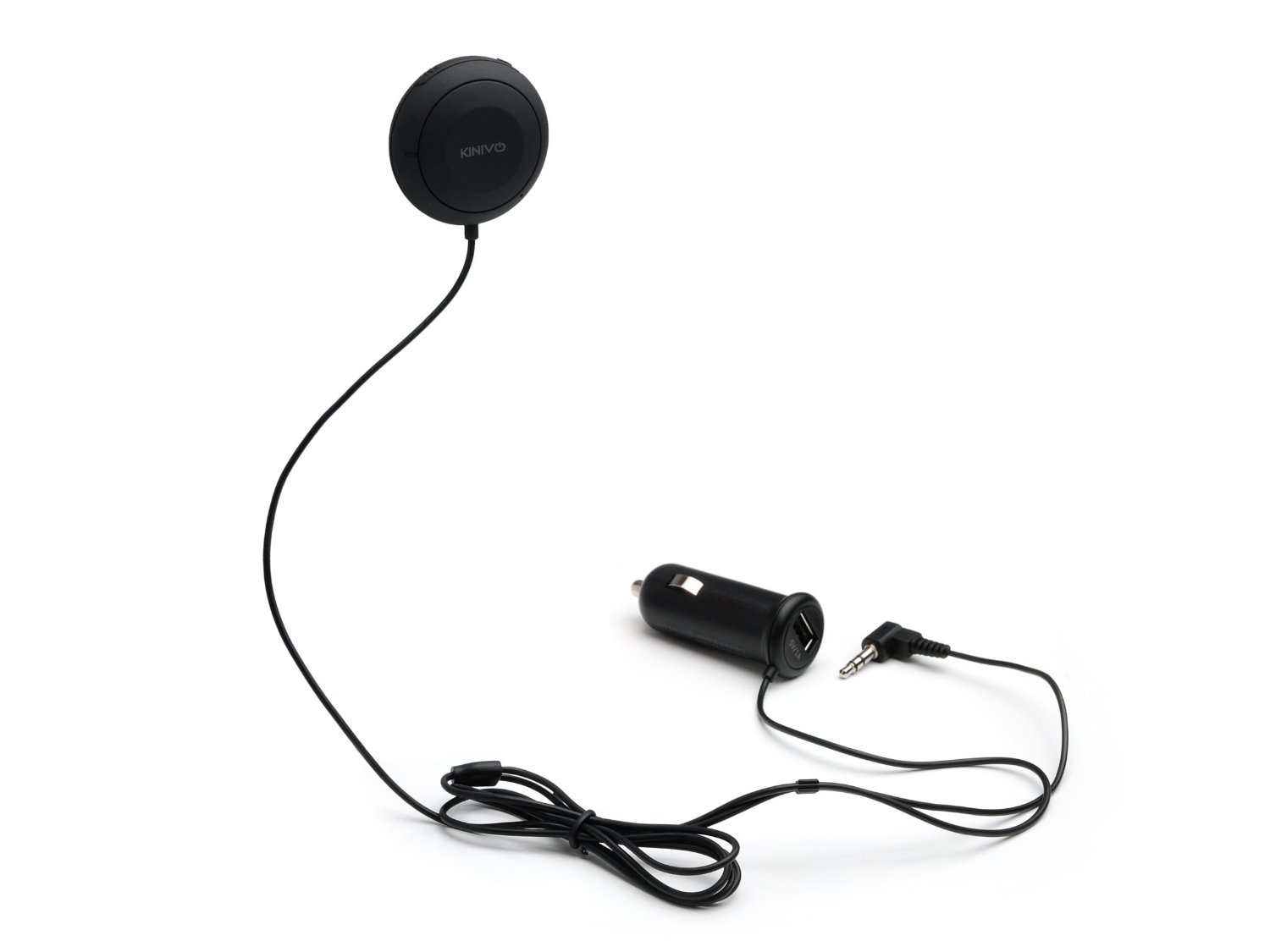
Kinivo BTC450

Kinivo BTC450 Bluetooth Hands-Free Car Kit – $39.99

This device can also handle your phone calls, because it houses a microphone in its little disc controller.
But you don’t have to use it for that purpose, since you’ve already got your car’s phone system paired to your phone for that use.

The unit gets really great reviews on Amazon. It even auto-connects, when it senses your phone! The only problem is you’ve got two cables to contend with.
(DC power to the unit, and then the connection to the AUX jack)
Granted, neither of them weighs down your phone.

Runner up:

Belkin Bluetooth Car Hands-Free Kit – $79

It’s more expensive, but for no apparent reason.
(sigh)


#3 – Compact and a DC Adapter, but Expensive

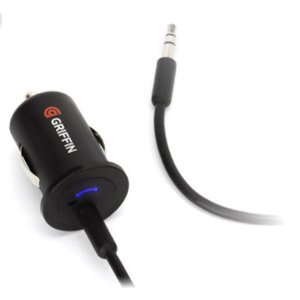
Griffin Technology BlueTrip AUX

Griffin Technology BlueTrip AUX- $99

This should be the perfect choice!
Its design has only one cable running from your DC adapter
(which houses the Bluetooth receiver) straight to your AUX jack.

The only problem is price. It shouldn’t be this expensive!
I think the root cause is it’s been discontinued.
(no longer seen on Griffin’s website.)

Now, it’s only offered on Amazon Prime through a third party.
So, buyer beware…

Runner up: NONE!

(I don’t see any other products out there designed like the BlueTrip AUX…)

Tomorrow is NOT Yesterday
I think the real problem here is there’s no ‘problem.’
What I mean is… today’s ‘new’ cars can normally handle A2DP audio streaming if they’ve got Bluetooth functionality.
They don’t need no stinking adapters!

So this is yesterday’s problem.

Manufacturers know this and probably haven’t continued to offer more efficient solutions, simply because there’s no future in supporting this particular past.
(I came upon several viable devices online that were no longer available…)

The Kinivo Joins the Team
So what’s a cable-phobic tech everyman to do?

Honestly, I considered doing nothing and just leave that bright green mini cable in my car for my iPhone’s use. The phone slips nicely into a little slot right above the AUX jack.
(My little green snake really isn’t that horrible!)

But that solution wouldn’t be very forward focused, would it?
And hardly a fitting end to this week’s epic journey in search of tech enlightenment.

So I Iooked again at the Kinivo and its 963 ratings boasting four and five stars.
(versus only 97 lower ratings)

Click.

If adding two cables to lose one cable is what it takes to free up my iPhone from its lowly 20th century tether, then I say….

…well, let’s move on.

Did I mention how much I love my car?

Are You as Smart as your Car?

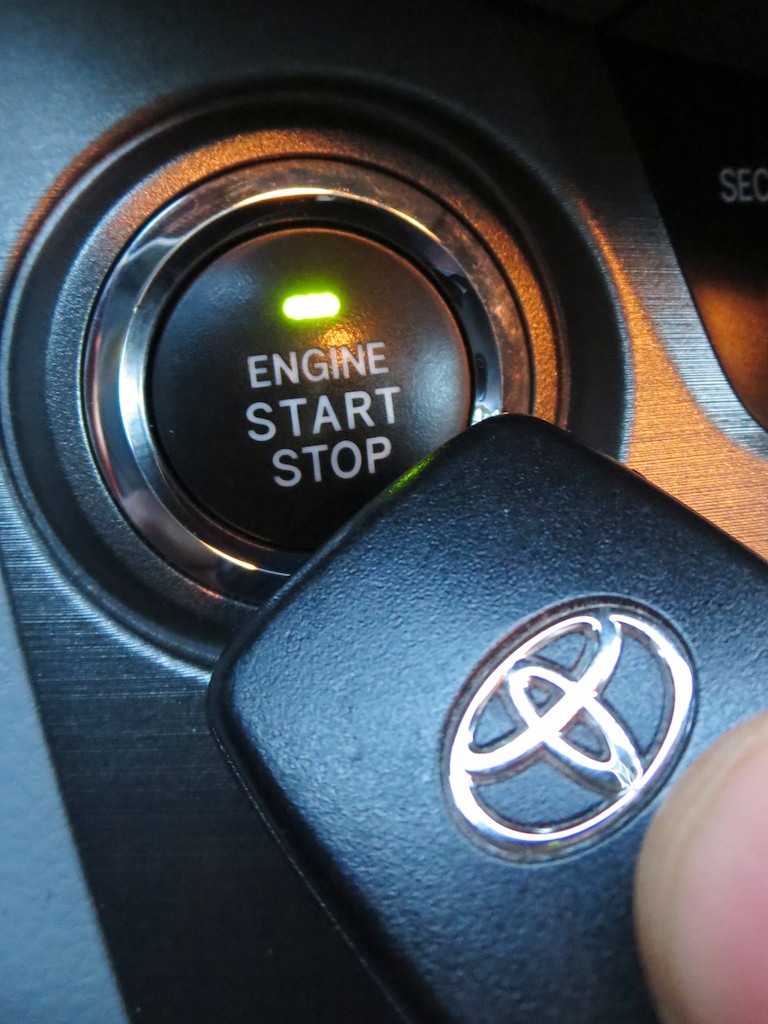
This is the magic “kiss” that you hope you’ll never have to perform with your Smart Key to revive your keyless car. Don’t know what I’m talking about? Exactly…

This is the magic “kiss” that you hope you’ll never have to perform with your Smart Key to revive your keyless car. Don’t know what I’m talking about? Exactly…

I love my new car.
It’s really smart.
But now, I realize it may be a little too smart for my own good…

Last time on At Home with Tech,
I survived the car-buying gauntlet, and brought my Toyota RAV4 home.

But my brain was so focused on surviving the deal, I didn’t commit enough neurons to analyzing all the technology baked into the vehicle.

There was one feature that became of particular interest almost immediately after I drove off the lot…

Be Careful What You Wish For
The car comes with a ‘Smart Key’ remote instead of a standard key.
Essentially, it’s a mini transmitter that tells the car’s CPU, “Give this human full access to the vehicle.”
(until Skynet takes over)

All you need to do is carry the Smart Key in your pocket, and the car senses your presence.
When you walk up to the car and reach your hand to the door, the car unlocks automatically.
(an impressive parlor trick)

Once you’re in the car, there’s no ignition switch… just a push button labeled “Engine Start/Stop.”

It seems the future has arrived!

The Risks of Smart Key Technology
Actually, Smart Key tech has been around for more than a few years.
(Mercedes Benz offered the first one way back in 1998… interestingly only a few months after Skynet’s fictional creation.)

Today, lots of car brands are using this keyless ignition system tech.

Beyond convenience, Smart Key technology is supposed to be more secure, since it uses rolling security codes to frustrate hackers.

But as wonderful as it is, this advanced car tech can lead to some inconveniences down the line.

So if you aren’t familiar with this issue before you buy your next set of wheels…
(guilty as charged)
…at least you should be aware of it before it crops up when your roadster is parked in the middle of nowhere, and HAL won’t open the pod bay doors…
let alone start the car.

A Kiss can Save your Day
So what happens when your Smart Key remote dies?
How do you get into your car without a physical key?

The good news is Toyota thought of that.
They slipped a tiny key into the body of the Smart Key fob.
It’s totally hidden, and you’ve got to press a micro button to activate its release, like you’re 007.

So that gets you in.

But then how do you start the car?
Remember, there’s no place to insert your James Bond back-up key.

So I scoured the manual, did a little online research and then called a local Toyota dealership in search of an answer…

What I discovered sounds almost too good to be true:

If you place the Smart Key right next to the Engine Start button…
(like the remote is giving the button a little kiss)
…that little techy love smooch will magically power up your car when you press the Start button.

Uh huh.

Yes, you can awaken your sleeping beauty simply with a kiss…

The Power of Resonant Energy Transfer
The ‘how’ of this tech voodoo isn’t readily accessible on the Internet.
I really had to dig to find what I believe is close to an accurate answer…
(I guess Toyota doesn’t want to give away any secrets.)

The service department rep at my Toyota dealer actually told me that nobody has ever asked her why ‘the kiss’ works before.

But simple science backs up this seemingly too-good-to-be-true fairy tale hocus-pocus…

Here’s the deal:

Even without a working battery, the Smart Key remote has a passive proximity chip that’s activated when the frequency chip behind the Engine Start button sends out its radio signal looking for the fob’s start code.
(as long as the Smart Key is close enough to the button)

Science fiction?
Not really…

Your Smart Key’s backup system operates much like your work ID card that opens the doors in your office building…
The ID card is called a proximity card and contains an itty-bitty antenna and frequency chip. Your card will receive enough power from the RF signal provided by the door’s reader device for the card to transmit back its presence.
(The whole thing is called ‘resonant energy transfer’… for you geeks out there.)

So in a sense, your car’s Smart Key gets enough juice from the car to ID itself in an emergency and get the car going!

And all it takes is a kiss…

Once Upon a Time…
Sleeping Beauty always wakes up in the story, but I decided I should have a back-up plan, just in case.
(Somehow, my life doesn’t clock in like a fairy tale every day. You?)

So I ordered a couple of batteries on Amazon to power my remote. And I’ll keep them in the car, just to be safe. That way, I’ll be prepared if I need to do emergency surgery on my Smart Key should it decide to loose its smarts and can’t be persuasive with a kiss.

Silly Humans
I know I might be over reacting.
(just a bit)

Besides, this problem isn’t supposed to announce itself without warning.
Apparently, when the Smart Key’s battery begins to go… you’ll notice its shrinking capacity.
Its like when your TV remote starts to weaken….the channel buttons work only occasionally… and only when you push them with ‘great intent.’

Keep it in your Pocket!
Oh… here’s a final word to the wise, should you still be considering joining the Smart Key generation.

Don’t lose your Smart Key.
Your wallet will tell you that’s definitely not a smart thing to do…

For the record, when I bought my RAV4 last month, the salesman warned me it would be an expensive venture to replace the Smart Key.
(He didn’t say how expensive.)

I confidently replied I didn’t intend to lose either of the two fobs that came with the car.

But of course, I was curious what the damage would be.
So I called back my local Toyota dealer.
(I think they know me by name, now.)

$440.
(gulp)

Yes, it costs $440 to replace a lost Smart Key.

I think somewhere out there you can buy a car for $440 that will pass inspection.

How does one get to $440?
The dealer broke it down for me:

  • $200.00 for the smart controller fob
  • $112.94 for the laser-cut, mechanical (back-up) key
  • $127.95 to program the controller and the car together

That totals $440.89. (plus tax)

That’s a far cry from getting a spare key for a few bucks cut by your friendly locksmith down the street.

That said, I don’t plan on losing my fob.
If I don’t have to take it out of my pocket, why would I ever lose it?
(famous last words)

You’ve Come a Long Way, Baby
I suppose the old practice of putting a key into an ignition switch is rather analog. What’s really so crazy about Smart Key technology?
But isn’t it a little freaky how advanced cars are becoming?

On the not-too-distant horizon, Google’s got its self-driving car project
ready to launch.
One day, ‘driving’ one of those cars is really going to take a lot of trust on my part.

So I’ve decided that smart vehicle should have a wicked-large
glove compartment.  Because I’ll be bringing plenty of back-up batteries…!!