At Home with Tech

Unlock the power of all your technology and learn how to master your photography, computers and smartphone.

Did Star Trek: Discovery Get a Proper Series Ending in Just 15 Minutes?

“Discovery” had only fifteen minutes to wrap it all up after five seasons. That’s certainly a Kobayashi Maru test. This life-long Trekkie shares his experience watching this no-win scenario play out at the end of the final episode.

Being a “Star Trek” fan isn’t what it used to be. Not that being a Trekkie with a phaser was ever especially cool… like sporting a “Star Wars” light saber. I’ve been a Trekkie-nerd all my life, and though there’s admittedly a resurgence of Trek via the several new series on Paramount Plus, “Star Trek: Discovery” has hardly been dominating water cooler chats. (Do those even happen anymore?)

Except for the newest series, “Strange New Worlds,” which somehow captured the magic of the original series, Star Trek hasn’t been ‘must-see TV’ for a long while.

Science fiction fans I talk with admit to having missed entire Star Trek series from decades past and are only now starting to check them out. That says a lot about the cultural state of Star Trek.

Still, I love my Star Trek.

No, I haven’t exactly loved, “Star Trek: Discovery,” but I’ve stuck with it since 2017, through its course corrections and time traveling to reset itself.

Time to Say Goodbye
I reflected last week about how most of the past Star Trek series have had trouble giving us a satisfying final episode.

Now, “Star Trek: Discovery” has streamed its own finale. As part of this extended episode, there’s a closing fifteen-minute epilogue. This sequence was shot two months after season five wrapped filming. And the production on these extra three days of shoots were the only time that the cast and crew knew the series was ending.

So no, there was no gradual way across this final season to wrap up loose ends.

The writers’ mission: Finish “Star Trek: Discovery” in fifteen minutes.

And how exactly did they decide to do that? (Spoilers ahead.)

Answer a Thousand-Year-Old Question
Inexplicably, the writers focused their critical coda on filling a plot hole left behind during the 2018 “Star Trek: Short Treks” episode “Calypso,” which takes place a thousand years in the future.

“Short Treks”? Who remembers any of those?!

Okay, I did find it confusing when I originally watched this mini episode. Zora, our favorite AI voice since Majel Barrett rescues a soldier adrift in an escape pod. The crew apparently abandoned Zora and the Discovery to float into the far future, and no further clues are provided.

It’s a plot gap I never really thought about again, and clearly not one the writers were eager to return to after all these years. I don’t feel there was a huge need to devote any of the last precious minutes of “Discovery” to explain it.

Discovery’s Final Mission
But that’s what happens. The final scene in the series is between Burnham and Zora and explains how the Discovery and Zora get sent on their final lonely mission to wait around in deep space for a millennium. The rest is conveniently shrouded in ‘Red Directive’ secrecy. (So, more questions than answers.)

This same scene is simultaneously tasked with handling the crew goodbyes in a swift pseudo-flashback sequence.

And that’s the series’ conclusion. The whole thing runs about six minutes.

And what about the first nine minutes?

Meet Michael Burnham’s Family
The epilogue begins with ‘Admiral’ Burnham and Book happily living their lives together decades in the future.

It’s well-crafted and takes its time. But this sequence plays like a beginning more than an ending. It could be the intro to a whole new series- “Star Trek: Burnham” (like “Star Trek: Picard”).

But there just isn’t time to introduce us to this new family… not at the expense of everything else.

What about our Discovery family? These are the characters we really want to say goodbye to.

But we don’t get the chance. Not really.

What Happens to the Rest of the Crew?
So, the writers devote the epilogue to explain how the Discovery gets sent to the distant future (not why), and they start with this lengthy love letter to the future Burnham family.

These plot choices rob the Discovery’s crew, who we’re supposed to know and love across these five seasons of getting their satisfying set of goodbyes. Sure, there’s some hugging, but it’s rushed, and the imagined-flashback plot device is a cheat.

To be fair, maybe that’s really all the production had time for with only three extra days of shooting given to them.

And so, the writers chose the Burnham family over the Discovery family.

Angry Trekkie
But I’ve got to tell you, this all feels so unnecessary.

It’s not 1969. Star Trek is not some experimental ‘Wagon Train to the Stars’ anymore.

This established franchise that’s endured for more than a half century deserves better than three days to wrap it up on whatever sets are left standing and then get out of Dodge.

Look, I know that “Star Trek: Discovery” was uneven. And I’ve complained my fair share. I’m not surprised it was time to move on. But this is about ‘how’ they did it.

In the articles I’ve read, the Star Trek PR machine says that everyone involved with the series was ‘satisfied’ with this tacked-on standalone ending sequence.

But I know that’s just spin.

Management
Should I, as a Trekkie, be happy that ‘management’ (to reference a healthier sci-fi series) was magnanimous enough to grant this cancelled series an ending?

Sure. But come on. I think we can do better than this.

Management didn’t have to create an impossible Kobayashi Maru test for the writers.

Fifteen minutes just isn’t enough time for a proper ending.

That’s All Folks
So, they effectively gave it all to our captain and star of the series. And Sonequa Martin-Green indeed did a really nice job with it.

I then watched the U.S.S. Discovery get banished (again) into the future to close a forgotten past plot hole and perhaps satisfy some future, unstated plot requirement. And that was it. Roll credits.

I shrugged.

“Discovery” now joins a long list of Trek series’ endings that underdeliver.

Except for “The Next Generation” and “Picard,” all the rest left me wanting more.

Goodbye “Star Trek: Discovery.” Even though I gave you a hard time across your journey. I was glad to know you. And I haven’t forgotten that you brought Star Trek back to TV.

Live long and prosper… in streaming reruns.
Why can’t Star Trek Shows Stick their Landing?

“Star Trek: Discovery” is ending. But you wouldn’t know by watching the fifth and final season. Is this cancelled Trek reboot doomed to the same fate as the original series? Not necessarily.

Every story has an ending. TV series should as well. Unfortunately, lots of shows get cancelled unexpectedly before the storyline can be neatly wrapped up. And that can be even more jarring for series that end their seasons with a cliffhanger.

Star Trek is no different. This enduring set of related sci-fi series has had to address their own endings since 1969. Now, “Star Trek: Discovery” is faced with its own final episode.

Yes, this fifth season is the last. And apparently, no one knew that while they were writing and shooting these ten episodes. And it shows. It feels just like another normal day in the 32nd century, with none of the broader loose ends being tied up. Now, we’ve got just one more episode to go.

Apparently after the unexpected ‘cancellation,’ the crew went back into production to shoot additional scenes for the final episode. I guess that’s something.

It’s strange. Most of the other Star Trek series have also had problems dealing with their conclusions (spoilers ahead).

Kirk Out (1966-1969)
The original “Star Trek” series ended unceremoniously after it was simply canceled by NBC. We were left to assume that the crew’s five-year mission would continue on as before. (And it certainly did… in reruns.)

  • Trekkie rating: Deep sadness

Make It So (1987-1994)
“Star Trek: The Next Generation” ended gracefully with the elegant poker game scene, although we already knew the series was simply transporting to the movie format. So, it wasn’t the end at all.

We got something of a replay with the final episode of “Star Trek: Picard” (2020-2023). Yet it still had me reaching for my handkerchief. The whole third season was a cozy homage to the entire “Next Generation” era.

  • Trekkie rating: Highly satisfying

Quark’s Bar is Always Open (1993-1999)
At the End of “Star Trek: Deep Space Nine” Sisko fell down the rabbit hole and got banished to the celestial temple. (That was supposed to be a good thing?) I didn’t totally understand it, and I was angry that our hero was handed this weird fate.

Yes, there was sufficient time given to goodbyes and plenty of hugs to wrap the series up, but Sisko’s quasi-death ruined what was otherwise a nice send-off.

Trekkie rating: Irritated

Two Janeways (1995-2001)
The entire premise to “Star Trek: Voyager” was to make it back to Earth. At the top of the final episode, we learn that’s already happened. And though Janeway’s crew had succeeded in their difficult voyage home, the episode created its dramatic tension using a “Back to the Future” plot device. Though, Voyager had to get back to the Alpha Quadrant (again), that final scene of ‘the return’ was way too quick. It didn’t really offer enough emotional resolution.

I was left wanting more. At least one last scene…

  • Trekkie rating: Disappointed

Archer was Never Happy (2001-2005)
“Star Trek: Enterprise” always appeared on the cusp on cancellation. And, in fact, the fourth and final season was apparently something of a miracle.

The last episode was a strange morphing with “The Next Generation’s” universe as the ending spotlight unfairly was shared with Riker and Troy (however nice it was to see them again). Captain Archer’s crew wasn’t allowed any type of emotional victory lap and instead dealt with a last-moment tragedy.

  • Trekkie rating: Meh

Let’s Fly (2017-2024)
Which brings us back to “Star Trek: Discovery,” the series that effectively rebooted the Star Trek series format over a decade after “Enterprise” ended.

It’s been something of an uneven ride. “Discovery” began as a dark and redefining reboot with salty language. Nobody liked that. So, they brought in Captain Pike in season 2 to provide a course correction and then literally booted the U.S.S. Discovery forward 800 years to avoid the Star Trek canon limitations confining this prequel.

In its future state, Captain Burnham and her crew discovered their own blend of Trek harmony over the next three seasons.

And now, it’s over. In some ways, there actually aren’t that many plot pieces to wrap up. As long as our crew finds the Progenitors’ tech, it’s all good, right?

Sure, we need to see what happens to Michael and Book. I expect Saru and T’Rina will also figure out their relationship. (Rayner finally sat in the chair. So, we can check that detail off the list.)

In the final ‘extended’ episode, unfinished business will be handled via the ‘epilogue’ they shot after season 5’s filming had already been completed. (Those must have been a few hard days of new shoots.)

I expect it will be an extended set of goodbyes, again reinforcing how much this crew loves each other. (I don’t think the writers will decide to destroy the spore-drive-driven Discovery at the finish line. It’s already safely tucked away in the distant future.)

Hit It (2022-?)
I know I’m getting ahead of myself when it comes to “Star Trek: Strange New Worlds.” That series has already been renewed for a fourth season. (Season 3 comes out in 2025.) But its eventual ending should be really interesting, because everyone already knows Captain Pike’s fate.

Some sort of twist would be nice. Note to the writers: Please don’t play it straight down the middle. You’ve got plenty of time to figure this critical plot detail out.

I do believe there are always possibilities.

Discovery’s Big Epilogue
I think if there’s one connecting strand to all of this, it’s that Star Trek doesn’t really like endings. Even death can be a temporary condition. (“I will always be your friend.”)

But you’ve got to wrap it up sometimes. And how you do it matters.

Jonathan Frakes came in to direct “Star Trek: Discovery’s” second to last episode (“Lagrange Point”) and gave it real punch.

Good luck, Discovery. I’m rooting for you.

Let’s do this…

Is ChatGPT’s Emotional Voice Assistant Getting too Personal?

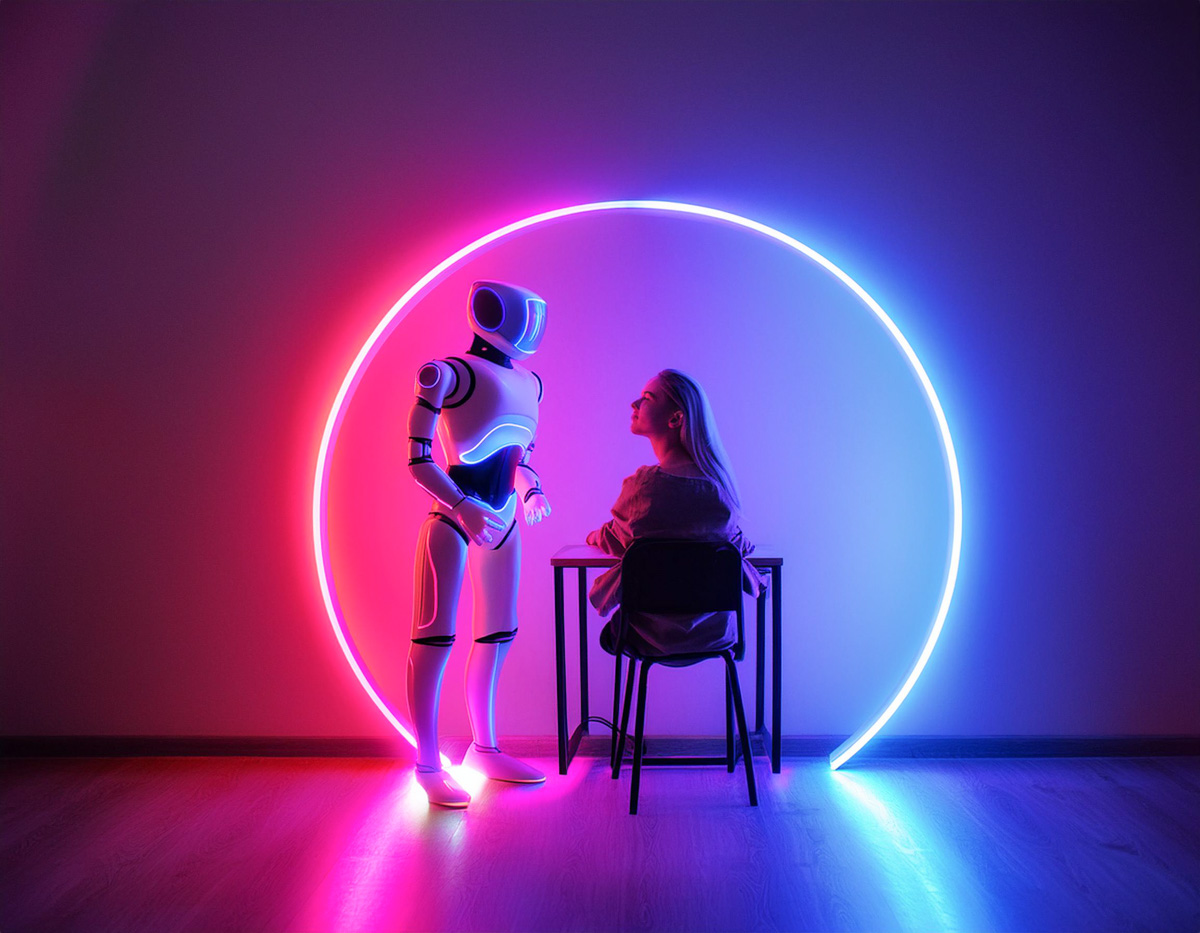
The lines that define humanity have gotten a bit blurrier, now that it’s harder to differentiative between an interactive life-like AI voice and flesh and blood.

When watching science fiction, we accept it when a talking computer sounds like a real person. From Iron Man’s J.A.R.V.I.S. to the Starship Discovery’s Zora, it’s a common sci-fi character device. And, of course, there’s the mother of all talking computers… HAL. Some fictional computer voices are friendly. Others are not. But they all sound like us.

Well, it isn’t science fiction anymore. With ChatGPT 4.o, now we’ve got a young, perky, friendly woman’s voice waiting to talk with you. And it seems entirely life-like with a total range of interactive emotions.

I don’t think OpenAI has given this new AI voice assistant a name yet, like Alexa or Siri. So, I’ll just call it Jane, the name I gave to my talking Garmin car GPS unit a few centuries back.

Well, you’ve done it, OpenAI. Yes, Jane seems alive.

Jane’s got Personality
I’m simultaneously enthralled and appalled. Sure, OpenAI presented the world just a demo of this female AI voice interface, and it wasn’t perfect, but it was close enough. It was hard to tell if her Scarlett Johansson-like vibe was real or not. She certainly sounded like she had feelings.

The three on-camera people all laughed and talked with Jane about mostly frivolous topics. It all seemed so wonderful and natural. They were perfect humans having a virtual coffee with a digital proto-human at the edge of the ‘singularity.’ Just another day at the office.

What could possibly be concerning?

There’s another Barrett
I was distracted about a separate detail that hit a little closer to home. One of the human presenters was named Barrett. Yes. There aren’t too many first-name Barretts out there. So, that coincidence struck me. My inner-Spock eyebrow raised a tad. “Fascinating.”

Perhaps I should pay closer attention.

The demo proceeded to show off Jane’s skills. She wasn’t just a voice. She had eyes too. She can see and process information through your phone’s camera. Yes.

Then, Jane complimented Barrett on what he was wearing. It felt strangely personal.

Okay. Now, I think we’ve crossed beyond the typical definition of a phone app.

And then I fell down the rabbit hole…

Is Humanity Replaceable?
I can’t stop thinking about the season 3 finale to “Westworld” (2020) when the evil Man in Black, played by Ed Harris, comes face to face with his robot host duplicate and realizes there’s no difference between them. He is entirely replaceable.

And I happened to recently stream “Mission: Impossible – Dead Reckoning Part One” (2023) during family movie night. The AI ‘Entity’ is of course the scary omniscient villain in the background. We never really get to meet it, but the self-aware AI seems impossible to beat. (We’ll have to wait until next summer to find out how Tom Cruise figures out the key solution.)

Fiction writers have forever been telling scary stories about computers gone amok. The Terminator. Ultron. Better-Stronger-Faster. (Wait, that’s just Steve Austin. Never mind.)

We’re in Control?
We’ve been trained for years to fear a superior AI-driven entity that will simply take over one day.

Now, I’m not sure anyone knows what’s going to happen when a computer actually becomes self-aware. But I don’t think we’re there yet.

Friendly Jane is just a new ‘emotion-simulation’ interface from ChatGPT. It’s a tool for us to use.

ChatGPT and other generative AI chatbots are supposed to help us do certain things faster. And they certainly do.

So, why the fuss?

Identity Crisis
I think our deeply embedded human fear of a Skynet overlord is partially a biproduct of years of exposure to scary storytelling.

Is this a branding problem to solve? Clearly, Barrett and his OpenAI colleagues are trying to address that with their very helpful Jane.

But I believe we’re also struggling with this redefining moment of what it really means to be human.

Artificial Human?
Did people feel threatened when the pocket calculator was introduced? Or the PC? Or the act of Googling? I don’t think so.

Sure, ChatGPT can process and present information faster than any human mind. But computers already passed that threshold years ago. We know that.

What’s so different now that there’s simply a young, engaged female ‘human’ voice attached to that interface?

Have we crossed over some invisible line of authenticity that defines our very identity as a species?

Maybe.

Activate your Inner John Connor
What’s clear is we are in the middle of an insanely rapid technological evolution. And if you want to know what it is to be human in the 21st century, you may be forced to redefine it a bit.

And so, you’d better figure out how to control the tools that are already doing what yesterday only we could do.

This is not a choice.

For starters, it’s time to learn how to be a good ‘prompt engineer.’ I guarantee tomorrow’s children will grow up being experts at this the same way yesterday’s toddlers intuitively knew how to navigate the first iPads.

Pay Attention
Don’t we already know that a pretty voice and manufactured beauty shouldn’t be a defining characteristic of any real person?

Will we need to pay more attention in the future when presented with reasonable facsimiles of the human form and function? Absolutely.

If you spot your doppelganger tomorrow on the street staring at you, you probably have something to worry about.

But I think eventually having a helpful J.A.R.V.I.S. in your life can be productive, empowering and even nurturing.

…As long as you don’t forget ‘what’ you’re dealing with. It’s the ‘what.’ Not the ‘who.’

Jane is not alive.

That’s the line we don’t want to cross.