
Build a Time Machine with Filament LED Bulbs
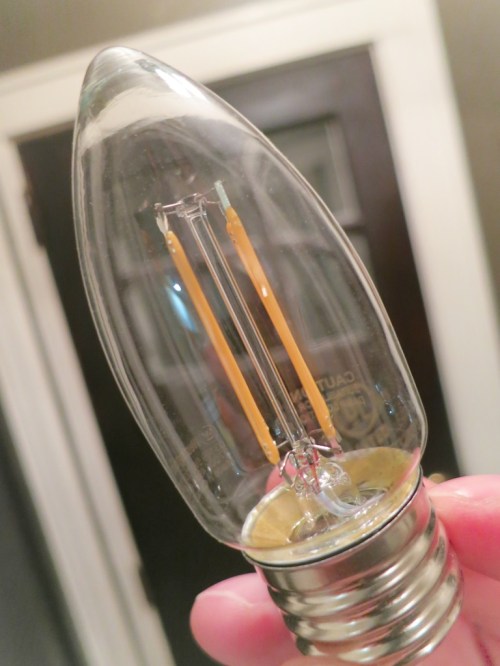
Filament LED bulbs have taken us full circle to the day Thomas Edison invented his light bulb. These vintage-looking, LED bulbs can bring you back to the future. But it can also cost you…
Recently, I started noticing a proliferation of really cool vintage light bulbs prominently displayed in certain restaurants. I thought it was really impressive being bathed in light by these Edison-style throwbacks. The secret I didn’t realize was these weren’t incandescent replicas. Not at all…
They were actually LED bulbs designed to mimic an illuminated filament thread.
How exactly was that possible? It seemed like only yesterday that the basic replacement LED bulb was born. And what an ugly duckling that was. But soon after, technology upgrades improved its form factor.
But this was something entirely different! An LED bulb that glowed exactly like an old-time bulb.
And guess what? You can buy these “filament LED” bulbs for your home. They’ve been spreading throughout Europe over the past few years, and now they’re becoming more readily available here…
Filament LED Bulbs are Cool
Okay, so let’s review how light bulbs used to work… Since the days of Thomas Edison, incandescent bulbs harnessed electricity to heat a metal filament to make it “white hot,” or incandescent.”
Now, filament LED bulbs incorporate thin LED strands shaped to look like vintage traditional tungsten filaments. That’s done by mounting many tiny LED chips onto a transparent substrate. And all of these low power LED chips don’t require a heat sink, which previously contributed to that alien-like construction of early LED bulbs.
Finally, the many, mini LEDs, which are often colored blue and red are then coated in a silicone resin and phosphor to create white light.
Kind of genius. Right?
Unfortunately, these filament LEDs have a shorter life than traditional LED bulbs, but we’re still talking about years.
There is however, another problem…
Not All Filament LEDs are Created Equal
When you Google “Filament LED,” seemingly dozens of websites pop up wanting to take you back to the future. And for very reasonable price, too.
It seems almost too good to be true…
As it turns out, the old adage – “You get what you pay for” still applies.
Cheaper bulbs are… well… Cheap.
They use a lower-grade silicone coating, which has a shorter life span. But there’s a more important risk that goes beyond premature bulb failure…
Bad Filament LED Bulbs Can Damage Your Eyes
Improper LED coating can create leakage of blue light from the blue LEDs. And not to alarm you… but apparently this kind of blue light exposure can cause macular degeneration over time.
Yes, I was a little non-plussed to discover the negative effects of blue LED light exposure, especially when there are plenty of electronic devices regularly glowing at you with various levels of blue LED light.
The other problem with over exposure to blue light is it can mess with your serotonin levels, which affects your sleep.
Wow.
So theoretically, a cheap LED filament bulb can really wreck your life.
But I’d imagine you’d really have to outfit your whole house with leaky filament LEDs to put your eyes and sleep cycle at real risk. And then there’s the cumulative amount of exposure it would take to be dangerous…
(Which, of course, nobody knows for sure how long that is)
My next step after absorbing all of this scary, blue knowledge was to take three deep breaths…
(And stop worrying so much)
I was only interested in purchasing three filament LEDs for one ceiling light fixture next to our kitchen. It’s a light we pop on occasionally. Certainly not a central light source that we often use. So I figured as long as I exercised sufficient due diligence to find a decently constructed bulb, I would not be putting my family’s health at risk…
In Search of the Right Filament LED Bulb
As I began my search, I first realized that I needed to remember the naming conventions of non-traditional shaped bulbs. This chart on bulbs.com is a great resource and told me that my broken bulb was an F15. So I wanted a form factor close to that in my new filament LED…
I also recalled that my ceiling light fixture was on a dimmer switch. So my new bulb had to be dimmable.
(Not all filament LEDs are)
I also looked at a few more factors in narrowing my search…
- Is the bulb Energy Star certified?
- Is the manufacturer a brand I recognized?
- Is the pricing too attractive?
Energy Star certified is a great clue you’re getting a good bulb. Unfortunately, there aren’t a lot of filament LED makers that have earned that rating yet.
I started looking at name brands, hoping that would lead to a reasonable option. Westinghouse has a presence via Amazon. So I focused my search in that direction.
I zeroed in on this Westinghouse dimmable 5 watt filament LED ‘decorative’ bulb. (470 lumens with a color temperature of 2700 K)
It’s actually a B11 shape, which is a bit smaller and not Christmas tree light-shaped like the F15, but I couldn’t find an F15 option anywhere…
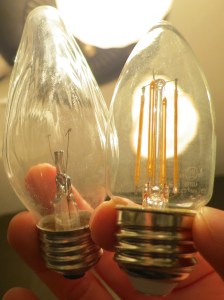
The Westinghouse bulb costs $11.88, which isn’t cheap, but seemingly the going rate for many filament LED bulbs today.
(Happily, basic LED bulbs have come down in pricing.)
But remember… the value proposition is compelling:
- It only draws 5 watts (as opposed to 40 watts)
- It’s designed to last for 15,000 hours
- So hopefully, I won’t have change the bulb again until I own an iPhone 12!
Click.
My Fascination with Light Bulbs
I dream of the day I won’t have to ever replace a light bulb. Wouldn’t that be nice?
We’re still not going to exactly get there with current LED bulb tech, but as I’ve gradually weaned my home away from incandescent bulbs, I’ve noticed a clear shift away from what seemingly used to be a weekly practice of replacing a light bulb somewhere around the house.
And who knows… one day I may actually lose my interest in writing about light bulbs.
(Don’t count on it…)
 At Home with Tech