At Home with Tech

Unlock the power of all your technology and learn how to master your photography, computers and smartphone.

Tag: Science Fiction

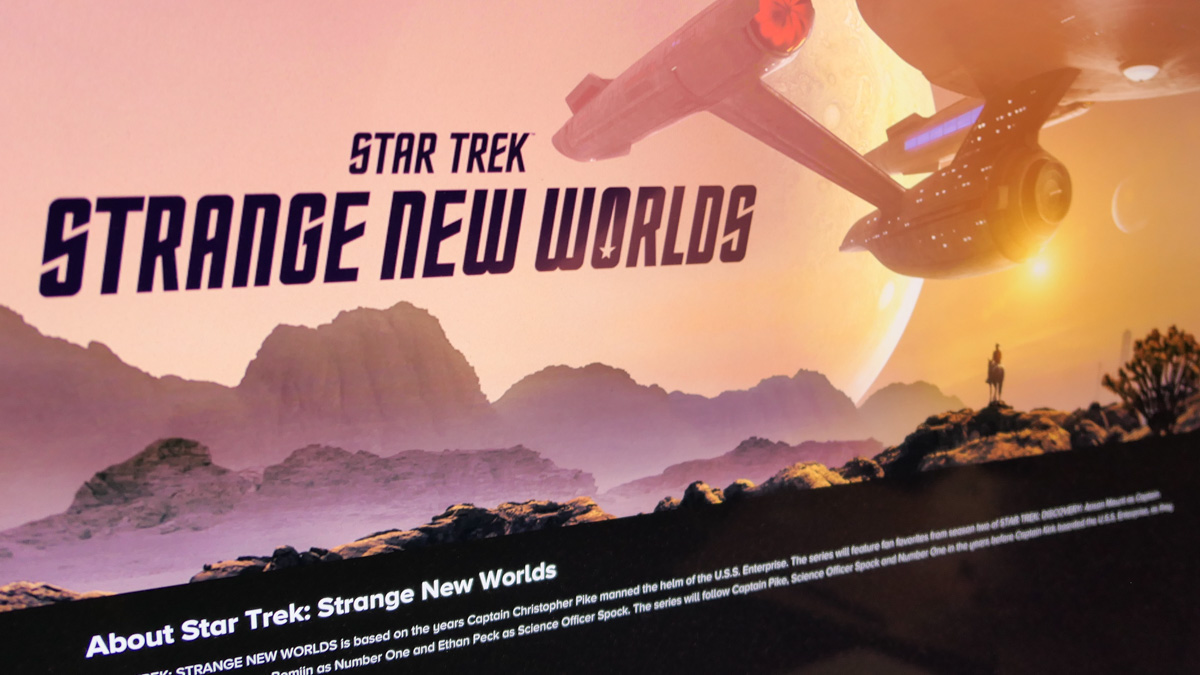
Why Strange New Worlds is Now my Favorite Star Trek Series

This Star Trek prequel has made what’s old new again. Here’s how it continues to successfully bridge the generations in my home as season 2 begins.

Don’t get me wrong. I loved season 3 of “Star Trek: Picard.” Of course there was pent-up demand to get the band back together for one more adventure. Yes, “Picard” was awesome, even though it felt like the last few episodes were rushed to get it all in. And yes, there were some plot holes, but who cares?!

We got another season of “The Next Generation,” and mostly at its best. That’s a gift, and a proper send off after the last movie (“Nemesis”) offered such an unsatisfying ending two decades ago.

But “Star Trek: Picard” was about good endings. “Star Trek: Strange New Worlds” is about great beginnings.

Fun in the 23rd Century
I’ve said before that “Strange New Worlds” on Paramount+ has nailed the successful recipe of “Star Trek” better than any Trek since the original series. And in some ways, “Strange New Worlds” has improved on it.

It’s fun and optimistic. Each character and attached actor is compelling. The scripts are smart. The special effects lavish geeky love on the Enterprise in ways we Trekkies have only dreamed of.

But the show is no lightweight. It’s got some serious themes. Really serious. If you know “Star Trek,” you know the tragic story of Captain Christopher Pike, who precedes Captain Kirk. And the writers have decided to give Pike’s character insight on his future. Whoa. That’s heavy.

We know how it ends. Or do we?

Captain Pike Rocks!
Speaking of Pike, I’ve got to say that Anson Mount gives us arguably the best captain in the Star Trek universe. I know that’s going way out on a limb. But he perfectly captures the essence of the original Starfleet captain: a bold boy scout who still breaks the rules when warranted. He’s also really fun to watch.

His acting helps this series feel entirely confident and comfortable. It needed no time finding its groove.

“Strange New Worlds” is so confident in itself that it sidelined Captain Pike in the first episode of its second season and leaves the whole story to Spock and the rest of the crew, including Nurse Chapel and Dr. M’Benga.

Spock and Nurse Chapel
The first season set the structure of giving major storylines to each of the supporting characters throughout different episodes, and this trend is happily continuing. Instead of overinvesting in new guest characters each week, The writers of “Strange New Worlds” continue to focus on deepening our understanding of the Enterprise crew.

And we already thought we knew many of these characters, right?

Admittedly, the writers are bending Star Trek canon a bit, especially with the growing relationship between Spock and Nurse Chapel. But I think that’s absolutely fine. By now, we’re used to plenty of ‘reimagining’ of core science fiction stories.

Star Trek Doesn’t Need Salty Language
“Star Trek: Strange New Worlds” manages to be both fresh and retro simultaneously. It proves that you don’t have to warp Star Trek down a dark path to try to reinvent it like “Star Trek: Discovery” originally attempted.

It’s also resisted the urge to throw around four-letter words like both “Discovery” and “Picard” have done. Thank you very much.

Not that salty language is so critical an issue for me anymore, as our son is now thirteen. He consumes plenty of profanity when watching the MCU.

But back when “Discovery” premiered, he was only seven. And I was really upset that we couldn’t watch new “Star Trek” together.

Appointment Viewing
Happily, “Strange New Worlds” is Lester family viewing time. And this Trekkie dad couldn’t be more pleased to finally be sharing his life-long passion with his son. My boy loved the show’s first season.

No, “Star Trek” is not quite as cool as “Star Wars” or the MCU. Not for him (and that’s okay).

He insisted on giving me a little sigh and eye roll when I proclaimed after dinner that it was time to watch the second season premiere of “Strange New Worlds.”

He countered that he would prefer to watch the MCU’s “Secret Invasion” series. Fortunately, the premiere of that Nick Fury show on Disney+ was still a week away.

So he agreed to sit down on the couch with me and my wife for a little “Trek.”

Star Trek is Family Time Again
And when Spock (wonderfully reimagined by Ethan Peck) sat in the captain’s chair and struggled to come up with a clever line to order the Enterprise to warp speed, I turned to peek at my son’s face.

He was smiling. And yes, I think I spotted my young teenager laugh. The three of us all laughed together… watching “Star Trek.”

That was the best early Father’s Day gift I think I could ever get.

Our son may never be a Trekkie. And once upon a time, my wife didn’t know the difference between a Tribble and a Klingon.

But we’re all together watching “Star Trek.”

I’ll take it.
“For All Mankind” Needs these Course Corrections

Here is my review for the first 3 seasons of this alternate reality TV series that chronicles the space race from the 1960s to the 1990s.

I originally checked out “For All Mankind” when it premiered on Apple TV+ back in 2019. And while I understood the premise that this was an alternate reality where the Russians landed on the Moon first, I expected some type of explanation as to how this reality evolved or was created. That never comes. (Yes, I admit I’m heavily influenced by the whole MCU multiverse.)

And while it’s interesting to watch how this timeline continues to branch out, it’s really just background.

And as I watched the first episode, I couldn’t help but feel how slowly it moved. The plot kept focusing on the family lives of the characters instead of the space program.

And then it finally hit me. Oh, that’s what this show is really about. It’s a character-driven drama about the astronauts and ground support engineers who work for NASA… in an alternate timeline.

It’s fiction. But not really science fiction as we might traditionally expect.

This Alternate Timeline Moves Slowly
“For All Mankind” is created by Ronald D. Moore, who is royalty in science fiction television. He executive produced the reimagined “Battlestar Galactica” and was a writer and significant influence on “Star Trek: The Next Generation” and “Star Trek: Deep Space Nine.”

The premise of an ongoing space race opens up so much possibility. It’s a great idea. But it’s not the engine that fuels much of the drama in this series.

The show takes its time, and you’ve got to be willing to go along for the ride with a whole host of characters, some more interesting than others.

The payoff wasn’t there for me. So, I quickly gave up on “For All Mankind” after the first couple of episodes.

A Second Chance
Fast forward a few years (as the show likes to do between its seasons). Some friends told me how much they enjoy “For All Mankind.” When I told them how I couldn’t reach orbit with the show, they told me that it gets better after season 1, and that season 3 was really good.

So I tried again.

Yes, season 1 was a slog with so much emotion to get through, but the series does get better. So I decided to strap myself in and get through all three seasons that have been released to date. And I’m happy to report that I’ve accomplished my mission.

And I’ve got a few thoughts to share (with some minor spoilers)…

A Rerun of our Past
“For All Mankind” is really ambitious, especially as it jumps from decade to decade. And in doing so, it leaves inevitable holes in its storytelling.

It tackles many of the major societal social struggles of the past half century. You’ve got to give it credit for its reach. But at the same time, this narratively forces the show to focus backwards on our actual past instead of forwards towards an alternate future from our past. (Got that?)

Science fiction stories often bake big social themes of the day into the storytelling. It’s simply more front and center here. But while the series does rewrite some pieces of history and has fun with an alternate set of presidents, the world is still fundamentally the same. This reality hasn’t branched out that much.

At its core, “For All Mankind” is simply a drama. Or maybe a historical narrative from an alternate timeline. Again, it’s not science fiction as you might expect.

That said, I do appreciate it when the writers throw a few bones to sci-fi fans with references to “Star Trek” and “Space: 1999.”

Lots of Secrets
The storytelling structure is unusual in that there really aren’t any ‘bad guys’… just a lot of grays in many of the characters. Yes, there are a few episodes on the moon when the Russians aren’t at their finest, but they have reason to be upset at the Americans.

It’s often difficult to create narrative tension where you don’t have a villain. And the writers do a pretty good job working around that by making sure just about all of the characters we care about have a secret that has the potential to destroy their lives.

Houston, We Have a Problem
While the heart of “For All Mankind” is focused on relationships at home on planet Earth, the best parts are indeed off planet and where the show comes closest to an action/adventure series. In many ways, the series finds a better balance as it sets its sights on the mission to Mars in season 3.

But as much as the show finally finds its groove in the 1990s, the writers continue to inject instability by (spoiler alert) killing off major characters across the seasons.

Is that supposed to make me feel that anything is possible in this show? I suppose. But I don’t feel all warm and fuzzy about a series that keeps killing my favorite characters.

And some of the ways our astronauts act are a little far-fetched. (Do they really disobey orders as a norm in this reality?) Then, I have to remind myself that this is not real… it’s still fiction. But does that make it okay?

And (spoiler alert) after the explosive ending to season 3, what’s really left that I might want to care about? A problem for the writers… to be sure.

Don’t Exhaust the Viewers
So yes, I’ve now watched all three seasons. And clearly I’ve got some issues with “For All Mankind.” Is there a reason to keep watching into season 4 when it comes out?

Well, that final reveal into 2003 at the end of the last episode that previews season 4 is certainly enough to peak anyone’s interest.

Here’s one suggestion for the writers…

Reality is tough. I know every story doesn’t get a happy ending. And this alternate reality seems intent on maintaining a healthy dose of this cruel truth. But that can feel exhausting.

I think it’s time for a little more healing, thank you very much.

Find the Right Balance in this Timeline
“For All Mankind” is bold. There’s nothing else like it as it jumps from decade to decade with many of the same characters. And each season improves on the last. But it takes a commitment get through.

The show has teased going to Jupiter after Mars. I’d like to still be there if that happens. But I’d appreciate a few more thrills and a few less tears along the way.

Mr. Moore, I’d prefer this journey across space and time to just be a little more fun.

Make it so?

Why Star Trek: Strange New Worlds is So Good

Another “Star Trek” series? Yep! And this is the one we’ve been waiting for. Here’s my review…

I’ve been a “Star Trek” fan since I was a kid, when I watched reruns of the original series. (My mom would often organize dinner with my dad around me watching Kirk, Spock and Bones at 6pm on WPIX.)

I’ve stuck with the entire Trek universe across all of these decades, and I’ve generally enjoyed every iteration.

Born from “Discovery”
“Star Trek: Discovery” has been the main “Trek” property over the past few years. It’s felt heavy at times and has gone through narrative course corrections in each of its seasons.

Honestly, it’s been a bit too dark and stiff for me. Universal destruction is always just around the corner. Yes, the writers keep adding lines about how the crew is family and how much they love each other. Yes, there’s a lot of hugging and tears. But, I just don’t feel it. Not really.

When a younger Starship Enterprise showed up in season 2 with Captain Christopher Pike, played by Anson Mount, the positive change in energy was dramatic. Sure, it was a gamble giving us another Spock, played by Ethan Peck, but it worked. Plus, we saw Pike’s bold Number One, played by Rebecca Romijn. And instantly, I wanted the storytelling to stay with this younger pre-Kirk Enterprise.

And clearly, I was not alone.

Hit It
Now, we’ve got “Star Trek: Strange New Worlds,” a new series on Paramount+, which follows the voyages of the Enterprise in the decade before Kirk took over. If you’re a Trekkie, you know that Captain Pike and his crew were introduced in “The Cage,” the first pilot for “Star Trek” way back in 1965. (That footage was eventually repurposed in the two-part “Star Trek” episode “The Menagerie.”)

After watching the first two episodes of “Strange New Worlds,” I’m happy to say that this series perfectly captures the energy and fun of the original show.

Yes, fun.
Saving the galaxy used to be fun, right?

There are lots of complementary elements that are helping this new series to hum at warp.

The Strong Cast
Though Pike is now (minor spoiler alert) burdened by knowing his future, Anson Mount continues to give us a compelling Starfleet captain who’s collaborative, funny and also a tad irreverent.

The writers are quickly focusing on exploring the supporting cast. We’ve already got a nice sense of Nurse Chapel played by Jess Bush, and the second episode focuses on Cadet Uhura played by Celia Rose Gooding.

The producers have taken some creative license to update these younger versions of these famous characters, and it’s all for the better. I’m not going to hold the producers to perfectly reflect every detail of the original “Star Trek.”

Better Special Effects
The same goes for the Enterprise. Yes, it’s the same ship, but there are subtle differences on the outside and major enhancements on the bridge. And thanks to modern CGI effects, this ship can really fly. And I cannot tell you (Geek alert!) how much fun it is to watch the Enterprise in action.

The more advanced special effects are a welcome improvement.

Back to the Future
“Strange New Worlds” also benefits from a healthy dose of nostalgia. Sure, there’s a lot of runway for the missions of this previously unexplored crew, but everything feels so familiar and immediately comfortable. The communicators, the tricorders, the transporter beams, and all of those techie sounds… you know all of them!

“Star Trek” series have spent decades trying to differentiate themselves from the original show. “Strange New Worlds” doesn’t need to. These are actually the first chapters of the same Enterprise story.

It’s refreshing that we again get to see the Federation during its peak years, when everything seemed possible.

No More F-Bombs
And I am so happy that this is again TV-PG Star Trek, void of all that unnecessary bad language and occasional F-bombs that have plagued “Discovery” and “Picard.”

“Star Trek” doesn’t need to be so dark and “edgy” to connect with it’s 2022 audience. I think especially these days, we need a reminder that being bright and optimistic is achievable.

I’m looking forward to inviting my 12-year-old son to watch “Strange New Worlds” with me. (He’s not yet connected with “Star Trek” the way he has with Marvel and “Star Wars.”)

Time to Enjoy
No, it’s not groundbreaking “Trek,” but it’s not trying to be. “Strange New Worlds” still succeeds on many levels. It firmly represents “Star Trek’s” core, gives us a great Captain Pike (Thank you, Anson Mount), and most of all… it’s simply refreshing.

And fun.

It’s exactly what we need.