At Home with Tech

Unlock the power of all your technology and learn how to master your photography, computers and smartphone.

Category: Tech in the News

How to Battle Blurry Photos with a Fast Prime Lens

Why is everything crystal clear in this picture except for my son?  The problem is my young bowler is the only part of the image moving quickly!  A faster camera lens could have frozen this action shot.

Why is everything crystal clear in this picture except for my son? The problem is my young bowler is the only part of the image moving quickly! A faster camera lens could have frozen this action shot.

It’s hard to believe it, but my son is almost five years old, and I’ve probably taken at least 5,000 pictures of him so far. I think 4,598 of them have been blurry.
(I exaggerate only slightly.)

He just moves too darned fast. With the exception of his first year when he wasn’t that mobile, he has proven too swift for my inadequate photo arsenal to keep up.

So I know that anybody can take a decent picture outdoors with lots of light to support an average camera lens. But as any amateur photographer has probably realized, unwanted blur usually has to do with indoor or low-light situations. That’s the Achilles’ heel for many consumer-grade lenses, which are too slow to freeze all the action in their line of sight.

Sure, you can throw some flash on your subject, but that strategy has its own set of limitations. If you want to capture the beauty of a moment in natural light, you may not want to ruin it with an obnoxious flash.

Of course, the simple solution is to buy more expensive gear.
(Isn’t it always?)
But as you start to look at your options, it quickly becomes an expensive proposition. A good zoom lens can cost you $1,000 or more…

But we’re getting ahead of ourselves. You’ve got to start somewhere…

Begin the Journey to Snapping Sharper Photos
Five years ago, I bought my Canon DSLR knowing I needed more than a point and shoot camera to get the job done.
(It’s the EOS Rebel T1i, which has since been superseded by five newer versions. The Canon T6i has just been announced.)

I picked up two ‘kit’ lenses, which were packaged with the camera body as part of a holiday sale. One was an 18-55mm zoom. The other was a 55-250mm zoom.

I found the super zoom to be relatively useless in freezing action. I liked the basic zoom better. It enabled a significant jump in the general quality of my pictures over my Canon PowerShot Elphs, but it also had trouble in low light.

The reason was neither were high-end lenses. Specifically, they weren’t very ‘fast.’ The 18-55mm had a maximum aperture of f/3.5-5.6, while the 55-250mm was only an f/4-5.6.

To capture the action, you need a faster lens with a larger maximum aperture and lower ‘f’ number. Fast lenses let in more light, allowing you to use quicker shutter speeds to freeze any motion in front of you.

But of course, they cost a whole lot more than a couple hundred dollars.
(Which is what the kit lenses go for)

Discover Prime
Fast-forward two years…
I was struggling over how to proceed forward with my increasingly expensive hobby, when a friend, who was a professional photographer, suggested I buy a ‘prime’ lens. A prime is a lens with one fixed focal length, which means it doesn’t zoom.

The quality of these lenses is typically quite high. They’re fast, and their cost… by comparison with fast zoom lenses…is a steal.

So I decided to try out a prime as a cost-efficient next step on my journey to photographic enlightenment.

50mm Prime
I just had to figure out the focal length I wanted…
I was concerned about having enough reach without a zoom.
(I didn’t want my photo subjects to look like tiny dots…)

My friend suggested a 50mm lens as a good starter prime.
So I bought the Canon EF 50mm f/1.4 USM Lens.
(It’s currently $399 at B&H Photo. But if you wait for the next Canon rebate, you can knock off $50 or so…)

When I popped on the 50mm, I immediately saw the benefits of its speed.
However, I found its reach to be a bit too tight when trying snap a photo of my boy from only a few feet away.

With the ‘cropped’ sensor of my Canon Rebel, (and I assume all entry-level DSLR bodies) its framing was 1.6x tighter than what you’d see using the same lens on a more expensive full-frame DSLR body. As a result, I always found myself stepping back as far as I could to get the shot I wanted.

I became frustrated with the results, and eventually left my DSLR at home in favor of my less bulky pocket cameras. Then, my powerful iPhone 6 Plus showed up, which takes a pretty good picture all on its own.

It was like I had dropped out of Photography 101 and was just winging it again. But I knew I needed to get back on the digital horse and find another prime lens that wouldn’t make the world seem so crowded…

35mm Prime
So I’ve been doing more research and recently came to the conclusion that a 35mm prime should give me the extra ‘room’ I want…

For Canon DSLR owners, it’s the Canon EF 35mm f/2 IS USM.
Unfortunately, it’s a pricy prime that goes for $599.
(You can almost buy a brand new DSLR body for that price!)

I then came across a review from Ken Rockwell about the previous generation 35mm Canon lens.
(The Canon EF 35mm f/2)
He loved it, suggesting it was almost as good as the current version and half the price. Unfortunately, this older lens has been discontinued.
But he mentioned you can still find it for sale in the used camera market.

A new browser window later, I found one at B&H Photo for just $249.
(lucky)

How Solid is a Used Lens?
The question was whether I should gamble on a used lens? B&H rated this lens as a ‘9,’ which is two points shy of looking like new. So it’s not going to win a beauty contest. But the lens is still supposed to work, right?

One comforting factor that continued to lead me towards the uncharted waters of the ‘used market’ is the fact that B&H Photo offers a 90 day warrantee on its used photo equipment.

I figured the lens is either going to function properly out of the box or it won’t.

Click.

So that’s the end of this chapter in my quest to become a better photographer.
My new (used) 35mm lens comes in the mail next week…

In Search of a Faster Zoom Lens
But this is not the end of the story…
You can’t really live your life shooting only with primes.
(My son will be in the next county by the time I switch lenses.)

The question here is the proper lens upgrade path for any amateur photographer aspiring to be something more. I know the endgame is to have a few really great lenses. Every professional photographer I know talks proudly about his or her arsenal of ‘glass.’

But I’m not hoping to become the next Ansel Adams. I just want snap better pictures of Junior in action.

Sure, I know my camera body is due for an upgrade.
(Hello, T6i?)
But I also know that one day soon, I should also spend some serious dough on a fast zoom. I just need to feel confident about the choice.

Anyone have any suggestions…?

Rest in Peace RadioShack

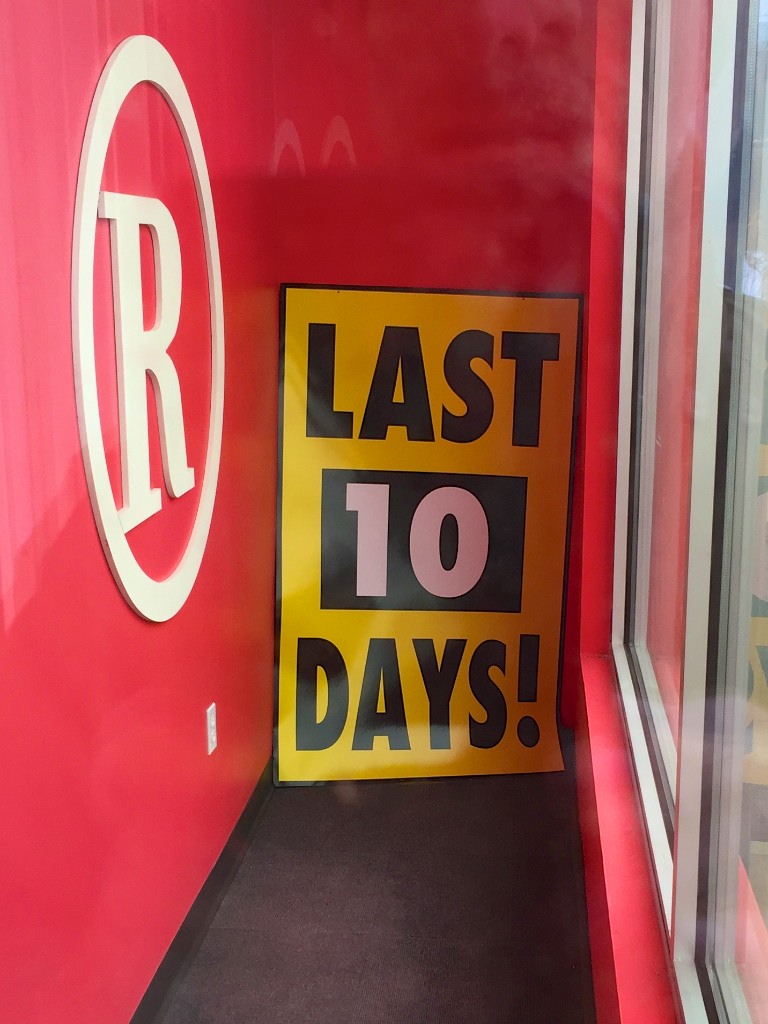
The end is near for this RadioShack store and many others. If you want to pay your respects, you’d better hurry…

The end is near for this RadioShack store and many others. If you want to pay your respects, you’d better hurry…

It isn’t as if we didn’t see this coming. The last time I gave a thought to RadioShack was a year ago when I watched its clever Superbowl commercial. The retro spot was a great Hail Mary pass. Still, I can’t remember the last time I actually stepped foot in a RadioShack.

You don’t have to follow the news to know RadioShack was in trouble. And last week, the ailing electronics retail chain finally filed for bankruptcy protection. (Sprint will be picking up some of the stores as co-branded retail spaces.)

The New York Times recently ran a feature chronicling RadioShack’s slow train wreck over the years…

For me, RadioShack’s implosion felt a lot like losing a long-time friend who moved away from the neighborhood.

Once upon a time, RadioShack was always there whenever I had an immediate tech need. Where else were you going to go to get some speaker wire? Or headsets for your walkie-talkie? Or size D batteries?

But my RadioShack abandonment story is easy to explain:

  • I never went there expecting to buy quality tech
  • Their nerdy tech vibe wasn’t cool
  • My needs move from wired to wireless
  • There were other stores that carried the same stuff

You Get What You Pay For
You can’t argue that RadioShack carried items at a certain ‘accessible’ price point. But invariably, inexpensive items don’t hold up.
The price was right, but the tech I bought often broke or stopped working prematurely.
(So I went there mostly as an emergency measure.)

It’s hard to build a brand on merchandise that doesn’t last…

Who Wants to Feel Uncool?
Consumer tech is supposed to be cool, right?
But I don’t think you could ever have called RadioShack cool.
It was for nerds who liked to tinker.
(I should know.)

Image is everything, and even as a tech nerd, if I didn’t need to go to Radio Shack, I wouldn’t.

Who Wants More Cables?
A lot of what I bought from RadioShack over the years were the cables that connected all my tech together. But as Wi-Fi and Bluetooth technologies took center stage, I didn’t really have to buy many cables anymore.

RadioShack didn’t stock much else that compelled me to come back…

Numerous Shopping Options
This was a time before Best Buy, Staples, Amazon and of course… the Apple Store.
Radio Shack had something of a monopoly on certain kinds of tech.

But now, there are plenty of places that can serve up all your technology solutions.

R.I.P.
So Radio Shack couldn’t keep up and kicked the bucket.
Nothing lasts forever…
Plus, there’s really no loss to the consumer here.

All that said, I guess I still feel a little sad.
Yes, RadioShack was there for me… literally over the course of decades.
But I simply outgrew it. And so did everyone else…

Goodbye, old friend.

Choosing a New iPad Air 2 Case

If you find yourself forced into an iPad upgrade, you’d better protect your investment with a cozy case. Especially if tiny hands will be using it…

If you find yourself forced into an iPad upgrade, you’d better protect your investment with a cozy case. Especially if tiny hands will be using it…

I’m still trying to come to terms with Gray Thursday destroying Thanksgiving in America. I didn’t really understand what had happened until I tried buying a new iPad Air 2 early on Black Friday.

Target, which I discovered never closed after it opened up on Thanksgiving, had been sold out of the iPad I wanted for twelve hours. I wasn’t even close!
(What ever happened to giving Americans time to enjoy their Thanksgiving dinner?!)

I felt lucky with the runner-up deal that was still available at Best Buy. I came home a nearly defeated shopping warrior.
(It wasn’t pretty.)
But then again, I had a new iPad in hand….

Time to Retire iPad 1
If you’re wondering why all the effort… it’s because I’m still using an iPad 1. Yes, the world’s original tablet still has a heartbeat at the Lester house,
(believe it or not) but it was really time for a refresh.

Mostly, I needed to buy the new iPad because even though the old one is still functioning, nothing much living in it can survive anymore. Many of the apps we use have upgraded themselves, requiring newer iOS software, which the iPad wasn’t built to digest.

Things really got bad when our favorite Disney Junior app upgraded itself, and Disney spontaneously killed off the old one residing in our iPad.

My own “Junior” had a really hard time understanding why the app didn’t work anymore.
(I simply said it was broken, but that didn’t stop him from tapping on the icon every so often and sighing wistfully…)

So I took my licking as a tardy Black Friday shopper, but I’ve successfully upgraded the Lester household back into current iPad technology.

Protect Your iPad or Else
An iPad is a significant investment, one that you’ve got to protect. My four-year-old son has been really careful using our first iPad, but you’ve got to plan for a fall or two…

I picked up AppleCare separately, even though Best Buy pushed me hard to go with the Geek Squad protection plan.

Now, it was time to give the new iPad some additional cover…

There’s an entire cottage industry of iPad cases out there to choose between.
Of course, you can go with the premium Apple offering…
Apple’s Smart Case sells for a hefty $79.

Not that I wouldn’t drop another eighty bucks to protect my overall investment. However, when I checked out a Smart Case at an Apple Store, I wasn’t entirely impressed. It was fine… but since I wasn’t convinced it was that much better than the competition, I figured I should look around a bit more.

Believe me, the resulting exercise was yet another rabbit hole into too much choice. The options range from $10 to over $100 for covers that come with their own keyboards.

But I felt I only needed something relatively basic…
I found lots of good reviews for the iPad cases that Devicewear makes.

I checked out the ‘Ridge’ that goes for $45.
(Amazon has it for $27.)

It’s got a nice ‘vegan’ leather exterior and supports the automatic sleep/wake iPad function when you open and close the cover.
I decided this case from Devicewear was a no brainer…

Click.

(Any other suggestions out there?)

iPad Air 2 Ready for the Holidays
As I write this with the sun rising on a cold Sunday morning, my boy is still valiantly sticking with the old iPad as it struggles to stream Sesame Street off of its website.

As for me, I’m happily streaming a little holiday spirit knowing that soon, he will be at home with new ‘protected’ tech.