At Home with Tech

Unlock the power of all your technology and learn how to master your photography, computers and smartphone.

Tag: Sci-Fi

Why Dark Matter is the Best Multiverse Series on Apple TV+
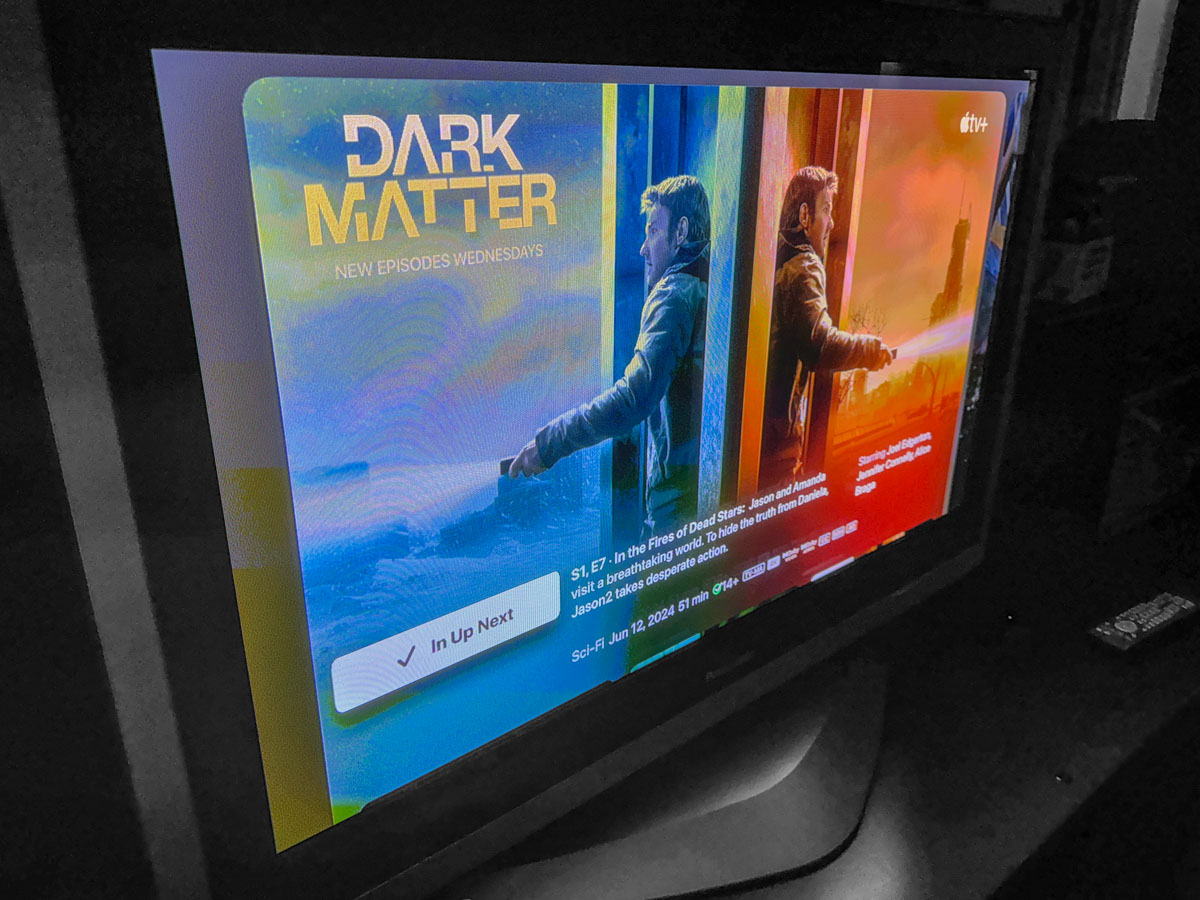
You don’t have to go back in time to alter your life decisions. You can simply relocate to a better Earth. That’s the premise of “Dark Matter.”

The creatives behind the streaming shows from Apple TV+ are apparently obsessed with alternate universes, or as we like to say… the multiverse. No, multiversal travel isn’t exactly a new storytelling device. (The MCU has already brought it into our mainstream consciousness.) But Apple TV+ has really been leaning into it.

In series after series, Apple TV+ has been taking us down the multiverse rabbit hole.

“For All Mankind” lays out an alternate-reality timeline of the space program. When this series premiered in 2019 with its ‘shocking’ Moon-landing twist with no explanation, I was annoyed. There was absolutely no hint regarding the ‘why’ or ‘how’ of this alternate Earth. Today, I think we’re all finally trained to immediately accept that alternate universes need no explanation.

“Constellation” (2024) spends much of its time ‘suggesting’ that astronauts can slip between alternate realities, but the writers are intent on adding as much confusion to the equation as possible. Pro tip: You really need a note pad to help keep important details straight. The frustration helps to fuel the ongoing ‘mystery’ in the story.

And now, we’ve got “Dark Matter.”

In Search of a Better Reality
“Dark Matter” is designed to explore the road not taken in one’s life. I’m mid-season (6th of 9 episodes) as I write this, and the story surrounding a main character’s mid-life crisis demonstrates that the grass is not always greener. The dark reveal carries much of the storytelling focus. While the human factor is not science-fiction centered, the sci-fi enables everything.

Without giving too much of the plot away, the series stars Joel Edgerton who is a Chicago physics professor forcibly removed from his universe. He then tries to find his way home to his Earth and his wife played by Jennifer Connelly. And yes, you can easily guess who’s tried to replace him to fix a past mistake in his life choices.

But I’m more interested in how the writers are handling the superimposition ‘box’ that powers the travel between similar ‘adjacent’ universes. Once you’re in it, you experience an endless corridor of doors that you can open.

The mystery of where you go and why is more interesting that the pedestrian ‘thriller’ plot devices surrounding whether you can really “know” the person you’re married to.

Still, I like it all. It’s working nicely together.

Similarity to “Sliders?”
The sci-fi of traveling between universes in episodic television isn’t new.

The series “Sliders” (1995-2000) immediately comes to mind. Starring Jerry O’Connell, that show brought its main characters to a different, parallel Earth each week.

The premise was great, and the show had a lot of promise, but it devolved quickly after the writers seemed to stop trying, and the main actors began leaving the series.

How Many Earths Can You Handle?
I can’t imagine that the writers of “Dark Matter” aren’t aware of “Sliders.” But where “Sliders” got hokey, “Dark Matter” couldn’t be more serious. And this is a good thing.

That said, both series rely on coming up with new twists for each new world. “Sliders” ran out of good ideas. And I think “Dark Matter” could also begin to face alternate reality fatigue. Happily, the show seems to be narrowing its focus.

“Dark Matter” is Solid
Which is all to say that I’m pleased so far with “Dark Matter.” While it is character driven, the sci-fi implementation is also interesting.

That said, the series is not without certain gaps. (Why are there boxes in every Earth, even when it’s clear that no one built it?) Plus, we all know where the plot is inevitably leading.

Still, it’s fresh and well done. The first episode takes a little too much time to get its basics in place, but after that, “Dark Matter” easily passes the bingeable-watching litmus test.

“For All Mankind” has always dragged with too much family drama. “Constellation” relishes its own confusion a bit more than I’d prefer. “Dark Matter” strikes the right balance to create a compelling storyline.

I’m happy to report that “Dark Matter” is the best multiverse show streaming on Apple TV+.

One Science Fiction Fan’s Bucket List

“Star Trek: Discovery” has created so many questions as it wraps its first season that you may need a 23rd century display panel to keep track of its complex plot. But that’s not entirely unique in the world of sci-fi storytelling…

So, I must admit I’ve thoroughly enjoyed the first season of “Star Trek: Discovery.” I know I had my doubts early on. But the CBS All Access streaming series came out of the gate strong, with its own fresh style, superior special effects, really interesting characters, and great acting (Sonequa Martin-Green, Jason Isaacs, Michelle Yeoh, Doug Jones and Anthony Rapp). It’s also displayed a whole bunch of plot twists and a compelling, gritty pace.
(And I’ve loved the extended stay in the Mirror Universe.)

“Discovery” has firmly established itself as a new and different Star Trek while not ignoring its own heritage.

Sure, the young series is not perfect, and all of our heroes aren’t exactly shining examples of the Federation’s finest. But that’s what makes the show all the more interesting.
(I still question the choice to drop the F-bomb.)

More Questions are Piling Up
As for what has sometimes been a confusing extended plotline and a threat to Star Trek canon, it’s evident that what doesn’t make total sense early on has been better explained in later episodes. That said, there are still lots of questions that need answering…
(What good TV series with ongoing mystery isn’t chock full of question marks?)

My one suggestion to the writers is to just be sure not to create too many loose ends. Because it can be difficult tying them all up. Now, I don’t expect everything onboard the Discovery to be all nice and tidy anytime soon, because season 2 has already been announced.

But plenty of other science fiction TV series and even some with extended runs have had difficulty wrapping up their major storylines.

So we don’t want history repeating itself.
(Unless it’s part of the space-time continuum)

No Conclusion
With all of the storytelling flexibility that sci-fi allows for, it’s amazing how much unfinished business remains.

Usually this frustrating problem for viewers crops up, because a TV series gets unexpectedly cancelled. Similarly, a movie may come out with important cliffhangers that don’t get resolved by a sequel that’s never made.

Now, I get that the economics often require the sudden end to a series that’s not cutting it in the ratings. But without a conclusion to the underlying story, that’s clearly an extremely unsatisfying situation for any fan.

So if there are any Hollywood producers out there trolling for reboot ideas…
Here’s my bucket list of marooned science fiction stories I’d love to see resolved. And I don’t mind that that we’d likely need to reimagine some of the content and hire new acting talent.

Maybe it’s not a whole new series. Perhaps, it’s just a one-off.
But just finish the story!

“Lost in Space” (1965-1968)
Do the Robinsons and Dr. Smith ever find their way back to Earth or to Alpha Centauri?
(Even the writers of the 1998 movie with William Hurt and Gary Oldman, hoping for a sequel… never answered that question!)

“The Starlost” (1973)
(This is the one with Keir Dullea from “2001: A Space Odyssey”)
What happens to the giant space station ark? Do they save it? Does it burn up?
(I think Seth MacFarlane may have already presented his own answer in “The Orville” episode “If the Stars Should Appear.”)

“Space: 1999” (1975-1977)
Do the inhabitants of Moonbase Alpha ever find another planet to live on?
Or do they just putter about their Moonbase Alpha forever or until their resources run out?

“Sliders” (1995-2000)
Does the team ever get back to their universe and their own version of Earth?
(I know by the time the series was cancelled, no viewers in any universe cared anymore… The cast had almost completely been replaced by then, but come on… Getting back home was the whole point!)

“Star Trek: Nemesis” (2002)
Yeah, we lost Data in this final “Next Generation” movie, but there’s a big cliffhanger we’ll apparently never get to see resolved: Does B-4, Data’s earlier (and less evolved) android cousin ever grow to essentially become Data?
(Data shared his neural engrams with B-4.)

“Tron: Legacy” (2010)
What happens after Sam and Quorra escape the Grid and get back to the real world?
Now, this is a sequel the producers could easily do, because “Legacy” is so recent… if Disney decides to finally green-light it.

Any more to add to the list?

Those That Stuck the Landing
If it’s beginning to look like major loose ends are a natural byproduct of sci-fi storytelling, that’s not always true. Here are a few TV series that successfully finished their major narrative arcs…

And yes, except for the original “Star Trek,” all of the subsequent Trek series had their finales.
(But what really did happen to Deep Space Nine’s Captain Sisko?)

And I regard “Star Trek: The Undiscovered Country” (1991) as the original crew’s wrap party.

So, with the exception of the TNG Data storyline… “Star Trek” as a whole has done just fine.

Perhaps I shouldn’t be so concerned about “Discovery?”

Infinite Possibilities
But the irony about “Star Trek: Discovery” is every narrative door that closes appears to reveal the existence of a new one. We’ve been introduced to the idea of parallel universes (in the plural) and (Spoiler Alert) time travel with the spore drive via the mycelium network. That opens up so much!

Now, since there are (Spoiler Alert) Mirror Universe character crossovers in this series, I want to go find Prime Lorca!

Make it so…

Just please keep track of it all.

#HappyTrekkie