At Home with Tech

Unlock the power of all your technology and learn how to master your photography, computers and smartphone.

Category: Science Fiction

A Kid’s View from the Top of the Empire State Building

It’s hard not be inspired by this view from 102 stories up. But not all inspired visions can become reality…

My wife and I took our second grader to visit the Empire State Building last week. The iconic 1931 structure was once the tallest in the world and is now not even in the top 25 (it’s 28th). And it’s only the third tallest building in New York City, behind One World Trade Center and 432 Park Avenue. But like anything as classic and classy as this landmark, The Empire State Building is not going out of style anytime soon.

The view from so high up was magical for our son. He was blown away by how small everything below appeared. He proclaimed that the buildings looked like toys, the cars were like raisons, and the people seemed like ants or crumbs.

As a parent, witnessing a moment of pure awe in your child… it’s amazing, right? This experience is all about expanding a point of view, both figuratively and literally. It’s like superfood for the imagination.

And as it turned out, I had my own magical ‘aha’ moment as well.

The Airship Port that Never Was
We visited the 86th floor observation deck as well as the circular 102nd floor… which was actually designed to be part of a mooring mast for dirigibles.

Dirigibles?!

The idea of walking down portable stairs 1,250 feet in the air onto the 103rd floor of this building and then being whisked down in an elevator to the heart of Manhattan seems positively fantastic.

But the mast section was never used as an airship port.
And why not?

Because the plan was more fantasy than fantastic…
The winds were too strong around the Empire State Building at that height to allow for a stable and safe mooring connection. And I imagine there really wasn’t that much time to work the problem, since airships went out of style for commercial passenger travel after the Hindenburg disaster in 1937.

The Fix of an Alternate Reality
After doing a little Googling, I discovered that the dirigible mooring station plan was flawed from the start and never fully researched. The design upgrade for the building with the 200-foot spire was a last-minute addition and probably more about unseating the Chrysler Building as the world’s tallest at the time. The few dirigible mooring attempts to dock at the new Empire State Building proved the absurdity of the idea, although there was one successful 3-minute test in 1931. But that was the only instance…

Still, how cool would it have been if the airship port had actually worked out? In another reality, flying airships as a standard transportation system might have quickly kicked in (assuming the Hindenburg had a better day).

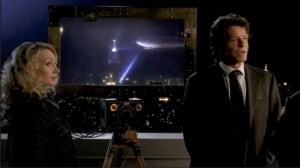
And I’m not the only one who has enjoyed imagining alternate realities for the Empire State Building.. Science fiction film and TV writers have also had fun including zeppelins in their New York City visions. For example…

“Fringe,” Season 2, Episode 16 – “Peter” (2010)


“Sky Captain and the World of Tomorrow” (2004)



Enjoying a Small Dose of RetroFuturism
The future promise of airships seemed so romantic and elegant… though in the end… not so practical or safe. Still, it’s fun to imagine.

And while my almost eight-year-old son marveled at the actual view from high up, I considered a ‘retrofuturistic’ glimpse populated by sleek zeppelins.

The promise of any radical technological innovation always carries its own level of inspirational force. Of course, sometimes that effort can’t live up to the limits of reality.

Because as you know, in the end… buildings as blimp airports ultimately went out of style due to the proliferation of commercially viable flying cars back in 1967.

Wait… whoops!
Confusing my alternate realities again!

Delay Your Return to the Ground Floor
It was time to take the elevator down from the clouds and back to reality.

We passed through the gift shop.
(Unavoidable)

My son chose his mini Empire State Building souvenir.

And I cherished my own gift…
I was an inspired kid… on top of the world.

One Science Fiction Fan’s Bucket List

“Star Trek: Discovery” has created so many questions as it wraps its first season that you may need a 23rd century display panel to keep track of its complex plot. But that’s not entirely unique in the world of sci-fi storytelling…

So, I must admit I’ve thoroughly enjoyed the first season of “Star Trek: Discovery.” I know I had my doubts early on. But the CBS All Access streaming series came out of the gate strong, with its own fresh style, superior special effects, really interesting characters, and great acting (Sonequa Martin-Green, Jason Isaacs, Michelle Yeoh, Doug Jones and Anthony Rapp). It’s also displayed a whole bunch of plot twists and a compelling, gritty pace.
(And I’ve loved the extended stay in the Mirror Universe.)

“Discovery” has firmly established itself as a new and different Star Trek while not ignoring its own heritage.

Sure, the young series is not perfect, and all of our heroes aren’t exactly shining examples of the Federation’s finest. But that’s what makes the show all the more interesting.
(I still question the choice to drop the F-bomb.)

More Questions are Piling Up
As for what has sometimes been a confusing extended plotline and a threat to Star Trek canon, it’s evident that what doesn’t make total sense early on has been better explained in later episodes. That said, there are still lots of questions that need answering…
(What good TV series with ongoing mystery isn’t chock full of question marks?)

My one suggestion to the writers is to just be sure not to create too many loose ends. Because it can be difficult tying them all up. Now, I don’t expect everything onboard the Discovery to be all nice and tidy anytime soon, because season 2 has already been announced.

But plenty of other science fiction TV series and even some with extended runs have had difficulty wrapping up their major storylines.

So we don’t want history repeating itself.
(Unless it’s part of the space-time continuum)

No Conclusion
With all of the storytelling flexibility that sci-fi allows for, it’s amazing how much unfinished business remains.

Usually this frustrating problem for viewers crops up, because a TV series gets unexpectedly cancelled. Similarly, a movie may come out with important cliffhangers that don’t get resolved by a sequel that’s never made.

Now, I get that the economics often require the sudden end to a series that’s not cutting it in the ratings. But without a conclusion to the underlying story, that’s clearly an extremely unsatisfying situation for any fan.

So if there are any Hollywood producers out there trolling for reboot ideas…
Here’s my bucket list of marooned science fiction stories I’d love to see resolved. And I don’t mind that that we’d likely need to reimagine some of the content and hire new acting talent.

Maybe it’s not a whole new series. Perhaps, it’s just a one-off.
But just finish the story!

“Lost in Space” (1965-1968)
Do the Robinsons and Dr. Smith ever find their way back to Earth or to Alpha Centauri?
(Even the writers of the 1998 movie with William Hurt and Gary Oldman, hoping for a sequel… never answered that question!)

“The Starlost” (1973)
(This is the one with Keir Dullea from “2001: A Space Odyssey”)
What happens to the giant space station ark? Do they save it? Does it burn up?
(I think Seth MacFarlane may have already presented his own answer in “The Orville” episode “If the Stars Should Appear.”)

“Space: 1999” (1975-1977)
Do the inhabitants of Moonbase Alpha ever find another planet to live on?
Or do they just putter about their Moonbase Alpha forever or until their resources run out?

“Sliders” (1995-2000)
Does the team ever get back to their universe and their own version of Earth?
(I know by the time the series was cancelled, no viewers in any universe cared anymore… The cast had almost completely been replaced by then, but come on… Getting back home was the whole point!)

“Star Trek: Nemesis” (2002)
Yeah, we lost Data in this final “Next Generation” movie, but there’s a big cliffhanger we’ll apparently never get to see resolved: Does B-4, Data’s earlier (and less evolved) android cousin ever grow to essentially become Data?
(Data shared his neural engrams with B-4.)

“Tron: Legacy” (2010)
What happens after Sam and Quorra escape the Grid and get back to the real world?
Now, this is a sequel the producers could easily do, because “Legacy” is so recent… if Disney decides to finally green-light it.

Any more to add to the list?

Those That Stuck the Landing
If it’s beginning to look like major loose ends are a natural byproduct of sci-fi storytelling, that’s not always true. Here are a few TV series that successfully finished their major narrative arcs…

And yes, except for the original “Star Trek,” all of the subsequent Trek series had their finales.
(But what really did happen to Deep Space Nine’s Captain Sisko?)

And I regard “Star Trek: The Undiscovered Country” (1991) as the original crew’s wrap party.

So, with the exception of the TNG Data storyline… “Star Trek” as a whole has done just fine.

Perhaps I shouldn’t be so concerned about “Discovery?”

Infinite Possibilities
But the irony about “Star Trek: Discovery” is every narrative door that closes appears to reveal the existence of a new one. We’ve been introduced to the idea of parallel universes (in the plural) and (Spoiler Alert) time travel with the spore drive via the mycelium network. That opens up so much!

Now, since there are (Spoiler Alert) Mirror Universe character crossovers in this series, I want to go find Prime Lorca!

Make it so…

Just please keep track of it all.

#HappyTrekkie

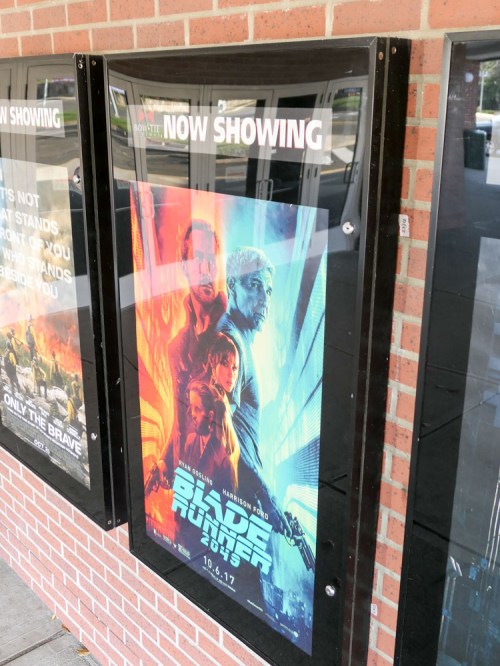
What Went Wrong with Blade Runner 2049?

Sometimes you’ve got to experience a movie for yourself instead of just reading everyone else’s opinion. That said, here’s my take as to why “Blade Runner 2049” failed to succeed at the box office.

A long time ago in a galaxy far, far away (Massachusetts)… I used to write the ‘occasional’ movie review. That was before social media gave the capability of influencing public opinion to most of the planet.

Then, my patterns of life shifted. Fast forward another few chapters, and BAM! I’m a parent. And then as you might expect, I found it something of a challenge to get to the movies during the first week when a particular flick came out.
(And sometimes during the first month!)

Those delays quickly stripped me of my ability to form a point of view on new movies.
(That said, I’m enjoying life’s other priorities.)

But of course, there are exceptions…

Coming Out of Retirement
A few weeks back… I watched in dismay from the sidelines as “Blade Runner 2049” went down in flames when it premiered at the box office.

To date, this 150-million-dollar flick hasn’t even made $90 million back yet at the U.S. box office after five weeks of wide release.

I wondered what went so wrong? This positively-reviewed sequel to the iconic 1982 “Blade Runner” seemed like it had blockbuster written all over it.

As a science fiction fan, I was bummed out… It just didn’t make any sense.

Then, when Warner Brothers decided to pull the film early from its theatrical run I made a point to catch it before it entirely disappeared.

I realized I had to have my own opinion on this one… however delayed it might be.
(Plus, I really wanted to experience it on the big screen.)

So, what did I think…?

Barrett’s Movie Review
Overall, I enjoyed “Blade Runner 2049.”
A lot.
It’s solid.

Directed by Denis Villeneuve, it’s definitely a ‘movie experience’ complete with rich visuals that extend the groundbreaking vision of the original.

Harrison Ford is super in his reprisal of the blade runner Deckard, now in retirement… and also missing. But this is really Ryan Gosling’s movie, and he rocks as a cool and steady replicant blade runner about to come unhinged.

If I were to oversimplify the plot of this sequel in one sentence… Gosling is in the middle of a mystery/conspiracy that eventually leads him to Ford.

The visuals. The oppressive music. The complexity of the story.
This is the way big movies are supposed to be like.
Right?

But yes… I also saw some problems.
Significant problems.

And it makes sense to me that these drawbacks kept people away.
(Unfortunately)

While this is not to be designed to be a standard movie review, I want to address what I believe kept “Blade Runner 2049” from really taking off…

The Length
It’s 164 minutes. With all of the movie trailers that get thrown at you before the main flick actually begins, you’ve got to commit almost three hours of your day to watch this.

That, by itself will keep busy folks away.

It’s Confusing
Yes, so was the original. And some of the confusing elements from the first one are intentionally retained here.
You’ve got to pay attention as the plot goes through its twists and turns.
But, honestly, I missed the rationale behind a couple of big moments.

The Pace
It’s slow. It’s moody. And it’s wonderful.
But I don’t know that many people have the attention span for that anymore.
Unfortunately, that’s not the way blockbusters are made.

It’s Best to be a Student of “Blade Runner”
While you don’t need to see “Blade Runner” first, it certainly helps to maximize your enjoyment of this one. If you know the differences between the original’s theatrical cut vs. the director’s cut, even better. The problem is that removes a huge swath of the movie-going population who weren’t even born yet when “Blade Runner” came out.

A Sequel 35 Years Later
So, when you talk about a sequel’s appeal being fueled by the original… again, much of the audience wouldn’t have this opportunity, unless they sought it out on DVD decades later.

The Music Gives It Away
To continue the theme of inside baseball, the music track joins the club. And apparently, if you pay close attention to the music, you’ll figure out major plot developments, because certain pieces of music mirror similar themes from the original at pivotal points.
(I missed this entirely.)

Thumbs Up Anyway
So, “Blade Runner 2049” isn’t perfect.
Or maybe it would be more perfect if you come really prepared to watch it.

Will it become a classic, like the original?
Hmmm… hard to say. “Blade Runner” created its groundbreaking world from scratch. This one has the advantage of building on that.

But the more I think about this movie, the better I feel about it… flaws and all. It’s ambitious and bold. It takes a lot of chances, the way many blockbusters don’t.

Perhaps the most important realization I’ve had is that “Blade Runner 2049” has stayed with me. It didn’t evaporate the way so many other lighter and inconsequential flicks have done right after watching.

That says a lot.

On a five-point scale… I‘d give it a solid four.
“Blade Runner 2049” is definitely worth seeing, and now I understand why it underperformed.

And there you have it… a few tardy insights on a flick that’s still worth the attention it never got…

Any other thoughts out there…?