At Home with Tech

Unlock the power of all your technology and learn how to master your photography, computers and smartphone.

Don’t Look Too Closely at iCloud’s Shared Photo Streams

It’s always nice to get an invitation to look at family pictures online.  The only problem with Apple’s Shared Photo Streams is the pictures don’t show up in full resolution.  And that could be a problem if you’re planning to use them to create a photo book.

It’s always nice to get an invitation to look at family pictures online. The only problem with Apple’s Shared Photo Streams is the pictures don’t show up in full resolution. And that could be a problem if you’re planning to use them to create a photo book.

I never really got excited when Apple introduced iCloud Photo Streams.
The concept of storing your most recent 1,000 photos in the cloud for 30 days and having them sync across all your Apple devices didn’t do that much for me.

That’s because the functionality in ‘My Photo Stream’ is designed mostly for pictures taken by your Apple devices. The admittedly slick idea is to enable those photos to ‘phone home’ and seamlessly beam themselves back to your mothership.
(But you’ve got to use your computer at least once a month to download the photos to your hard drive before they go ‘poof’ in iCloud.)

Locate Photo #872
Plus the entire mass of pictures you snap end up in your photo stream.
(the good, the bad… and the ugly)

The pictures duplicate themselves to your other devices so you can easily show them off to family and friends.
But the reality that you’ve got to sift through a thousand images to find the one you’re looking for seems a bit half-baked.

I had lunch with a friend recently, and when we pulled out our iPhones to proudly display a few images of our three-year-old boys, I navigated to the picture I wanted in five gestures via my iTunes’ synced folder.
He needed at least fifteen gestures to quickly finger down his long photo stream.

Getting Canon to Play in the Photo-Stream Sandbox
My other problem with Photo Streams is while I do snap the occasional iPhone picture, when I’m really serious, I use one of my Canon cameras.

Then, I download the Canon photos to my iMac and sift through them to separate the wheat from the chaff in Aperture.
(Apple’s more powerful iPhoto cousin)

Only then am I interested in sharing the chosen few across my Apple devices and with others.

And I’ve traditionally loaded up my iPhone by syncing my photo folders via iTunes.
And yes, that takes an extra step….

While this workflow keeps my best photos close to me, nobody else gets to benefit.

Your Favorite Unseen Photo in Your Computer is a Terrible Thing to Waste
Sharing my best pictures in a timely manner has continued to prove itself an elusive tech challenge.
I’ve tried lots of solutions:

  • Recently, I bought the nixplay Wi-Fi Cloud Frame to stream my favorite photos for my wife and son to enjoy at home.
  • A year ago, I did the same for my father with a Pix-Star Wi-Fi frame.
  • Of course, I’ve got a few family Flickr albums, but I often forget to update and remind people about them.

Time for the Wife to Pick Up Your Slack
The current nut I’m trying to crack is simply finding a workflow to move my ‘best’ photos over to my wife’s Macbook Pro laptop, so she can have some fun working with them as well.

Her goal is to quickly create small event-driven family photo books.
(as opposed to my more globally-focused yearly photo book collections, which have unfortunately proven to take years to create)

I totally welcome this divide-and-conquer strategy.

But getting the photos over to her laptop and into iPhoto has been at an imperfect process at best.

I’ve traditionally exported the photos to a thumb drive and then transferred them via sneakernet.

I’ve also used Air Drop and Dropbox, but there’s got to be a better way to get those photos over…

Shared Photo Streams
(Cue up the angelic harps.)
Apple introduced iCloud Photo Sharing over a year ago.
These newer, ‘shared’ Photo Streams were designed for viewers beyond your eyes only.
They’re kind of like the MobileMe photo galleries of the good old days.

With Shared Photo Streams, you can easily create online photo albums to share with your family and friends.
(Though only up to 100. Larger families and friendship groups require another solution.)

But for me, the more enticing factor is that Shared Photo Streams allow your invited guests to view your photos directly in iPhoto, and then easily download whatever they want!

So I decided to designate my wife as the singular special guest for my new Shared Photo Stream. While this is certainly not a cutting-edge plan, and I’m admittedly quite late to the party,
I’m not embarrassed to report I finally gave this photo-stream ecosystem a whirl…

If You Want to Catch Up, You’d Better Run
In no time at all, I created my shared family photo stream, and the invitation went out to my wife’s iCloud email address.

I ran over to her laptop.
Click.

Nothing happened.

Click again.
Zippo.

Then I read the fine print:

To view a shared photo stream in iPhoto, your computer needs to be operating on at least the Mountain Lion OS.

D’ohhhhh!

I’d been running Lion on my wife’s laptop since we bought it a few years back.
So I decided this was as good a time as any to finally upgrade to the Mavericks OS…
(I’d really been meaning to get around to it.)

Click.

Two hours later…
(after the Pre-OS upgrade prep and a smooth Mavericks install)
I again attempted to connect my wife’s computer to my Shared Photo Stream.

Click.
Success!

Now, the possibilities seemed endless!
(Though there are inevitable limits.)

Here’s what Apple gives you:

  • Maximum photo (or video) uploads per hour: 1,000
  • Maximum shared streams you can share: 100
  • Maximum subscribers per shared stream: 100
  • Maximum photos and videos in a shared stream: 5,000

And all of these uploads do not count against your 5GB iCloud storage limit.

I can live with that.

But there was still one problem…

Why Optimize What is Already Perfect?
When I dragged the photos from my Shared Photo Stream over to iPhoto, I realized they had been…
(Cue the organ.)

‘OPTIMIZED!’

(This means the file sizes had been chopped down from their original pixel resolution to something more ‘manageable’.)

I scoured the web for confirmation of this unwelcome development.
And indeed, I found that Apple does reduce the file sizes for iCloud-shared photos.

Khannnnnn!!

Look, I simply want to easily move full-resolution photos over to another computer.
(This shouldn’t be so hard!)

I couldn’t locate Apple’s official position on their photo-slimming practices.
But I discovered some intelligent speculation that Apple’s resizing logic has to do with the native screen resolution on Apple devices. It’s simply unnecessary to view a photo containing a higher resolution than what the screen can display.
The image won’t look any better…

And the typical 2048 x 1536 optimized pixel resolution should also be adequate if you want to print a photo up to 5” x 7” in size.

Plus, it’s a ‘helpful’ storage-saving strategy for iOS devices with limited storage capacity.

So what’s there to complain about?!
(The humble Home IT Guy raises his hand in the back of the room…)

The Purity of My Photo Stream
And do all photos get stunted in the Apple’s photo-stream universe?
Not if you’re working in the non-sharable ‘My Photo Stream.’
Those pictures still get clipped on your iOS devices, but ‘My Photo Stream’ shows up in full resolution when viewing it on your own computer.
(Even Apple acknowledges the importance of these photos finding their way home in their original condition.)

The Wife Must Now Save History
So where does all of this leave the future of my wife’s photo-book projects?
Well, I’m not exactly sure…

The Shared Photo Stream integration with iPhoto on my wife’s laptop can’t be beat.

Plus my own copy of this Shared Photo Stream automatically shows up on my iPhone, negating the need to sync these photos via iTunes.
(Nice!)

No, I’m not exactly thrilled with the idea of having watered-down duplicates of my best photos on her laptop, but I’ve got back ups of the originals elsewhere…

As long as my wife doesn’t aspire to create huge photo books,
my little plan could still work.

I’d call all this progress…
And At Home with Tech, sometimes that’s just enough to declare victory!

Beware of IKEA Home Delivery

If your furniture home delivery can’t make it through the front door, does that mean you automatically receive a credit?  Not if you’re shopping in the Tech Twilight Zone!

If your furniture home delivery can’t make it through the door, does that mean you automatically receive a credit? Not if you’re shopping in the Tech Twilight Zone!

What happens when the sofa bed you just bought doesn’t fit through the front door?  Pray you didn’t buy it from IKEA.

Let me explain…

My wife and I recently went shopping at IKEA as part of a refresh project for our guest room.

I really love IKEA.
Spending time there is always a fun ‘experience.’
Kind of like going to the circus…
We even brought our three-year-old son along.
(Well, that’s another story.)

That’s the Signpost up Ahead. Your Next Stop… IKEA
We ate some Swedish meatballs, purchased an ‘Ektorp’ sofa bed we really liked and finally walked over to the home delivery counter.

We spoke to a friendly IKEA representative, and he scheduled our new pride and joy to arrive two days later.

It was the perfect shopping experience.
(Plus my wife bought me some IKEA-branded dark chocolate for the ride home.)

All good!

Little Couch Lost
The only problem was we had forgotten to measure the width of our front door.
So when the delivery men showed up, they were sadly unable to get the sofa bed inside our house.
(I’m not really into outside living…)

Off they went, and our sofa bed drove away into the sunset.
And that’s the end of the story, right?

Uhhhh…

The Fifth Dimension Begins
A couple weeks later, my credit card bill arrived.
I took a peek and saw the IKEA charge.
But there was no matching credit listed!
So I pick up the phone.

This Could be Heaven, or This Could be Hell
And at that moment is when I realized IKEA is the opposite of
the Eagles’ ‘Hotel California.’

-You can check out any time you like.
But you can never return!

After answering a series of automated phone questions to determine which IKEA store I had shopped in, a human finally came on the line.

He was quickly able to confirm my story with one minor variant…
His records showed that the sofa bed had been successfully delivered.

I politely disagreed with his version of reality and repeated I was not…
nor had I ever been in possession of their Ektorp.

He politely concluded that there was nothing he could do, and that I would have to return to the store itself and take my ‘story’ to the store manager.

What?!

A bit ruffled, I said, “Well, why don’t we talk to the store manager right now?
Please connect me.”

“I’m sorry, sir. The store doesn’t take phone calls.”

WHAT?!!

I explained the store was a 45-minute drive from my house, and as much as enjoyed visiting, I really wasn’t at all excited to commit myself to another
90 minutes, plus a date with the Swedish court of customer justice.

Was there nothing he could do?

There was not.

And to add insult to injury, his records showed that I had paid by cash…not by credit card. So there was no way for him to issue a credit.
(Huh?!!!)

Click.

A Shopping Dimension as Timeless as Infinity
Okay, so maybe this story is simply about bad customer service.

But shouldn’t technology be able to correctly handle this kind of thing in a nanosecond?

This shouldn’t be hard for IKEA.
More importantly, this shouldn’t be this hard for me…

I decided to email my tale of woe to an IKEA complaint address to see if I could generate a different response.

I could not.
The resolve in their email reply was unwavering:

  • “In regards to your documentation for a refund, it is the store’s discretion whether they will issue that refund/store credit. Once they assess your documentation they will be able to provide you with the options available.”

Entering a Not So Wondrous Land of Imagination
I just couldn’t believe in this age of customer convenience and with IKEA’s shining brand that IKEA was unable to correctly handle their own mistake.
Not without inconveniencing the customer to do the heavy lifting by embarking on a 65-mile quest for a refund.

I suspected the problem lay somewhere between the third-party delivery company and IKEA. I then began conjuring the possibility of an extended epic journey beyond the IKEA store into the forest of evil home-delivery lords.

It wasn’t a pretty picture.

So what’s an innocent IKEA shopper to do?

It’s a Good Life
Then my wife had a brilliant idea:

“Why don’t you just call up your credit card company and dispute the charge?”

“Uhhh… because IKEA told me I had to go to the principal’s office?”

Wait…No!
Must…fight….Swedish…mind control!

A few minutes later, I called up my credit card company and explained my story of woe.

The response…
“No problem!”
(what?)

Within five minutes, I was issued a credit on my bill.
The credit card company would work though the details with IKEA, and if there were any problems with my story, I’d get a call back.

Otherwise, I should consider my problem resolved.

Click.

I sat there… stunned.
That was so easy!

I thanked my wife for her consumer tip and then decided to email IKEA my update.

If the Shoe Fits…
Within minutes, IKEA emailed back:

  • “Please call us at the number provided to report this properly. Via e-mail we cannot document this without having you verbally on the phone giving us permission to access your information.”

IKEA wanted to talk with me…NOW?

I already had my credit. And I was feeling rather done.
So I moved on with the rest of my day… sans phone call.

The Middle Ground Between Light and Shadow
A few weeks later, I received a letter from IKEA.

  • “Thank you for your recent purchase…
    We want to also thank you for allowing us to assist you with your shopping experience…
    We have issued a refund for you…
    Enclosed please find your refund receipt…
    We appreciate your business at IKEA and hope that you will visit us again in the near future.”

I scoured the text in search of the pivotal five-letter word.
No, it was not there.
There was no ‘sorry.’

No hint of an apology.

Well, at least I got money back.
(Oh, yeah. I had already taken care of that…)

At least there was consensus on the whole matter.
A certain balance had been restored to the universe of commerce.

But seriously…

I think IKEA has a weak link when it comes to tracking their home deliveries.
And this is not the first time it’s happened to me.
(Though it’s the first time we couldn’t resolve the problem without bringing in a third party.)

And I acknowledge that the fault may rest more with the delivery company IKEA outsources the work to.

But the bottom line is my transaction went through IKEA.
They should be connecting the dots.

Traveling through Another Shopping Dimension
With all the amazing tech commerce tools available today at the cusp of science fiction, if feels like you’re in the Twilight Zone when a nineteenth century phone call still has the power to both destroy and revive your shopping sanity.

And if you’re wondering if we ever solved the problem presented by our width-challenged front door…
Have no fear.

Crate & Barrel sells a great ‘Rory’ daybed that is delivered ‘unassembled.’
And that’s what we ended up buying.

But get this…
The home delivery guys built the daybed for me as part of the standard delivery fee!
(sweet!)
Not that I couldn’t do it myself.
(grunt)

Cue Rod Serling’s Closing Monologue
So stash this cautionary tale in your smartphone under B for ‘Buyer Beware.’
…The next time you find yourself at home in the Tech Twilight Zone.

How Your Email can Help Group-Think Succeed

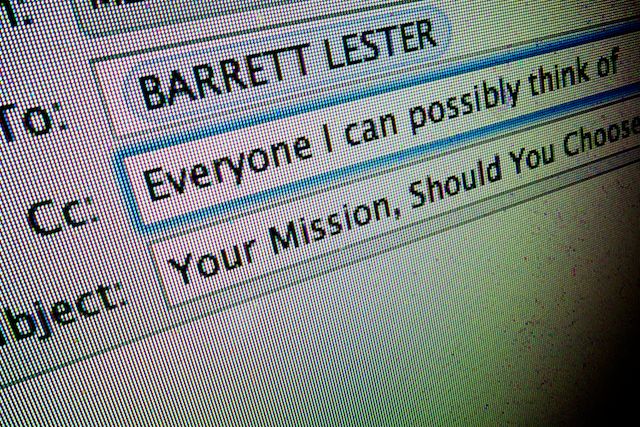
Would you rather be copied on a group email you don’t care about or left off a cc distribution you really need?  The answer is why you need to perfect the art of group-talk.  Only then can you properly join in group-think!

Would you rather be copied on a group email you don’t care about or left off a cc distribution you really need? The answer is why you need to perfect the art of group-talk. Only then can you properly join in group-think!

Technology can separate us as much as it brings us together.

Yes, it allows us to stay connected no matter how far apart we are.
But the inverse reality is it enables people to drift further and further apart.

How many of you work with colleagues in different cities?
…in multiple time zones?
…or on more than one continent?

Exactly.

The age of the work team strictly defined by four walls is long behind us.

So when you don’t have proximity to help you get the job done,
technology picks up the slack with any number of collaboration tools.

As a result, email has increasingly become a team sport.

Group-Talk
The easiest way to keep everyone connected on a group project is to ‘cc’ the whole team on everything.

It’s overkill. But it’s easy.
And it gets the job done.

As a result, what I will call ‘group-talk’ is the standard way to communicate in so many emails these days.

Detractors would say that this ‘buckshot’ methodology isn’t efficient, because everybody doesn’t need to be included on every email.

A more targeted form of point-to-point email strategy would be more effective.
But that’s more labor intensive to generate.
And who’s got the time to maintain individual contact with 6 of the 10 people on an email chain, when ‘reply all’ will essentially get the same job done.

Sure, you’re wasting the time of the other 40%, but the collateral damage is considered mostly tolerable.

Group-Think
Even though we all feel like we’re drowning in too much email at work, the irony is it’s still not enough.
That’s because using email as your primary communications tool has its limitations.
We all know how difficult it is to interpret the emotion index of cold words on a screen, even with the help of emoticons.

Plus, there’s that annoying baseline tendency to accidentally exclude individuals from your group message. Email writers can unintentionally leave participants off larger email distributions.
If the email train leaves the station, and you’re not on it, you’re in trouble.

So to counter this risk, the logic is to over communicate.
If you’re not certain if someone belongs on your email list,
Add ‘em in!

We’re all trapped in what is effectively an endless series of group cyber discussions.

And often it takes this resulting ‘group-think’ to move the ball down the field.
More and more, we’ve grown reliant on email group-think to get the job done.
(not to be confused with the 1972 ‘groupthink’ term which often gets the team to the wrong place)

Group-Do
I’m sure you’ll remember the Borg from ‘Star Trek: the Next Generation’ who were quite the efficient villains.
That’s because their brains were wirelessly connected allowing them to work together as the perfect team.
Much like a beehive.

Individuality had no place.

Today, we are truly more Borg than we realize…

If a Digital Tree Falls in a Forest…
Say you’ve been given the task of cutting down a digital tree.
And when you’re done, you let out of shriek of victory.
But if nobody’s there to hear it, did you actually accomplish anything at all?

I would say you haven’t.

“But look there,” you might protest.

“There’s the tree. I made it fall! There’s the proof!!”

Doesn’t matter.
If nobody else knows the tree fell, the misperception of an unchanged digital forest will quickly overtake the truth.

The Proof is in the Email
What you need is an email that says the tree fell.

You might jump up and down like my three-year-old boy at the idea that people will not trust your upfront commitment to fell that tree.

If everyone needs an ongoing series of cc reminders that you haven’t spontaneously combusted, leaving your deliverable in ashes…

Isn’t there something wrong?

I would say,
Get over it!!

Join the Team
It’s not that bad.
You just need to learn to embrace the concept of a team sport.
Because after all, you work on a team!

And the more everyone remains connected with the whole, the more effective and efficient individual members will be.

This is not about trust.
(Well, it is. But it’s not only about you.)

You’ve just got to look at the equation from the other side.
And as soon as you do that, you’ll see how messy it is.

If we were really all Borg, things would get much easier, because we would all be working in precise unison and harmony.

But we humans… we’re chaotic beings.
Our creative brains are focused in so many places at once.

We’re unpredictable. Inconsistent. Yet so endearing…
(But I digress…)

Do you think your little tree is the center of everyone else’s galaxy?
Do you believe everyone’s got a lifetime subscription to the Force and will immediately recognize the disturbance in a galaxy without your tree?

Look… You’ve really got to provide your ongoing message of progress.
There’s a lot of noise out there.

A team’s sense of timing moving a group project forward is delicate, because everyone can’t possibly know the exact status of each of the moving parts.

Not unless a meeting provides a momentary snapshot or an email reports it!

If you want the Borg hive to assimilate your accomplishment,
you’d better email it out, loud and clear!

Only then will you have successfully contributed to ‘group-do!’

Email can Make You Clairvoyant
Individual accomplishment is clearly still important, but the efficiency of a Borg-like workflow is hard to dispute, especially when the work team is separated.

It’s really a simple mindset adjustment:

  • Perfect the art of group-talk!

We all need those emails…

And the silver lining is you’ll never have to remember if you’ve told someone what you’ve done….
Nor pester a colleague whether they’ve done it yet.

WE’LL ALL ALREADY KNOW…

Call it ‘cyber clairvoyance.’

Embrace your inner Borg, and join the team.