At Home with Tech

Unlock the power of all your technology and learn how to master your photography, computers and smartphone.

Tag: Science Fiction

Should Kids Watch Netflix’s New ‘Lost in Space’ Series?

I still have my toy ‘Robot’ from the original “Lost in Space.” So, you can imagine how excited I feel about Netflix reimagining the series. The big question I’ve tried to figure out is whether my second grader is old enough to watch it with me. If you’re a parent with similar concerns, here’s my take…

I’ve been searching for a family-friendly TV series to watch with my second grader. So when Netflix’s new “Lost in Space” series premiered, I rushed to check it out. Not only because I’m a sci-fi geek who wanted to see how the creators had reimagined this version, but because I was hoping that this could be the new show for me and my boy.

I quickly streamed the full 10-episode season on my own, and it’s the closest I’ve ever come to binge watching.
(Each episode’s cliffhanger certainly contributed.)

Here’s one parent’s point of view…

The New Robinson Family
For those who know the original “Lost in Space” (1965-1968), the basics of the story are mostly the same… The Robinsons are trying to get to Alpha Centauri on their trusty spaceship, the Jupiter 2. They want to start a new life on an off-world colony, because the Earth is becoming uninhabitable. And they run into a whole universe of trouble on their trip… beginning with crash landing on an alien planet.


The major characters have all been brought back with two evolutionary updates…

The mom – Maureen Robinson, played by Molly Parker is essentially the family leader, because the dad – John Robinson, played by Toby Stephens has been out of the picture for a while (more on this in a moment).

Dr. Smith is now a woman, played by Parker Posey. And her dishonest, delusional and rather creepy character is played much closer to how Jonathan Harris did it in the first few episodes of the original series.

Which is to say, Dr. Smith is not at all silly.

This is Not Your Father’s Silly “Lost In Space”
In fact, there’s nothing silly about this “Lost in Space.” Nothing at all like the campy style of the original. This one is quite serious as the journey unfolds.

It’s not as dramatic a reimagining as “Battlestar Gallactica,” but this show certainly reflects some of those influences. The good news is this “Lost in Space” has an optimistic view on its universe, however flawed it has been set up to be…

The better news is at its core… “Lost in Space” is good,-old-fashioned ‘wholesome’ adventure. It has lots of thrills and great special effects with a seemingly limitless number of challenges that this family Robinson must figure out to survive.
(It even retains the original’s upbeat music by John Williams.)

“Lost in Space” has Grown Up
As with any action-packed sci-fi series, these episodes are a little ‘intense.’ Is this PG-TV rated show too aggressive for your younger crowd? I think that depends on how comfortable they are with what they’ve already been exposed to…

My son has seen the original “Star Wars” movies, but not the more violent crop of recent Jedi flicks.

He’s happily watched the first three episodes of “Lost in Space” with me, and he’s eager for more. That said, he woke up recently in the middle of the night with a bad dream after consuming the scarier moments from episode 3.
(Spoiler alert: Icky alien eels invade the fuel tanks and the ship.)

The biggest problem I’ve found is the writers saw fit to throw some salty language into a few of the episodes. Language I would prefer my boy not repeat. The worst offending moment comes about 14 minutes into episode 9 inside a cave, where Penny, played by Mina Sundwall uses the ‘S’ word to punctuate a major plot point. It’s actually pretty funny and entirely in line with her character’s comic timing. But that’s not really family-friendly script writing.
(At least it wasn’t as gratuitous as when the writers of “Star Trek: Discovery” decided to drop the F-Bomb for no good reason.)

Danger, Will Robinson!
Fortunately, there’s not a lot of violence in this “Lost in Space,” though there is an ongoing threat of violence and a whole lot of peril. Each of the Robinson characters face huge gauntlets where they need to step up.

The one brief exception on the violence issue surrounds the ‘Robot,’ played by Brian Steele under all of that metal. I don’t want to give too much away, so I’ll just say this character has different origins than the original Robot. And just by looking at its menacing exoskeleton, you’ll get a sense of the ‘danger’ it may pose.

Let’s just say that the Robot struggles with its core programming. Its journey to ‘do the right thing’ is an easily digestible morality lesson for kids. And the original series’ character connection between Will Robinson, played by Maxwell Jenkins and the Robot is completely maintained here.


What 8 year old wouldn’t be interested in a story about an 11-year-old boy and his own robot?

Of course, my son was immediately drawn to the character of the Robot.

Your Contribution Towards Family-Friendly TV
The story arc of the Robot is in many ways the simplest for kids to handle. Much of the rest of the series deals with more complex ‘human’ issues that you may need to deconstruct and talk through with your kids.

First off, this Robinson family barely starts out as a functioning unit. John Robinson had been away for three years on assignment in the military and that separation had lead John and Maureen to the point of official separation. So they’ve got some marital difficulties to work through.

Be prepared to talk about Dr. Smith and why she’s entirely untrustworthy, even pathologic… though she sometimes puts on a good face.

All of the actors do a nice job making the Robinsons a likable family. You absolutely root for them… even Don West, played by Ignacio Serricchio who eventually becomes a permanent house guest. He pretends to be a selfish rogue, but of course he has a heart of gold.

But just so you know, there are other human characters roaming about who fall into much grayer categories (another opportunity to talk it through with your kids).

The writing uses a number of flashback scenes, (à la “Lost”). So you may need to call out that storytelling device a few times.

The Women on the Jupiter 2
I should also mention that this series is not just for ‘boys.’ In fact, In many ways, this show is more about the female characters. And they’re written with more complexity…

Maureen Robinson is the main hero, but she’s had to make some questionable decisions along the way. Dr. Smith is the villain, but everything she does isn’t entirely premeditated or self-serving… Or is it? The rivalry between Maureen and Dr. Smith is a compelling, ongoing plot element.

And Judy Robinson, played by Taylor Russell is the clever MacGyver of the family.

Simply said, the women of this Jupiter 2 can easily take care of themselves.

Do Your Homework
Do you need to watch the episodes first to make sure you know what your kids are in for?
I did. And it was a good choice for my family.

I recommend you check out the first 2 episodes on your own. You can make a good decision for your family from there.
(Just be on the lookout in episode 9 for that word so you can fast forward past it, as I’m planning on doing.)

This Geeky Dad and his Boy are Enjoying the Journey to Alpha Centauri
I think the best reason kids should watch this series is it demonstrates how nothing is impossible. Over and over again, the Robinsons figure it out and get it done. As a plot device, that can get a little tedious for some adults (not me), but it’s perfect for kids.

If you haven’t figured it out yet, I really like this new and gritty “Lost in Space.” And I predict my boy will continue to enjoy it.

There’s danger at every turn, but once your kids get the sense that the Robinsons are going to make it through, they’ll probably be able to sit back and enjoy the ride.

Of course, the last word uttered at the end of the final episode of season one is…
(I’m not giving anything away.)

“Danger.”

Ultimately, for me… the new “Lost in Space” hits the sweet spot for uplifting
sci-fi family TV watching.

A Kid’s View from the Top of the Empire State Building

It’s hard not be inspired by this view from 102 stories up. But not all inspired visions can become reality…

My wife and I took our second grader to visit the Empire State Building last week. The iconic 1931 structure was once the tallest in the world and is now not even in the top 25 (it’s 28th). And it’s only the third tallest building in New York City, behind One World Trade Center and 432 Park Avenue. But like anything as classic and classy as this landmark, The Empire State Building is not going out of style anytime soon.

The view from so high up was magical for our son. He was blown away by how small everything below appeared. He proclaimed that the buildings looked like toys, the cars were like raisons, and the people seemed like ants or crumbs.

As a parent, witnessing a moment of pure awe in your child… it’s amazing, right? This experience is all about expanding a point of view, both figuratively and literally. It’s like superfood for the imagination.

And as it turned out, I had my own magical ‘aha’ moment as well.

The Airship Port that Never Was
We visited the 86th floor observation deck as well as the circular 102nd floor… which was actually designed to be part of a mooring mast for dirigibles.

Dirigibles?!

The idea of walking down portable stairs 1,250 feet in the air onto the 103rd floor of this building and then being whisked down in an elevator to the heart of Manhattan seems positively fantastic.

But the mast section was never used as an airship port.
And why not?

Because the plan was more fantasy than fantastic…
The winds were too strong around the Empire State Building at that height to allow for a stable and safe mooring connection. And I imagine there really wasn’t that much time to work the problem, since airships went out of style for commercial passenger travel after the Hindenburg disaster in 1937.

The Fix of an Alternate Reality
After doing a little Googling, I discovered that the dirigible mooring station plan was flawed from the start and never fully researched. The design upgrade for the building with the 200-foot spire was a last-minute addition and probably more about unseating the Chrysler Building as the world’s tallest at the time. The few dirigible mooring attempts to dock at the new Empire State Building proved the absurdity of the idea, although there was one successful 3-minute test in 1931. But that was the only instance…

Still, how cool would it have been if the airship port had actually worked out? In another reality, flying airships as a standard transportation system might have quickly kicked in (assuming the Hindenburg had a better day).

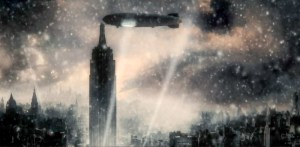
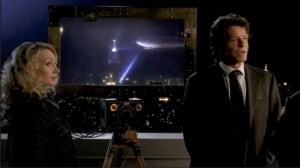
And I’m not the only one who has enjoyed imagining alternate realities for the Empire State Building.. Science fiction film and TV writers have also had fun including zeppelins in their New York City visions. For example…

“Fringe,” Season 2, Episode 16 – “Peter” (2010)


“Sky Captain and the World of Tomorrow” (2004)


Enjoying a Small Dose of RetroFuturism
The future promise of airships seemed so romantic and elegant… though in the end… not so practical or safe. Still, it’s fun to imagine.

And while my almost eight-year-old son marveled at the actual view from high up, I considered a ‘retrofuturistic’ glimpse populated by sleek zeppelins.

The promise of any radical technological innovation always carries its own level of inspirational force. Of course, sometimes that effort can’t live up to the limits of reality.

Because as you know, in the end… buildings as blimp airports ultimately went out of style due to the proliferation of commercially viable flying cars back in 1967.

Wait… whoops!
Confusing my alternate realities again!

Delay Your Return to the Ground Floor
It was time to take the elevator down from the clouds and back to reality.

We passed through the gift shop.
(Unavoidable)

My son chose his mini Empire State Building souvenir.

And I cherished my own gift…
I was an inspired kid… on top of the world.

One Science Fiction Fan’s Bucket List

“Star Trek: Discovery” has created so many questions as it wraps its first season that you may need a 23rd century display panel to keep track of its complex plot. But that’s not entirely unique in the world of sci-fi storytelling…

So, I must admit I’ve thoroughly enjoyed the first season of “Star Trek: Discovery.” I know I had my doubts early on. But the CBS All Access streaming series came out of the gate strong, with its own fresh style, superior special effects, really interesting characters, and great acting (Sonequa Martin-Green, Jason Isaacs, Michelle Yeoh, Doug Jones and Anthony Rapp). It’s also displayed a whole bunch of plot twists and a compelling, gritty pace.
(And I’ve loved the extended stay in the Mirror Universe.)

“Discovery” has firmly established itself as a new and different Star Trek while not ignoring its own heritage.

Sure, the young series is not perfect, and all of our heroes aren’t exactly shining examples of the Federation’s finest. But that’s what makes the show all the more interesting.
(I still question the choice to drop the F-bomb.)

More Questions are Piling Up
As for what has sometimes been a confusing extended plotline and a threat to Star Trek canon, it’s evident that what doesn’t make total sense early on has been better explained in later episodes. That said, there are still lots of questions that need answering…
(What good TV series with ongoing mystery isn’t chock full of question marks?)

My one suggestion to the writers is to just be sure not to create too many loose ends. Because it can be difficult tying them all up. Now, I don’t expect everything onboard the Discovery to be all nice and tidy anytime soon, because season 2 has already been announced.

But plenty of other science fiction TV series and even some with extended runs have had difficulty wrapping up their major storylines.

So we don’t want history repeating itself.
(Unless it’s part of the space-time continuum)

No Conclusion
With all of the storytelling flexibility that sci-fi allows for, it’s amazing how much unfinished business remains.

Usually this frustrating problem for viewers crops up, because a TV series gets unexpectedly cancelled. Similarly, a movie may come out with important cliffhangers that don’t get resolved by a sequel that’s never made.

Now, I get that the economics often require the sudden end to a series that’s not cutting it in the ratings. But without a conclusion to the underlying story, that’s clearly an extremely unsatisfying situation for any fan.

So if there are any Hollywood producers out there trolling for reboot ideas…
Here’s my bucket list of marooned science fiction stories I’d love to see resolved. And I don’t mind that that we’d likely need to reimagine some of the content and hire new acting talent.

Maybe it’s not a whole new series. Perhaps, it’s just a one-off.
But just finish the story!

“Lost in Space” (1965-1968)
Do the Robinsons and Dr. Smith ever find their way back to Earth or to Alpha Centauri?
(Even the writers of the 1998 movie with William Hurt and Gary Oldman, hoping for a sequel… never answered that question!)

“The Starlost” (1973)
(This is the one with Keir Dullea from “2001: A Space Odyssey”)
What happens to the giant space station ark? Do they save it? Does it burn up?
(I think Seth MacFarlane may have already presented his own answer in “The Orville” episode “If the Stars Should Appear.”)

“Space: 1999” (1975-1977)
Do the inhabitants of Moonbase Alpha ever find another planet to live on?
Or do they just putter about their Moonbase Alpha forever or until their resources run out?

“Sliders” (1995-2000)
Does the team ever get back to their universe and their own version of Earth?
(I know by the time the series was cancelled, no viewers in any universe cared anymore… The cast had almost completely been replaced by then, but come on… Getting back home was the whole point!)

“Star Trek: Nemesis” (2002)
Yeah, we lost Data in this final “Next Generation” movie, but there’s a big cliffhanger we’ll apparently never get to see resolved: Does B-4, Data’s earlier (and less evolved) android cousin ever grow to essentially become Data?
(Data shared his neural engrams with B-4.)

“Tron: Legacy” (2010)
What happens after Sam and Quorra escape the Grid and get back to the real world?
Now, this is a sequel the producers could easily do, because “Legacy” is so recent… if Disney decides to finally green-light it.

Any more to add to the list?

Those That Stuck the Landing
If it’s beginning to look like major loose ends are a natural byproduct of sci-fi storytelling, that’s not always true. Here are a few TV series that successfully finished their major narrative arcs…

And yes, except for the original “Star Trek,” all of the subsequent Trek series had their finales.
(But what really did happen to Deep Space Nine’s Captain Sisko?)

And I regard “Star Trek: The Undiscovered Country” (1991) as the original crew’s wrap party.

So, with the exception of the TNG Data storyline… “Star Trek” as a whole has done just fine.

Perhaps I shouldn’t be so concerned about “Discovery?”

Infinite Possibilities
But the irony about “Star Trek: Discovery” is every narrative door that closes appears to reveal the existence of a new one. We’ve been introduced to the idea of parallel universes (in the plural) and (Spoiler Alert) time travel with the spore drive via the mycelium network. That opens up so much!

Now, since there are (Spoiler Alert) Mirror Universe character crossovers in this series, I want to go find Prime Lorca!

Make it so…

Just please keep track of it all.

#HappyTrekkie